Seasoned for Eternity: Proteomics Reveals Ancient Egyptians Glued Mummies with Sesame and Moringa Seeds
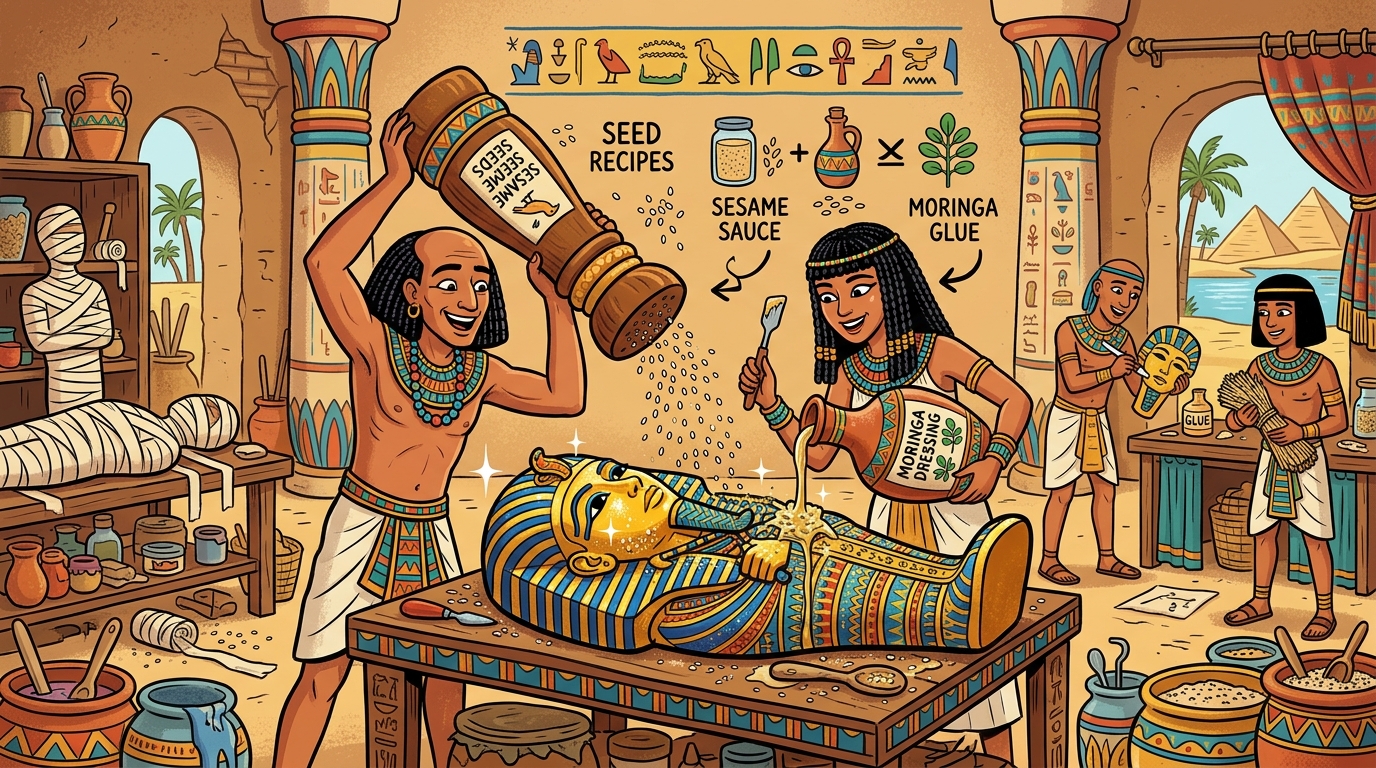
For thousands of years, we assumed ancient Egyptian embalmers and artisans were working with standard-issue workshop glue: boiled animal hooves, hides, and perhaps a splash of egg white. But modern molecular forensics just revealed that the craftsmen preparing pharaonic tombs were basically running a five-star gourmet salad bar.
According to a landmark study published in Science Advances led by researcher Clara Granzotto, high-resolution mass spectrometry proteomics was used to analyze microscopic samples from ancient Egyptian funerary artifacts—including gilded cartonnage mummy masks and vibrantly painted sarcophagi preserved at the Museum of Mediterranean and Near Eastern Antiquities in Stockholm.
🏺 The Pharaonic Recipe Book
Instead of finding mundane livestock collagen alone, the protein mass spectrometer lit up with distinct botanical signatures:
- Sesame Seed Storage Proteins (Sesamum indicum): The same tiny seeds you find on burger buns provided rich globulin and albumin proteins that acted as natural emulsifiers and flexible binders.
- Moringa Oleifera ("Drumstick Tree") Extracts: Revered across the Nile Valley for sacred ritual oils, moringa seed proteins provided water-resistant adhesion that survived three millennia of desert heat.
- Hybrid Organic Chemistry: Artisans deliberately blended these seed pastes with animal collagen and tree resins, creating composite adhesives far more sophisticated than archaeologists had ever realized.
This wasn't an accident or casual cross-contamination from an artisan snacking on hummus during a lunch break. In ancient Egyptian cosmology, sesame and moringa were sacred plants imbued with divine rebirth and immortality. By incorporating their protein-rich oils into the very binder holding a deceased noble's mask together, embalmers were executing both high-level materials engineering and a profound religious sacrament.
The discovery is a massive victory for conservation science. Analyzing organic glues previously required scraping off destructive chunks of priceless antiquities. With micro-sample proteomics, conservators can identify the exact amino acid sequences of 3,000-year-old adhesives using particles barely visible to the naked eye.
🥗 The Ultimate Shelf-Life Guarantee
If your superglue dries out in the kitchen drawer after three weeks, take notes from the ancient Nile. When you blend royal devotion, collagen, and a generous sprinkle of sesame seeds, your craft project can comfortably outlast entire empires.
So next time you drizzle sesame dressing on your lunch, remember: you’re not just eating a healthy meal—you're enjoying the exact formula ancient Egyptians trusted to hold their pharaohs together for eternity.
You might also like
Why Thousands of Ancient Skeletons Have Intact Brains: The Science of Accidental Bio-Plastics
Archaeologists have cataloged over 4,400 ancient human brains that survived for millennia while every other organ rotted away. A new molecular study reveals how wet decay turns neural tissue into indestructible biological polymers.
The Great Molecular Arm Wrestle: Why the 2026 Nobel Prize in Chemistry Won't Shake Your Right Hand
The 2026 Nobel Prize in Chemistry honors Henri B. Kagan and Kenso Soai for cracking homochirality—explaining how a microscopic nudge can cause one mirror-image molecule to mercilessly bully its twin out of existence.
The Great Worm Pub Crawl: Scientists Win Ig Nobel for Sorting Drunk Worms in an Obstacle Maze
University of Amsterdam physicists got thousands of aquatic worms tipsy on beer-strength ethanol, built a tiny hexagonal pegboard maze, and proved that sober worms make vastly superior life choices.