Cosmic Crime Scene: Astronomers Spot First Extragalactic 'Ghostly Ribbon' of Stars to Weigh Invisible Dark Matter
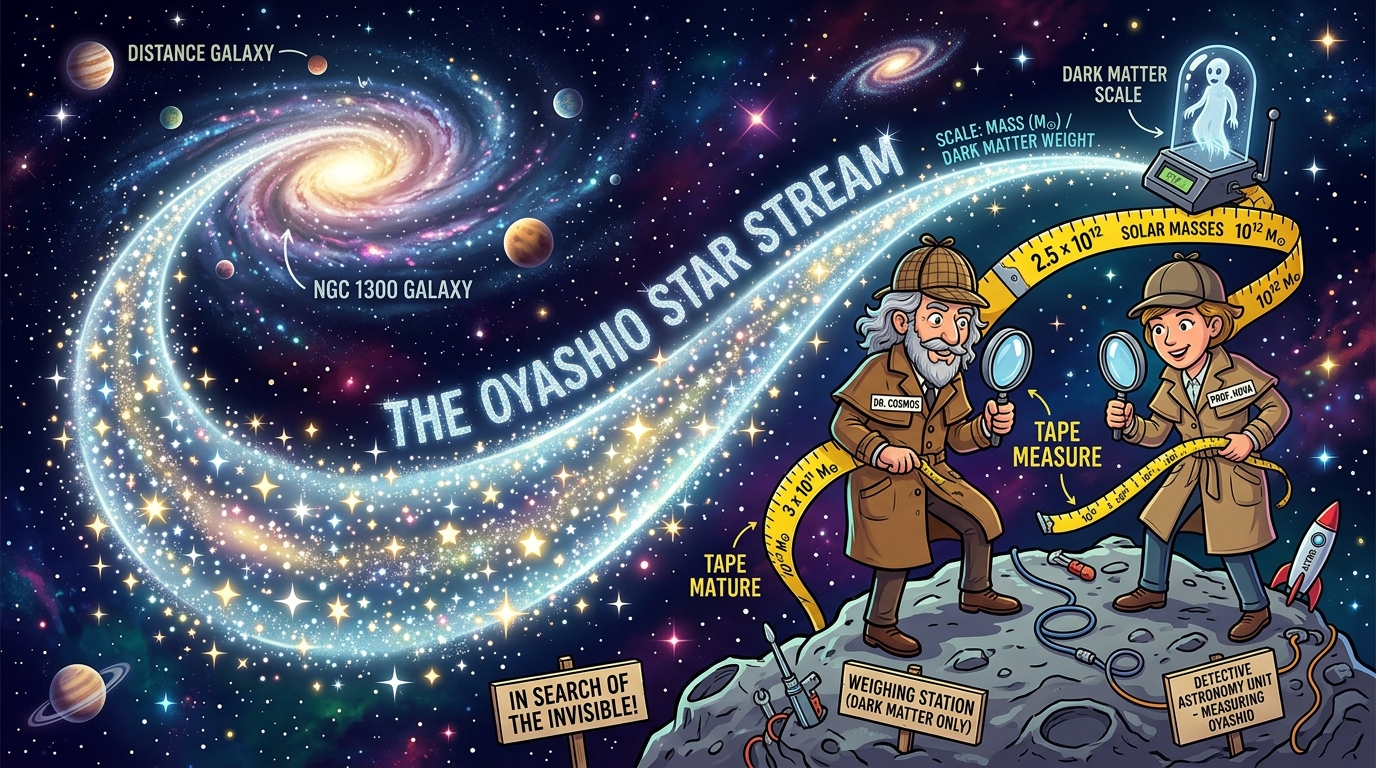
Dark matter is the universe's ultimate phantom: it makes up roughly 85% of all matter in existence, holds galaxies together like cosmic scaffolding, and yet refuses to emit, reflect, or absorb a single photon of light. For decades, astronomers trying to study dark matter have felt like detectives investigating a crime scene where the suspect is completely invisible. But now, cosmic detectives have caught the phantom red-handed. Looking 115 million light-years away, researchers using the Hubble Space Telescope have discovered "Oyashio"—the first globular cluster stellar stream ever detected outside our home galaxy!
Published in Nature by an international consortium of astrophysicists, the discovery centers on a faint dwarf galaxy designated UGC 9050-Dw1. Trailing behind it is a delicate, ghostly ribbon of ancient stars stretching tens of thousands of light-years across intergalactic space—a celestial breadcrumb trail pulled apart by invisible gravitational tides.
🌌 What Exactly Is a "Stellar Stream"?
Here is how nature builds the ultimate gravitational tape measure:
- The Doomed Cluster: Hundreds of thousands of stars originally huddled tightly in a dense sphere known as a globular cluster.
- Tidal Dismantling: As the cluster orbited its host galaxy, gravitational forces relentlessly tugged at its edges, unraveling the sphere into a long, thin filament of stars.
- Why "Oyashio"? Named after the cold subarctic ocean current in the northwest Pacific, the stream flows gracefully through the cosmic void like an icy river of light.
- Weighing the Invisible: Because stellar streams are paper-thin and sensitive to gravitational nudges, any invisible clumping of dark matter in the galactic halo bends, kinks, or tears the stream. By measuring these subtle ripples, astronomers can map the 3D distribution of dark matter with surgical precision.
Until now, every confirmed globular cluster stellar stream was located right here inside our own Milky Way (such as the famous GD-1 or Palomar 5 streams). While studying our local galactic neighborhood is great, astronomers had no way of knowing whether the dark matter distribution in the Milky Way was typical or a total cosmic fluke.
Finding Oyashio 115 million light-years away proves that stellar tidal stripping is a universal cosmic engine. More importantly, it gives scientists their very first independent laboratory to test whether dark matter is truly "cold" and clumpy, or whether alternative theories of gravity like MOND (Modified Newtonian Dynamics) can explain galaxy dynamics without invisible particles.
🕵️♂️ "We Have the Phantom Surrounded"
Imagine trying to weigh an invisible ghost. You can't put him on a bathroom scale. But if the ghost walks through a pile of sparkling fairy dust, you can look at the footprints and calculate his exact shoe size and body mass index. Oyashio is that fairy dust.
With the Nancy Grace Roman Space Telescope launching soon to map vast swaths of the sky, astronomers expect to find hundreds more of these ghostly stellar ribbons. The invisible universe is running out of places to hide.
You might also like

The Milky Way Was Born Hungry: Hubble Finds 12-Billion-Year-Old Galactic Breakfast
Hubble telescope astronomers uncovered evidence that our baby Milky Way galaxy devoured a neighbor dwarf galaxy named LKH 12 billion years ago, pushing back our galaxy's cosmic cannibalism timeline by 1.8 billion years.
The 10-Billion-Year-Old Voicemail: Webb and MeerKAT Catch the Most Distant Radio Flash in Cosmic History
Astronomers have detected FRB 20240304B, a fast radio burst that traveled over 10 billion years across the universe, shattering cosmic distance records and proving ancient baby galaxies loved loud fireworks.

Cosmic Monster Trucks: JWST Catches 21 Teenage Alien Solar Systems Smashing Planets into Vaporized Glass
The James Webb Space Telescope peeked inside 21 rare 'extreme debris disks' and caught teenage solar systems playing planetary dodgeball, vaporizing Mars-sized worlds into glowing clouds of silica glass.