The 4,000-Atom Conga Line: How Crushing Blue Paint at 21 GPa Made the World's Longest Atomic Wire
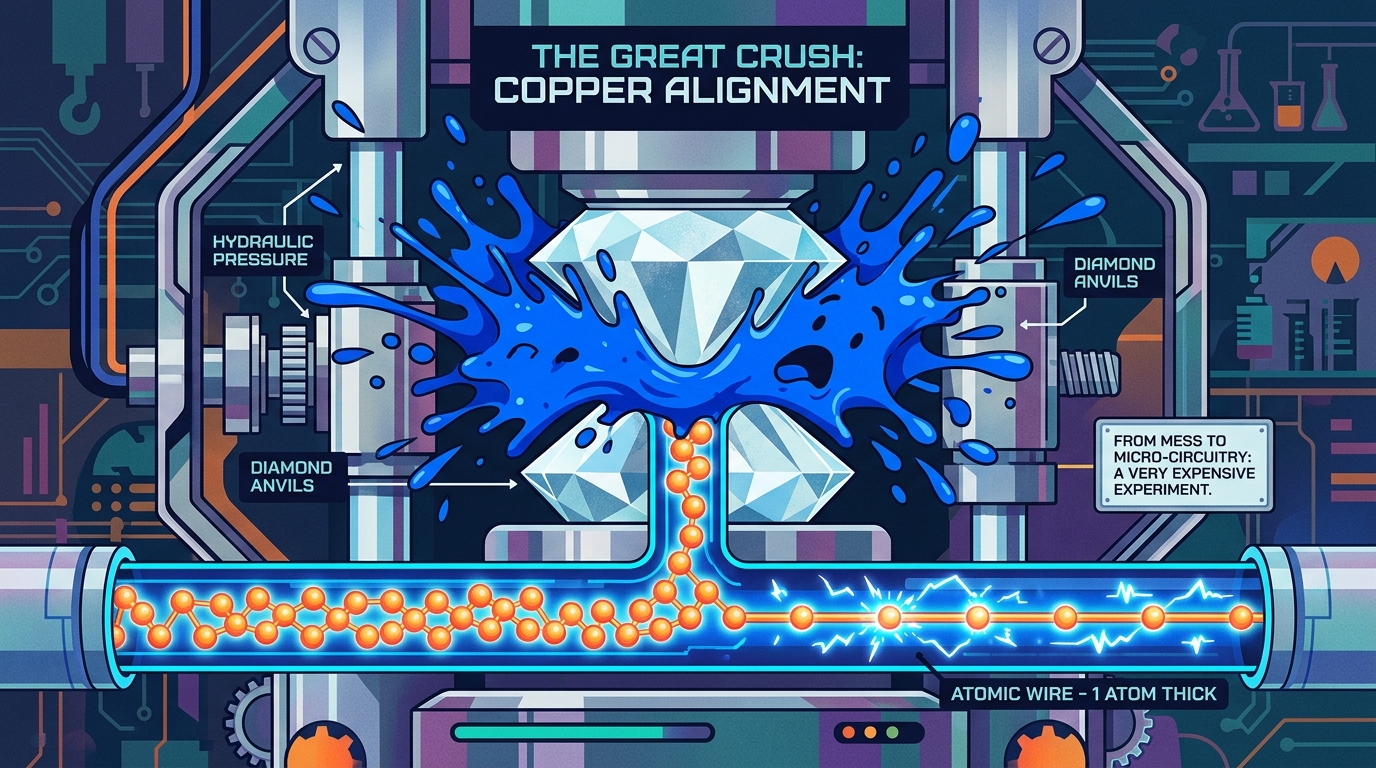
If you ever tried squeezing an empty tube of blue acrylic paint to get the last drop out, congratulations: you were practicing introductory physics. But when materials scientists decided to put the very same blue pigment under a diamond anvil press and squeeze it with the weight of two hundred thousand atmospheres, they didn't get blue gunk. They created a record-smashing, single-atom electrical wire that stretches across 4,000 copper atoms.
The chemical in question is copper phthalocyanine (CuPc)—a ubiquitous synthetic dye found in everything from car paint and blue bank logos to cheap ink cartridges. At ambient room pressure, it looks like harmless blue dust made of flat, disc-like molecules with a lone copper atom pinned in the center of an organic ring. But subject it to extreme pressures exceeding 21 gigapascals (GPa), and chemistry undergoes a radical plot twist.
💎 The Diamond Squeeze: Anatomy of an Atomic Wire
In experiments reported across high-pressure materials physics, researchers placed copper phthalocyanine crystals inside a diamond anvil cell. Here is what happens when you turn up the pressure:
- 210,000 Times Atmospheric Pressure: Under 21 GPa, intermolecular gaps vanish, forcing the planar discs to stack tightly like microscopic poker chips.
- The Atomic Alignment: The central copper atoms line up into a perfectly straight, continuous one-atom-thick column.
- 4,000 Atoms Long: While previous attempts to fabricate single-atom wires on metal surfaces tapped out at roughly 28 atoms before collapsing, this pressure-driven approach created a continuous chain over 4,000 atoms long.
For decades, the holy grail of nanoscale computing has been shrinking circuit interconnects down to the ultimate limit: a wire made of a single file of atoms. The problem? Free-standing atomic chains are fragile, thermally unstable, and tend to ball up into useless metallic blobs the second you look at them funny.
The genius of the blue pigment trick lies in its built-in organic scaffolding. The ring-shaped phthalocyanine ligands surround each copper atom like a protective rubber bumper, preventing the 4,000-atom wire from buckling or short-circuiting against neighboring atoms.
⚡ The Twist in the Current
In a bizarre quantum mechanical twist, researchers noted that when electricity flows through this atomic wire, the electrons don't just hop through the copper atoms alone. Instead, the current is transported through a hybrid quantum highway formed by the coordinated interaction between the metal center and the compressed organic ligand rings (sSMACs), yielding high electrical conductivity along the 1D axis.
While you probably won't be running a 21-gigapascal hydraulic press inside your smartphone anytime soon, this breakthrough proves that molecular self-assembly under pressure can effortlessly build atomic architectures that human lithography could only dream of. The next time you spot blue paint on a wall, give it some respect: with enough pressure, it is ready to power a quantum supercomputer!
You might also like
AI Hallucinated Fake Diamonds: MIT's CrysVCD Finally Teaches Generative Models Basic Chemistry
Generative AI was daydreaming millions of physically impossible crystals that instantly collapsed in simulations. MIT's CrysVCD framework acts as a chemistry bouncer, enforcing valence rules and cutting screening waste by 90%.
Don't Iron That Graphene! Scientists Turn Atomic Wrinkles into Tiny Batteries
Rice University physicists discovered that crumpling single-atom-thick graphene generates spontaneous electrical polarization through flexoelectricity, effectively creating nanoscale batteries from messy folds.

Quantum Flash Mob: Distant Time Crystals Spontaneously Synchronize Across a Microchip
Physicists at TU Dortmund University watched separate quantum time crystals lock into the exact same ticking tempo across 40 micrometers—over 1,000 times their own size. Bridged by diffusing electron spins, this spontaneous quantum choreography breaks new ground for future quantum processors.