The Ultimate Cosmic Hide-and-Seek: Chandra Uncovers 84 Stealth 'Hypersoft' Beacons
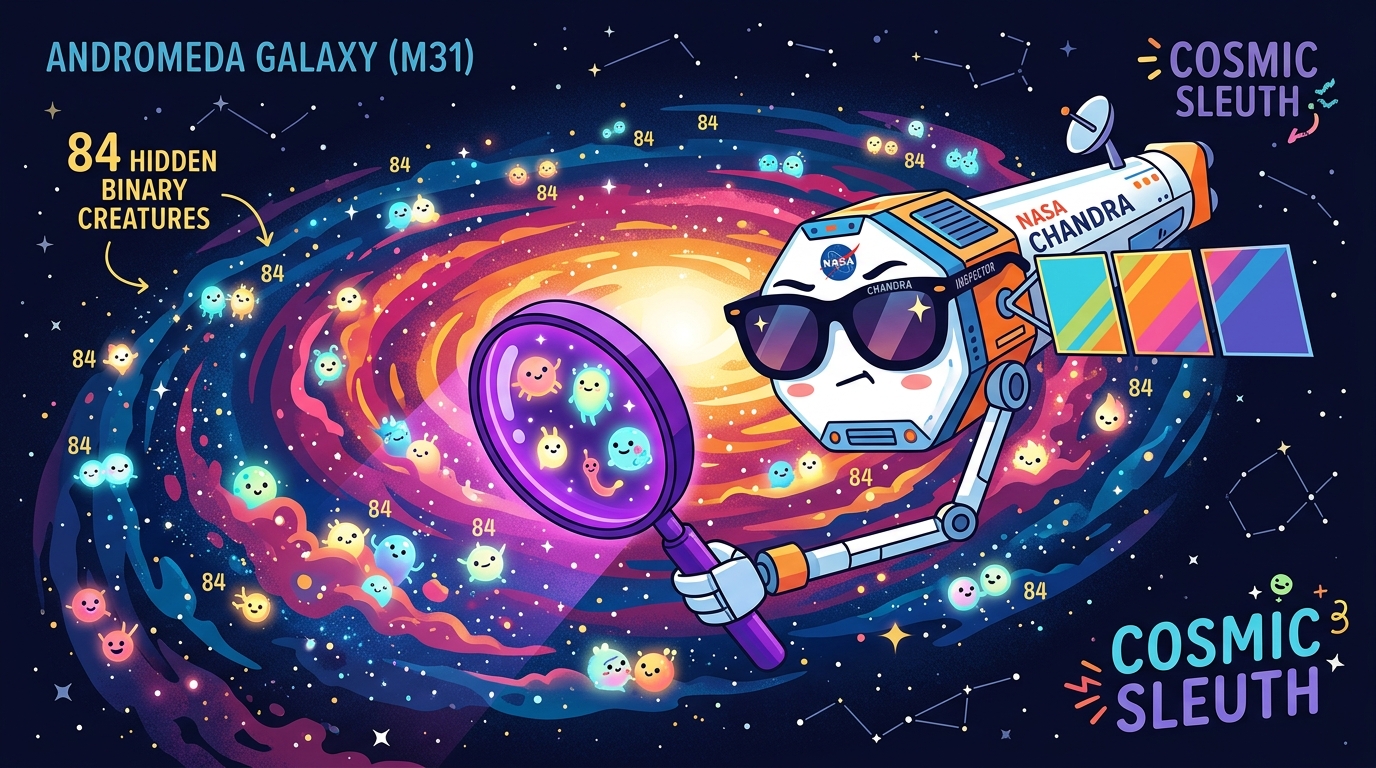
Imagine a lighthouse so bright it could blind an entire solar system, except its beam is tuned to a frequency that interstellar space absorbs like a thick blackout curtain. On September 9, 2026, astrophysicists from the University of Alabama announced in Nature Astronomy that they caught 84 of these stealth cosmic powerhouses lurking across six nearby galaxies—including Andromeda (M31) and the Pinwheel Galaxy (M101). Meet the newly christened "hypersoft X-ray sources" (HSSs).
For decades, high-energy astronomers thought they had the universe pretty well mapped: when a dying dense star feeds on a companion, it usually blasts out fierce, high-energy X-rays like an angry laser show. But team leader Mustafa Muhibullah suspected that a huge demographic of cosmic monsters was slipping right under our noses by playing cosmic stealth games.
🔭 How to Catch a Stealth Cosmic Beacon
The researchers didn't build a new mega-telescope; they mined 25 years of NASA's Chandra X-ray Observatory public archives with an ingenious detection strategy:
- The Energy Filter Trick: They filtered millions of cataloged pixels for objects that flared brightly in ultra-low-energy (soft) X-rays, but vanished completely into the blackness when looking at medium- or high-energy X-ray bands.
- The Extreme-UV Monster: What appears to Chandra as a faint, gentle whisper of low-energy X-rays is actually just the tip of the iceberg: these systems blast colossal amounts of extreme-ultraviolet (EUV) radiation.
- The Hydrogen Smoke Screen: Because neutral hydrogen gas throughout interstellar space gobbles up EUV light instantly, these 84 objects were completely invisible to traditional ultraviolet telescopes.
So what actually are these bizarre cosmic engines? The prevailing hypothesis is that they are tight binary dance partners where a compact heavyweight—such as a white dwarf, neutron star, or stellar-mass black hole—is gorging itself on gas stripped from a companion star at a frantic pace.
If the white dwarf theory holds true, these 84 stealth beacons could be the long-sought missing progenitors of Type Ia supernovas—the exploding stellar bombs that astronomers use as "standard candles" to measure the expansion rate of our entire universe. For years, theorists couldn't figure out where all the pre-explosion white dwarfs were hiding. Turns out, they were just wearing ultraviolet stealth cloaks.
🕵️♂️ 84 Ghosts Busted
It turns out the universe isn't missing thousands of white dwarf binaries—we were just looking through the cosmic peephole with the wrong glasses. Never underestimate a dead star's ability to play the galaxy's most successful game of hide-and-seek.
With 84 newfound specimens cataloged across spiral and elliptical galaxies alike, Chandra has proved once again that old archival data is a literal goldmine. Who knows what other galactic phantoms are silently humming in the dark, waiting for someone to flip the right filter?
You might also like

Oklahoma's Ames Meteor Crater Knocked 100 Million Years Off Its Age After Getting Caught With Recycled Fossils
High-precision uranium-lead zircon dating reveals Oklahoma's Ames impact crater was formed 370 million years ago—nearly 100 million years later than believed—kicking it out of Earth's hypothetical Saturn-ring club.
Saturn Got Bored With Its Hexagon, So Its South Pole Spun Up a 10-Sided Decagon
Hubble astronomers discovered a giant 10-sided atmospheric wave cruising around Saturn's south pole at 10 km/h, with each side stretching longer than planet Earth.

Enceladus Is Running an Interstellar Smoothie Bar That Pre-Sorts Alien Life for NASA
Saturn's icy moon doesn't just spew water into space—it slowly freezes, crashes, and shatters ocean droplets into pre-concentrated ice grains so future probes won't have to dig through cosmic slush.