The Moon's Far Side Preserved 1,000°C Magnetic Hard Drives in Natural Glass Beads

If you thought modern solid-state drives were resilient, wait until you hear about the Moon's natural data storage solution: trapping thousand-degree iron nanoparticles inside impact glass for billions of years without losing a single bit of magnetic memory.
When China's Chang'e-6 lander touched down in the Apollo basin within the Moon's colossal South Pole-Aitken basin, it scooped up regolith from a region never before sampled by humans. While planetary scientists expected to find typical lunar dust, researchers examining the samples under high-resolution electron microscopes stumbled upon something that shouldn't exist at room temperature: natural gamma-phase iron (γ-Fe) crystals locked in eternal suspended animation.
🧲 The Lunar Magnetic Time Capsule
In a study published in the Proceedings of the National Academy of Sciences (PNAS), a research team led by Professor Haifeng Du from the Chinese Academy of Sciences revealed how ancient impacts built microscopic cosmic hard drives:
- The High-Temperature Rebel: On Earth and the Moon, metallic iron is almost universally alpha-iron (α-Fe), arranged in a body-centered cubic structure. Gamma-iron (γ-Fe), with a face-centered cubic structure, normally exists only at blazing temperatures between 912°C and 1,394°C.
- Flash-Frozen by Cataclysm: When hypervelocity meteorites slammed into the lunar crust, the intense kinetic energy instantly vaporized and melted mineral grains into molten silicate droplets.
- The Glassy Cocoon: In the vacuum of space, those molten droplets cooled so violently fast—quenched in fractions of a second—that the iron atoms never had time to rearrange back into ordinary alpha-iron. They were frozen in place inside glassy spheres.
- Vortex Magnetic Shield: Electron holography confirmed these nanoscale γ-Fe particles formed closed-loop magnetic vortex domains. These vortexes are so magnetically stable that they resist demagnetization over cosmic timescales.
Why does this matter to anyone other than hardcore mineralogists? Because the Moon has a massive identity crisis when it comes to magnetism. Today, the Moon has no global magnetic field to speak of—an astronaut's compass needle would just spin around aimlessly. Yet ancient Apollo rock samples hinted that billions of years ago, the young Moon generated a surprisingly stout magnetic shield powered by an internal liquid-core dynamo.
The trouble was that most lunar rocks were repeatedly reheated, melted, and scrambled by relentless asteroid bombardments, effectively wiping their magnetic memory tapes like a toddler playing with refrigerator magnets.
💾 Nature's Ultimate Write-Once Memory
These newly discovered γ-Fe glass beads act as uncorrupted geological black boxes:
- Impervious to Interference: Sealed deep inside amorphous silicate glass and shielded by vortex domain walls, the nanoparticles preserved the exact magnetic field intensity present when the glass droplet solidified.
- Decoding the Far Side Dynamo: Because Chang'e-6 sampled the Moon's far side, researchers can now compare the far side's ancient magnetic signature with Apollo's near-side data to test whether the lunar dynamo was symmetrical or lopsided.
- Carbon's Secret Help: Trace amounts of carbon dissolved in the melt helped stabilize the crystal lattice, proving ancient meteorites delivered the chemical stabilizers required to lock in the record.
Next time you accidentally corrupt a thumb drive by unplugging it without clicking "Safely Remove Hardware," remember that the Moon managed to preserve high-temperature magnetic data for three billion years using nothing but molten rock and a catastrophic cosmic collision.
You might also like
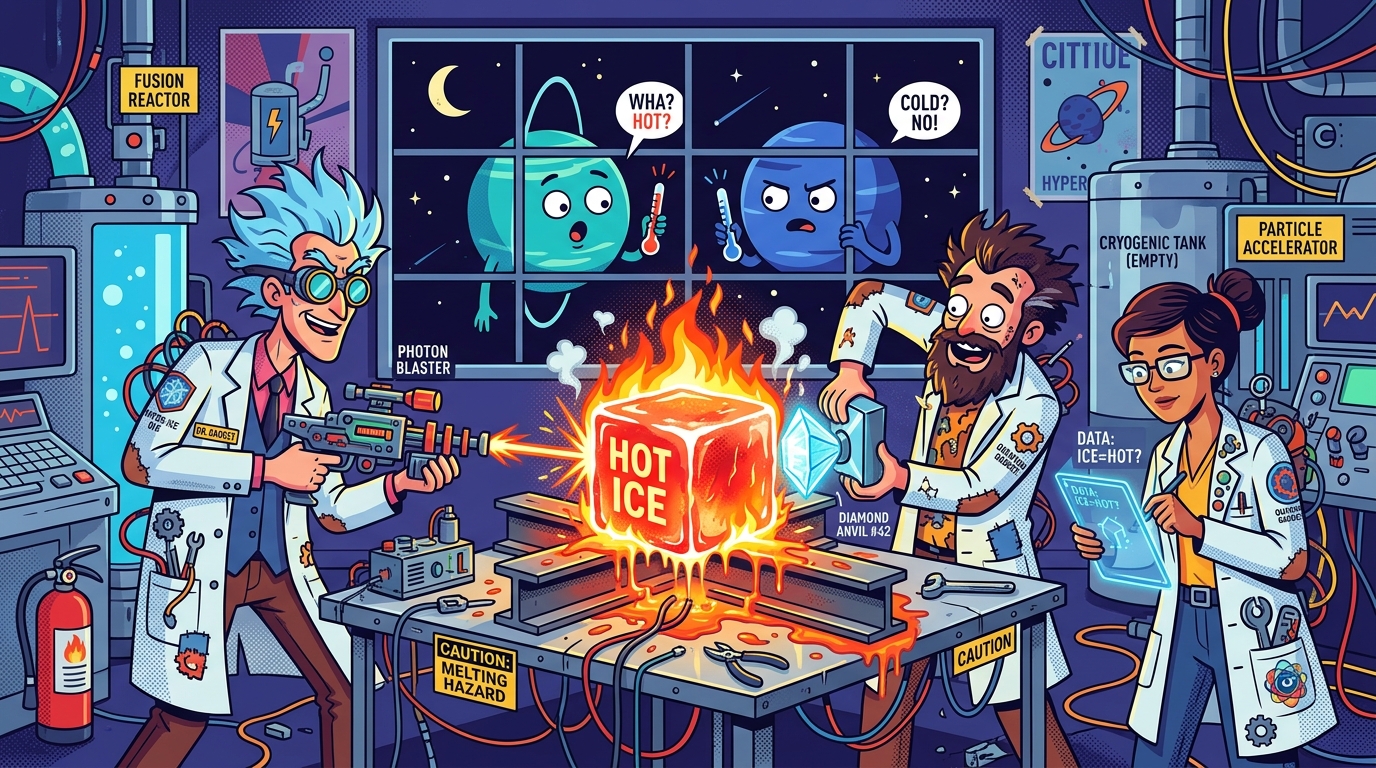
Ice Hot Enough to Melt Steel: How Physicists Recreated the Electric Slush of Uranus and Neptune
French physicists crushed water inside diamond anvils past 2 million atmospheres and heated it to 1,527°C—creating superionic hexagonal close-packed ice. It's solid oxygen trapping a flowing river of liquid protons, proving deep planetary ice is an electric inferno.
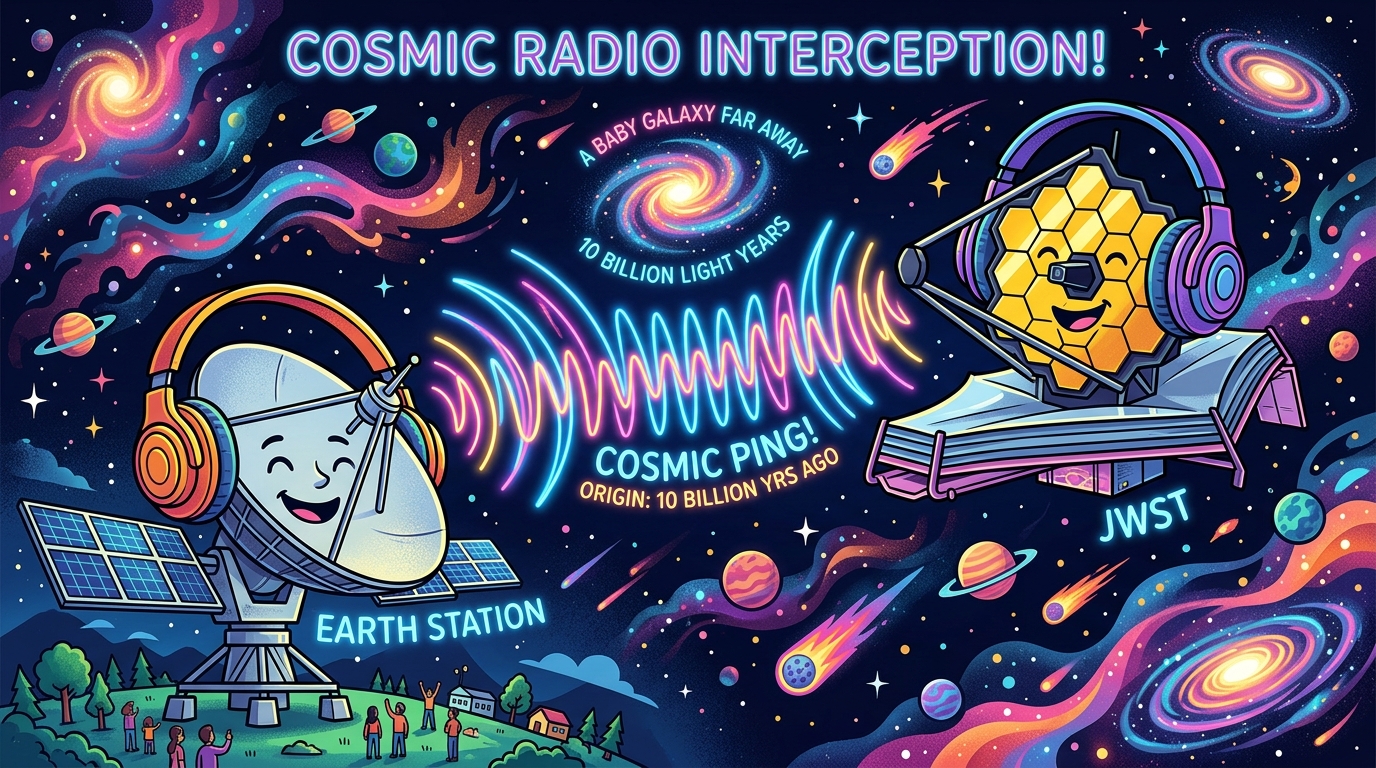
The 10-Billion-Year-Old Voicemail: Webb and MeerKAT Catch the Most Distant Radio Flash in Cosmic History
Astronomers have detected FRB 20240304B, a fast radio burst that traveled over 10 billion years across the universe, shattering cosmic distance records and proving ancient baby galaxies loved loud fireworks.

Fishing for Cosmic Ghosts at the South Pole: How a Giant Ice Cube Won the 2026 Nobel Prize in Physics
The 2026 Nobel Prize in Physics goes solely to Francis Halzen for melting 86 giant holes into two miles of Antarctic ice, turning the frozen continent into the world's weirdest telescope to catch elusive cosmic neutrinos.