Baking Biology from Scratch: David Baker's $95M AI Bakery for Alien Proteins
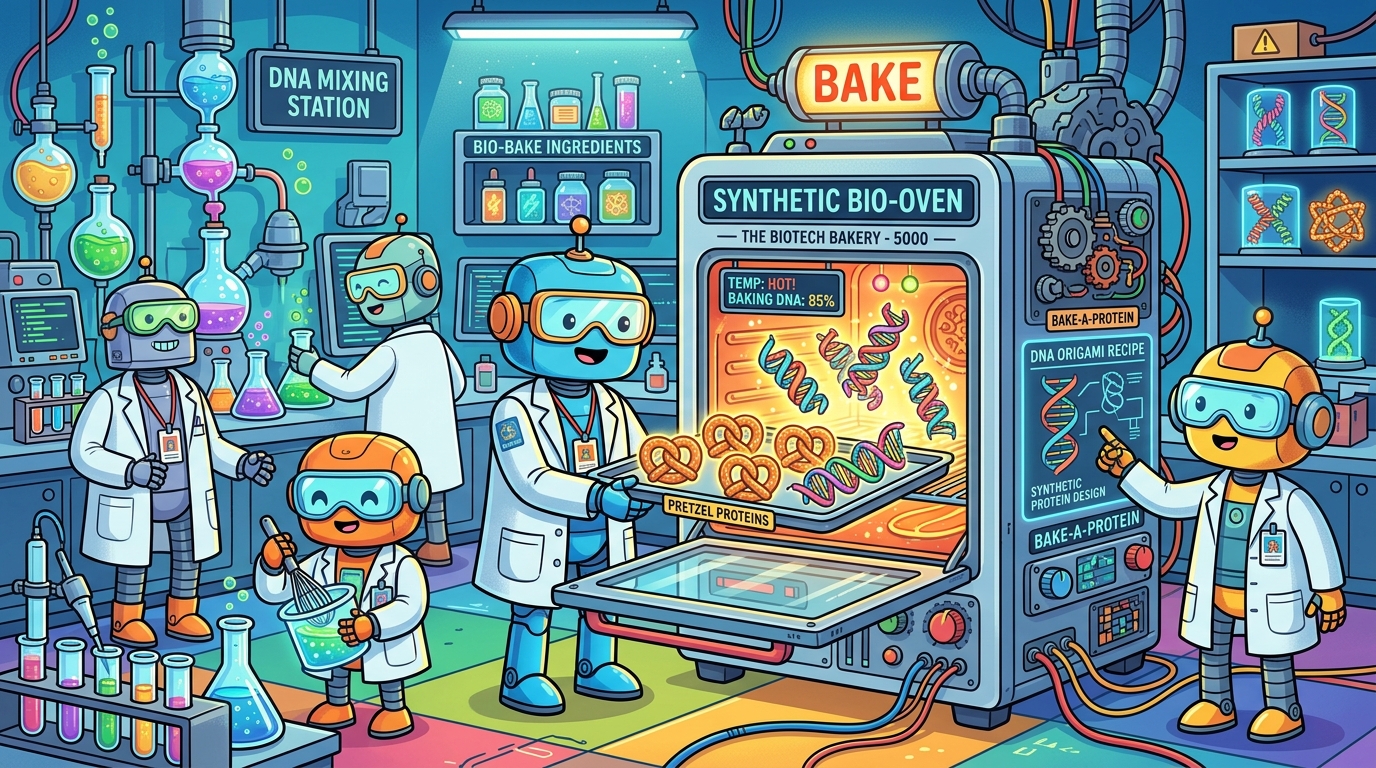
For nearly four billion years, biological evolution operated like a procrastinating home cook: it threw whatever random ingredients were lying around in the primordial soup into an evolutionary blender and hoped for the best. That’s how we ended up with things like wisdom teeth, the appendix, and proteins that break down when you look at them wrong. Now, Nobel laureate David Baker and a dream team of scientists have decided it's time to take over the kitchen.
Launched on September 3, 2026, the AI BioDesign Initiative is a massive, nearly $95 million research coalition uniting the Allen Institute, the University of Washington Medicine Institute for Protein Design, and the Fred Hutch Cancer Center. Their audacious goal? Teach generative artificial intelligence to engineer biological molecules, synthetic genes, and bespoke proteins from scratch that have never existed anywhere in nature.
🧬 The Design-Build-Measure-Learn Bio-Loop
Instead of guessing molecular shapes with trial-and-error chemistry, the initiative pairs deep generative AI models with automated robotic "wet labs." The AI dreams up exotic protein origami designed to tackle specific jobs—like chewing up plastic water bottles in landfills or neutralizing neurodegenerative brain plaques. Robotic arms then synthesize the physical molecules, test their real-world potency, and feed the experimental data right back into the neural network.
Led by Nobel laureate David Baker and renowned genome scientist Jay Shendure, this isn't just about editing existing DNA—it's about writing entirely new biological operating systems.
- Beyond Nature's Recipe Book: Natural evolution was constrained by whatever mutations happened to help prehistoric critters survive long enough to mate. AI BioDesign skips survival games and crafts ultra-specialized nanomachines designed specifically for 21st-century crises.
- Enzymes with Superpowers: The initiative is designing hyper-efficient catalytic enzymes that can break down indestructible industrial PFAS "forever chemicals" and microplastics in ocean currents.
- Living Bio-Computers: By programming synthetic gene circuits that process logic gates inside living cells, the team is laying the groundwork for microscopic medical scouts that diagnose diseases inside blood vessels and synthesize custom medicines on demand.
- Radical Open Science: Rather than locking these molecular superpowers behind corporate paywalls, the Allen Institute is committed to releasing open-source models, training datasets, and molecular libraries for researchers worldwide.
🥨 The Molecular Bakery Is Open
Think of traditional biochemistry as foraging through the wild forest for edible roots. The AI BioDesign Initiative is opening a Michelin-starred patisserie where AI algorithms design molecular pretzels and custom pastries down to the exact atomic fold.
Mother Nature had a respectable four-billion-year run, but she was never equipped with GPU clusters and diffusion algorithms. Welcome to the era where biology is no longer an accident of history—it's a high-performance software stack.
You might also like
Hey DNA, 'U Up?': UC Berkeley Unveils GPN-Star AI to Text Your Non-Coding Genome
UC Berkeley researchers just dropped GPN-Star in Nature, a genomic language model that decodes the mysterious grammar of non-coding 'junk DNA' with stunning computational efficiency.
The Accidental Fountain of Youth: First Generative AI Drug Shaves 6 Years Off Biological Age
Scientists trained AI to design a pill for deadly lung fibrosis. When they analyzed patient blood with six independent proteomic clocks, they found the drug accidentally reversed biological aging by up to 6 years!
The Human Power Button: UCSD AI Cracks the DNA 'On-Switch' Controlling 60% of Our Genes
For half a century, biologists knew that a mysterious molecular code dictated exactly where RNA polymerase begins reading our genes. Now, UC San Diego researchers used machine learning on 500,000 synthetic DNA sequences to crack the genome's universal master key!