Enceladus Is Running an Interstellar Smoothie Bar That Pre-Sorts Alien Life for NASA
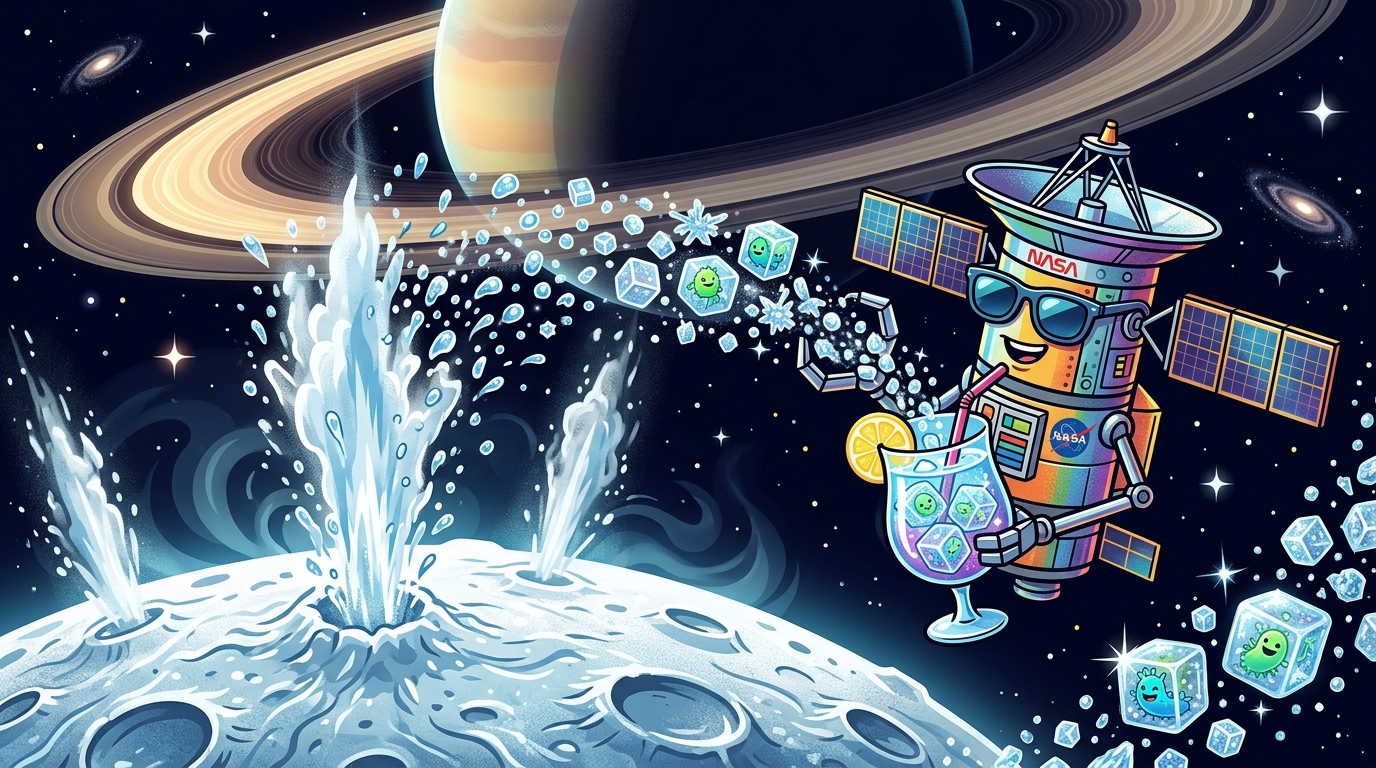
If you ever worried that discovering extraterrestrial life would require billion-dollar deep-sea submarines, laser-drilling through twenty miles of solid ice, and praying you don't drop the probe's antenna into an icy abyss—relax. Saturn's frozen moon Enceladus has decided to do the lab work for us.
For nearly two decades since NASA's Cassini spacecraft first flew past Enceladus' dramatic south-polar geysers, astronomers assumed the moon was essentially a cosmic fire hose on blast. The common theory went: warm subsurface ocean water shoots through the "tiger stripe" crevasses into the vacuum of space, flash-freezes into uniform microscopic slush balls, and sprays indiscriminately across the Saturnian system.
🍹 The Cosmic Cocktail Shaker Mechanism
In a groundbreaking paper published in Science Advances, planetary scientist Professor Frank Postberg and his team at Freie Universität Berlin revealed what is actually happening inside those supersonic vents:
- The Slow Freeze: Instead of flash-freezing in a millisecond, oceanic droplets ascending through the narrow cracks cool down gradually over several minutes.
- Chemical Layering: As the droplets slowly freeze, different salts—carbonates, chlorides, phosphates, and complex organic polymers—crystallize out at different temperatures, creating segregated "flavor layers" rather than a bland mix.
- The 1,000 km/h Demolition Derby: Rocketing upward at speeds up to 1,000 kilometers per hour, the frozen droplets slam headfirst into the jagged ice walls of the fractures.
- Microscopic Shattering: The impact shatters the droplets into tiny fragments just a few micrometers wide, ejecting concentrated chemical packets straight into orbit.
Why does this matter? Because in a typical planetary ocean, organic compounds and biological molecules might be diluted down to parts-per-billion. If a spacecraft flew through and grabbed a random scoop of generic water, detecting microscopic alien microbes would be like trying to taste a single grain of sugar dissolved in an Olympic swimming pool.
Enceladus' slow-freeze-and-shatter conveyor belt changes everything. By crystallizing and fracturing the brine, the moon pre-sorts and concentrates rare chemicals into individual ice grains. When Cassini's Cosmic Dust Analyzer (CDA) sampled 961 salt-rich grains, it was not tasting diluted soup—it was sampling concentrated hors d'oeuvres.
🚀 NASA's Lazy Astrobiology Playbook
Future interplanetary explorers can completely skip the hard part:
- No Drill Bits Required: You don't need a heavy nuclear-powered melting robot to penetrate the icy crust.
- Flyby Buffet: A probe just needs to glide through the plume with an onboard mass spectrometer sticking out like a cocktail glass.
- Pre-Packaged Samples: If Enceladus' hydrothermal vents host methanogenic bacteria or primitive alien biochemistry, the moon's natural centrifuge has already packaged them into bite-sized ice crystals for collection.
So hats off to Enceladus. In a universe where finding extraterrestrial biology usually demands unimaginable engineering feats, Saturn's sixth-largest moon is happily blending the drinks, crushing the ice, and tossing alien biosignatures right through NASA's front windshield.
You might also like

Oklahoma's Ames Meteor Crater Knocked 100 Million Years Off Its Age After Getting Caught With Recycled Fossils
High-precision uranium-lead zircon dating reveals Oklahoma's Ames impact crater was formed 370 million years ago—nearly 100 million years later than believed—kicking it out of Earth's hypothetical Saturn-ring club.
Saturn Got Bored With Its Hexagon, So Its South Pole Spun Up a 10-Sided Decagon
Hubble astronomers discovered a giant 10-sided atmospheric wave cruising around Saturn's south pole at 10 km/h, with each side stretching longer than planet Earth.
Meet Elias 2-24 b: The Cosmic Toddler Caught Devouring Dust in Its Protoplanetary Crib
Astronomers reanalyzed archival Keck and ALMA data to discover Elias 2-24 b, the youngest exoplanet ever spotted at under 1 million years old. Clocking in at Jupiter's mass, this celestial newborn is already terrorizing its solar nursery 450 light-years away.