Cosmic Imposter: JWST Unmasks a 100,000-Solar-Mass Black Hole Cosplaying in a Giant Hydrogen Onesie
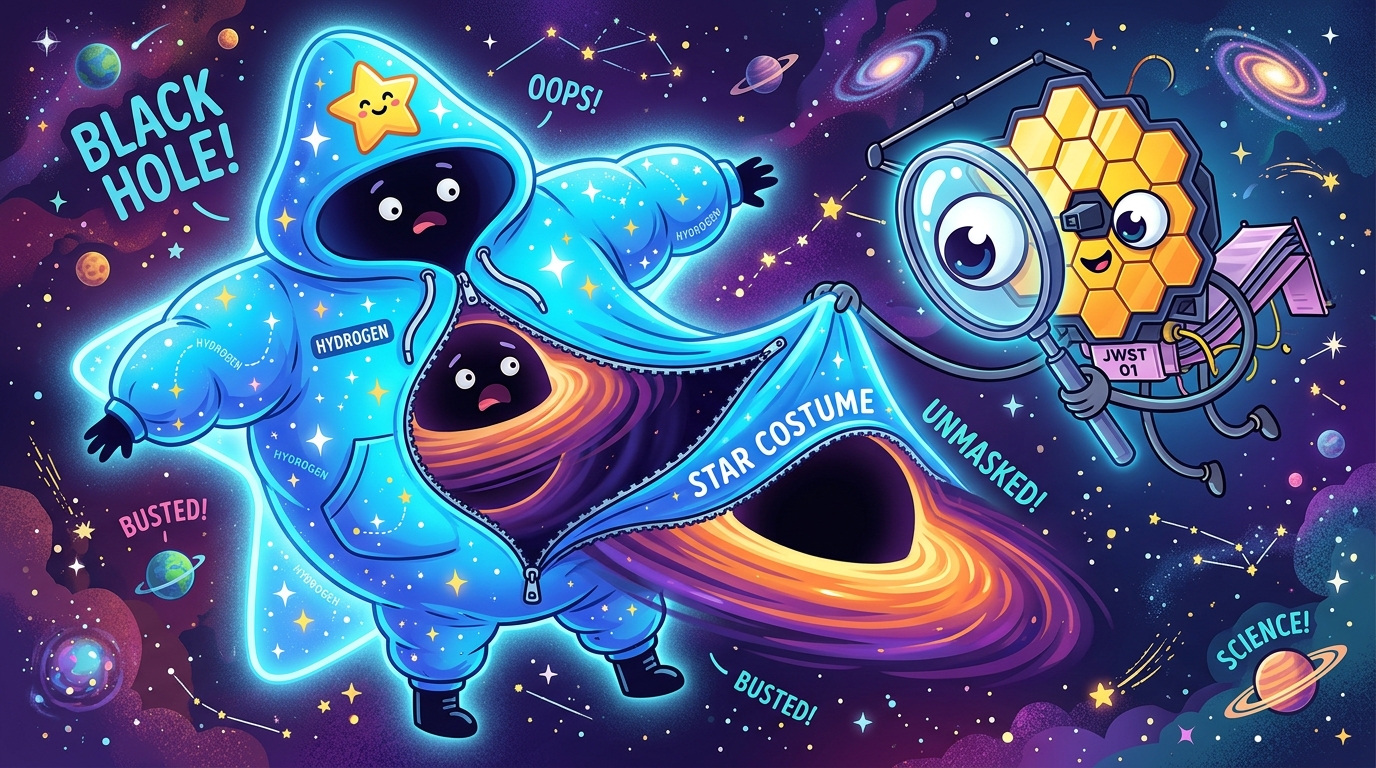
Ever since the James Webb Space Telescope opened its golden honeycomb eyes on the early cosmos, astronomers have been losing sleep over mysterious "Little Red Dots"—bizarre, ultra-compact red smudges that seemed far too bright, far too dense, and far too early in the universe's history to exist. Now, the verdict is in: Webb has caught one of these objects red-handed. Meet MoM-BH*-1, a 100,000-solar-mass supermassive black hole wearing a giant, puffy hydrogen onesie to disguise itself as a polite supergiant star.
Discovered by an international team during the Mirage or Miracle (MoM) deep-sky survey, MoM-BH*-1 dates back to a mere 660 million years after the Big Bang. At first glance through standard infrared filters, it looked like an impossibly hyper-luminous supergiant star shining with the brightness of over 100 billion suns. But when astrophysicists dissected its light spectrum, they realized there was no nuclear fusion core inside—just a raging gravitational abyss gorging on gas beneath a cosmic disguise.
✨ How to Build a "Black Hole Star"
Here is the astronomical recipe for cosmic identity theft:
- The Core: An intermediate-to-supermassive black hole weighing roughly 100,000 to 1,000,000 times the mass of our Sun.
- The Onesie (Pseudo-Photosphere): Rather than forming a flat accretion disk, infalling hydrogen forms an ultra-dense, turbulent, self-gravitating gas cocoon millions of kilometers thick.
- The Optical Illusion: Radiation roaring out from the accretion zone cannot escape directly into space. Instead, it gets trapped and scattered within the dense hydrogen shell, warming the outer surface until it radiates thermal light identical to an enormous, hyper-luminous star.
- The Imposter Revealed: Broad emission lines and extreme energy density detected by JWST's NIRSpec finally blew the whistle, proving the core was thousands of times more compact than any stellar interior.
This discovery solves one of JWST's greatest ongoing cosmic headaches: how did supermassive black holes weighing billions of solar masses appear so quickly within the first few hundred million years of cosmic time? Standard accretion limits (the Eddington limit) say black holes shouldn't be able to swallow gas fast enough without blowing it away. But wrapped inside a dense, protective envelope of hydrogen, the black hole can engage in "super-Eddington" binge-eating in secret without the rest of the universe noticing.
Astronomers suspect that many—if not most—of the enigmatic "Little Red Dots" peppering the distant universe are actually baby quasars going through this exact awkward "onesie phase" before they blow off their gas envelopes and emerge as roaring galactic monsters.
🎭 "Excuse Me, Sir, Your Black Hole Is Showing"
You have to admire the audacious cosmic cosplay: an object whose gravity is so violent that light cannot escape puts on a fluffy jacket of hydrogen, walks into an astronomy survey, and proudly introduces itself as "just a normal, shiny oversized star." Nice try, MoM-BH*-1, but JWST has the receipts.
As JWST continues scanning the primordial dawn, astronomers are bracing for even more cosmic chameleons. Turns out, the baby universe wasn't just crowded—it was wearing costumes.
You might also like

JWST Catches 'Black Hole Star': A Cosmic Monster Wearing a Giant Puffer Jacket
Astronomers find MoM-BH*-1, a solar-system-sized beast from the early universe that shines 100 billion times brighter than normal stars—powered by an enshrouded 100,000-solar-mass black hole.

Cosmic Monster Trucks: JWST Catches 21 Teenage Alien Solar Systems Smashing Planets into Vaporized Glass
The James Webb Space Telescope peeked inside 21 rare 'extreme debris disks' and caught teenage solar systems playing planetary dodgeball, vaporizing Mars-sized worlds into glowing clouds of silica glass.

Cosmic Wardrobe Malfunction: JWST Catches Asteroid Chariklo's Rings Radically Shifting Opacity in Real Time
Astronomers thought planetary rings were timeless cosmic jewelry. But new James Webb Space Telescope observations reveal that mini-planet Chariklo swapped its ring opacity like mood rings—in just 10 short years.