Knock, Knock, Who's There? Underground LUX-ZEPLIN Detector Catches a Mysterious Whisper from the Dark Universe
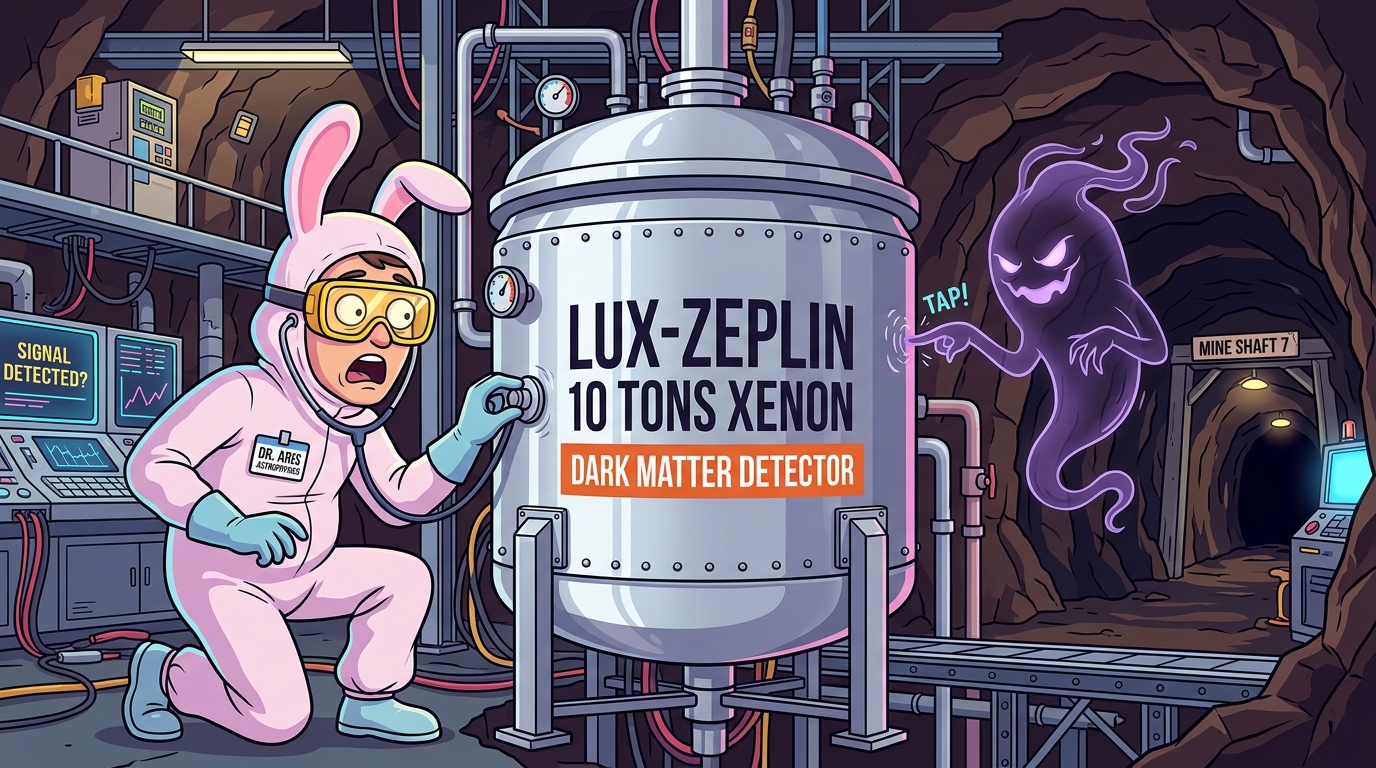
If you want to catch the most elusive phantom in the cosmos, you don't look up at the stars—you dig nearly a mile into the Earth, hide inside a former gold mine, and freeze 10 tons of liquid xenon into a vat of radioactive silence. That is exactly what the international LUX-ZEPLIN (LZ) collaboration did at the Sanford Underground Research Facility in Lead, South Dakota. And in early September 2026 at the TeVPA astrophysics conference in Japan, they dropped a bombshell: their hyper-sensitive underground trap heard a single, unexplained high-energy knock.
Dark matter makes up roughly 85% of all matter in the universe, acting as the invisible gravitational scaffolding that keeps galaxies from flinging themselves apart into space. Yet despite decades of searching, humans have never caught a single particle of it in the act. The LZ detector was specifically built to change that. Shielded by 4,850 feet of solid rock from the cacophony of cosmic rays and surface radiation, LZ acts as the quietest room in the western hemisphere, waiting for a hypothetical Weakly Interacting Massive Particle (WIMP) to bump into a xenon nucleus.
🔬 Anatomy of the 248 keV Mystery Event
Here is what scientists saw during 220 live days of deep underground data collection:
- The Event Energy: A solitary, razor-sharp recoil measured at 248 ± 23 keV, striking deep within the detector's fiducial volume.
- The Statistical Tension: In a region where standard background radiation models predicted virtually zero noise, the event registers at a local significance of 3.4σ (global 2.6σ).
- The Liquid Xenon Core: 10 metric tons of purified liquid xenon instrumented with hundreds of ultra-sensitive photomultiplier tubes.
- The Mystery: Traditional WIMP models predict gentle, low-energy tickles—not a sharp, energetic smack at nearly 250 keV.
The scientific world is appropriately holding its collective breath. LZ spokesperson Professor Richard Gaitskell made sure to emphasize that this is not an official discovery claim—in particle physics, you need a gold-standard 5-sigma significance to break out the champagne. An exotic, unexpected background contamination or an uncharted radioactive decay chain could still explain the rogue signal.
However, if this isn't instrumental noise, it could herald an entirely new class of dark sector physics: perhaps inelastic dark matter, solar axions with unexpected mass profiles, or dark matter candidates that interact through heavy mediator bosons. Rather than gentle cosmic dust, dark matter might pack a serious punch.
👻 The Cosmic Ding-Dong-Ditch
Imagine building a $50-million soundproof vault 5,000 feet underground, sitting in pitch-black silence for a full year with top-tier headphones, and suddenly hearing someone tap politely on the exterior glass once—and then never again. The universe just played the ultimate cosmic ding-dong-ditch on our finest particle physicists.
The LZ collaboration is now grinding through their next multi-year dataset, collecting millions more hours of xenon tranquility. Whether this solitary 248 keV ping dissolves as a statistical phantom or gets joined by sibling events, South Dakota's subterranean gold mine has officially turned into the hottest detective office in theoretical physics.
You might also like

The Moon's Far Side Preserved 1,000°C Magnetic Hard Drives in Natural Glass Beads
Scientists analyzing Chang'e-6 lunar soil discovered rare high-temperature gamma-iron trapped inside impact glass beads, creating microscopic magnetic fossils that remember the Moon's ancient dynamo.

Ice Hot Enough to Melt Steel: How Physicists Recreated the Electric Slush of Uranus and Neptune
French physicists crushed water inside diamond anvils past 2 million atmospheres and heated it to 1,527°C—creating superionic hexagonal close-packed ice. It's solid oxygen trapping a flowing river of liquid protons, proving deep planetary ice is an electric inferno.

Weighing the Big Bang's Soup: Telescopes Measure Universe's First 5 Minutes Helium to 0.5%
Astronomers pointed the twin-eyed Large Binocular Telescope at 15 pristine galactic fossils for 130 hours to measure the exact amount of helium forged in the first five minutes of the Big Bang with three times greater precision than ever before.