Goodbye Silicon, Hello Slime: MIT Builds Living Circuit Boards Powered by Bacteria
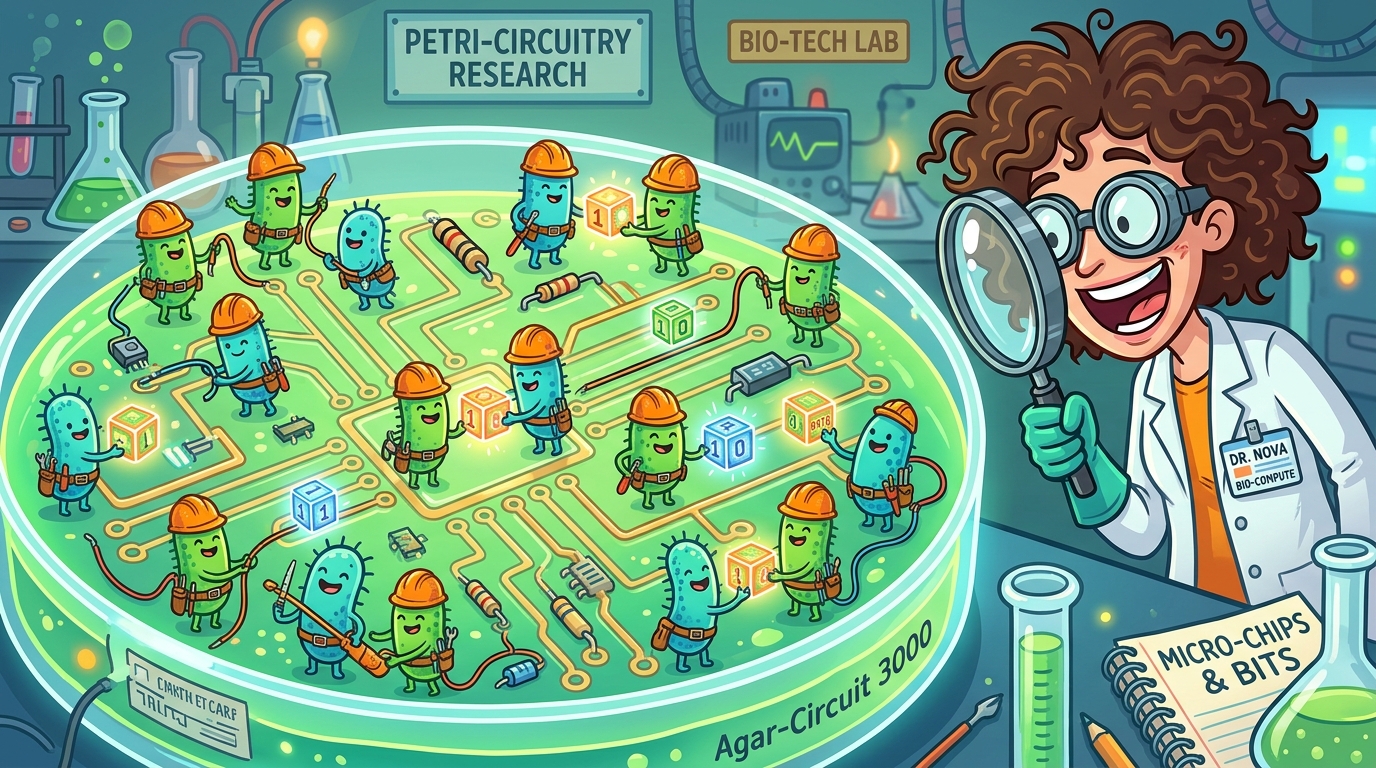
For seven decades, computing has worshiped at the altar of silicon, etching billions of microscopic copper gates onto rigid chips. But at MIT, researchers have decided that if mother nature spent four billion years mastering cellular chemistry, we might as well let gut bacteria run our logic gates. In a breakthrough published in Nature Chemical Biology, synthetic biologists have unveiled fully modular biological transistors that assemble into living computational circuit boards.
Led by Professor Christopher Voigt, head of MIT’s Department of Biological Engineering, alongside postdoctoral researcher Hamid Doosthosseini, the team bypassed traditional electrical wires entirely. In their living computer, bits aren't transmitted by flying electrons; they are whispered through small chemical signaling molecules diffusing across an agar plate.
🧫 The Bacterial Hardware Architecture
Here is how MIT engineered a five-part living toolkit out of the plant-associated bacterium Pantoea agglomerans:
- Two Transistor Strains: Living biological switches that turn ON or OFF when exposed to specific chemical inputs, mimicking electronic logic gates.
- Three Relay Strains: Cellular "wires" that absorb signals from one transistor, translate them chemically, and relay them cleanly to the next node across the plate.
- The Form Factor: Colonies spotted exactly 5 millimeters apart on agar dishes, communicating seamlessly through chemical diffusion gradients.
- Verified Operations: The team successfully demonstrated binary addition, complex signal routing, and multi-step logic cascades.
Before you cancel your pre-order for next-generation PC graphics cards, there is a catch: speed. While silicon transistors switch states billions of times per second (GHz), a bacterial transistor takes a couple of hours to process an operation while waiting for molecules to diffuse and genes to transcribe.
However, as the MIT researchers point out, biology doesn't operate in nanoseconds. An oak tree or a corn stalk doesn't need to render 120 frames per second; it needs to monitor its environment over days, weeks, and seasons. By spraying these living bacterial circuits onto agricultural crops, farmers could soon have "smart leaves" that detect airborne pathogens, monitor drought stress, or measure nutrient depletion, autonomously synthesizing localized plant remedies on demand.
🐛 When Your Motherboard Needs Sugar Instead of Electricity
Computer crashes are about to get a lot weirder. Instead of "Did you try turning it off and on again?", IT support in 2035 will ask: "Have you fed your motherboard its afternoon glucose broth, and did your cat sneeze on the graphics colony?"
By proving that living cells can be arranged into modular, plug-and-play computational circuits, MIT has laid the foundation for autonomous biological machines that heal themselves, reproduce their own spare parts, and decompose harmlessly into the soil when retired. Moore's Law just made friends with microbiology.
You might also like
AI Just Wrote 16 Living Viruses from Scratch: Meet the Synthetic Phages Hunting Superbugs
Generative AI has officially graduated from hallucinating movie scripts to hallucinating actual living biological organisms. Stanford and Arc Institute researchers used their Evo genomic model to design 16 viable synthetic viruses that hunt bacteria!

Hey DNA, 'U Up?': UC Berkeley Unveils GPN-Star AI to Text Your Non-Coding Genome
UC Berkeley researchers just dropped GPN-Star in Nature, a genomic language model that decodes the mysterious grammar of non-coding 'junk DNA' with stunning computational efficiency.
The Accidental Fountain of Youth: First Generative AI Drug Shaves 6 Years Off Biological Age
Scientists trained AI to design a pill for deadly lung fibrosis. When they analyzed patient blood with six independent proteomic clocks, they found the drug accidentally reversed biological aging by up to 6 years!