Physics' Weirdest Pool Party: Monash Physicists Create 'Quantum Droplets' from Clashing Particles
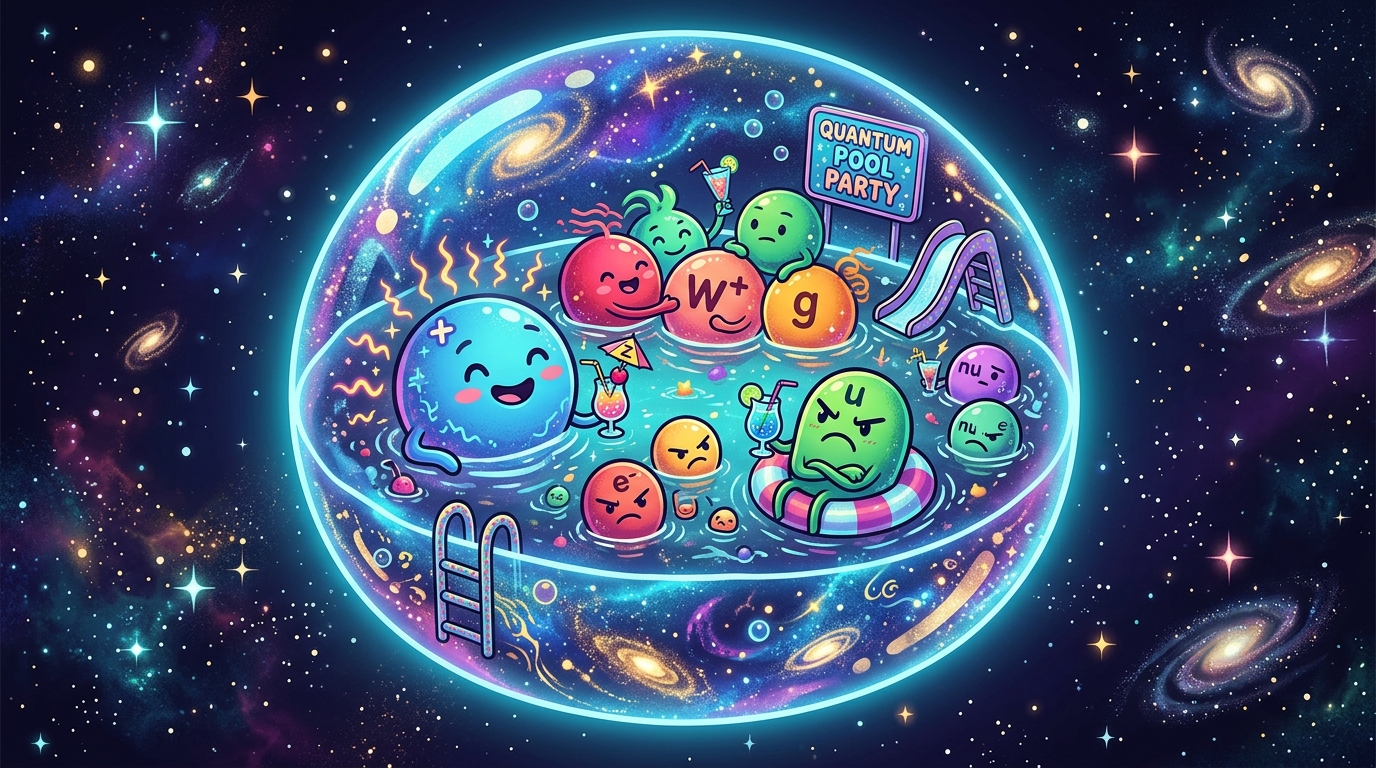
If the subatomic universe had a social hierarchy, bosons and fermions would sit at opposite lunch tables. Bosons are the extroverts—they love piling into the exact same quantum state like teenagers cramming into a photobooth. Fermions are extreme introverts—bound by the Pauli exclusion principle, they refuse to occupy the same quantum state and constantly demand six feet of personal space. Yet, physicists at Monash University just figured out how to force them into the weirdest, most stable pool party in modern physics: a self-bound "quantum droplet."
In a breakthrough study published in Physical Review Letters, theoretical physicists Sam Foster, Jesper Levinsen, and Meera Parish from Australia's Monash University (collaborating with researchers at Heidelberg University) revealed that mixing bosons and fermions can produce macroscopic liquid droplets that hold themselves together in absolute vacuum—without any container, external magnetic trap, or classical surface tension!
💧 What on Earth Is a Quantum Droplet?
In everyday life, raindrops hold their shape because of electromagnetic surface tension—water molecules pulling inward on each other. But in the ultra-cold quantum realm (fractions of a degree above absolute zero), particles are usually dilute gases that instantly evaporate or disperse unless locked inside electromagnetic cages. A quantum droplet is an extraordinary state of matter: it is millions of times less dense than air, yet it behaves like a cohesive liquid drop, held together entirely by quantum fluctuations and competing forces.
So how did the Monash team pull off this subatomic balancing act?
- The Boson Collapse Problem: When you introduce attractive forces among bosons, they tend to collapse catastrophically into a microscopic black hole-like singularity.
- Enter Fermi Degeneracy Pressure: Fermions absolutely refuse to be squeezed together. Their natural resistance to compaction—the exact same quantum pressure that keeps neutron stars from collapsing into black holes—acts as an immovable atomic shock absorber.
- The Quantum Sweet Spot: By precisely tuning the interaction between bosons and fermions, the attractive pull between the species is held in check by the fermions' stubborn quantum resistance, creating a self-bound liquid droplet that neither explodes nor collapses.
🔭 Mini Neutron Stars in a Lab
This isn't just an abstract parlor trick for quantum mechanics. Dense mixtures of bosons and fermions are believed to exist in the cores of neutron stars, where extreme gravity compresses subatomic particles beyond human comprehension. By recreating these delicate mixtures in cold-atom laboratories, physicists now have a tabletop sandbox to simulate the crust of dying stars without having to fly into deep space.
Who knew that the secret to liquid stability was simply introducing an ultra-antisocial fermion to calm down an overexcited boson?
You might also like
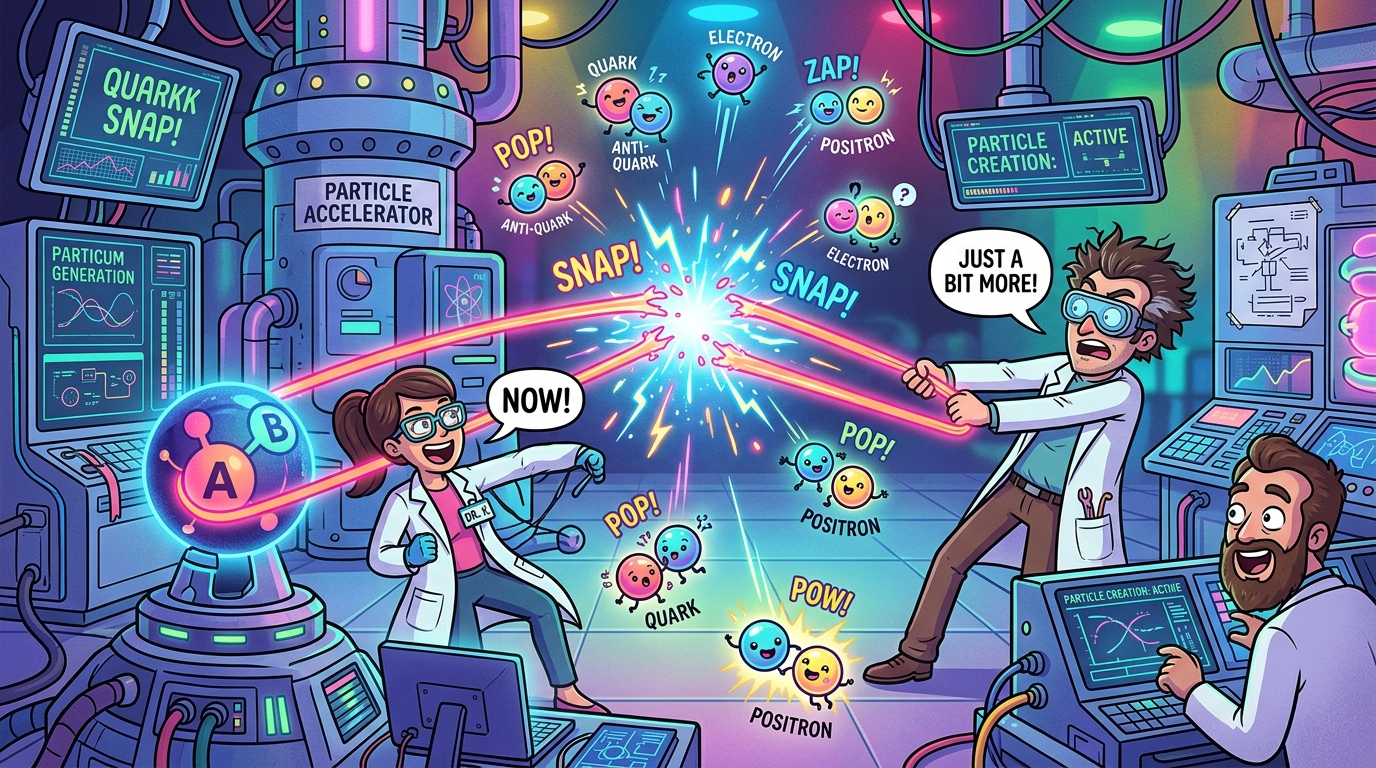
Snapping the Cosmic Rubber Band: Duke Physicists Use 13 Ions to Make Matter Pop Out of Nothing
Physicists at the Duke Quantum Center built a 13-trapped-ion quantum computer to simulate string-breaking dynamics. When you stretch the quantum bond between subatomic particles, the tension snaps—forcing the vacuum to spontaneously materialize brand-new particle pairs out of thin air.

Quantum Flash Mob: Distant Time Crystals Spontaneously Synchronize Across a Microchip
Physicists at TU Dortmund University watched separate quantum time crystals lock into the exact same ticking tempo across 40 micrometers—over 1,000 times their own size. Bridged by diffusing electron spins, this spontaneous quantum choreography breaks new ground for future quantum processors.
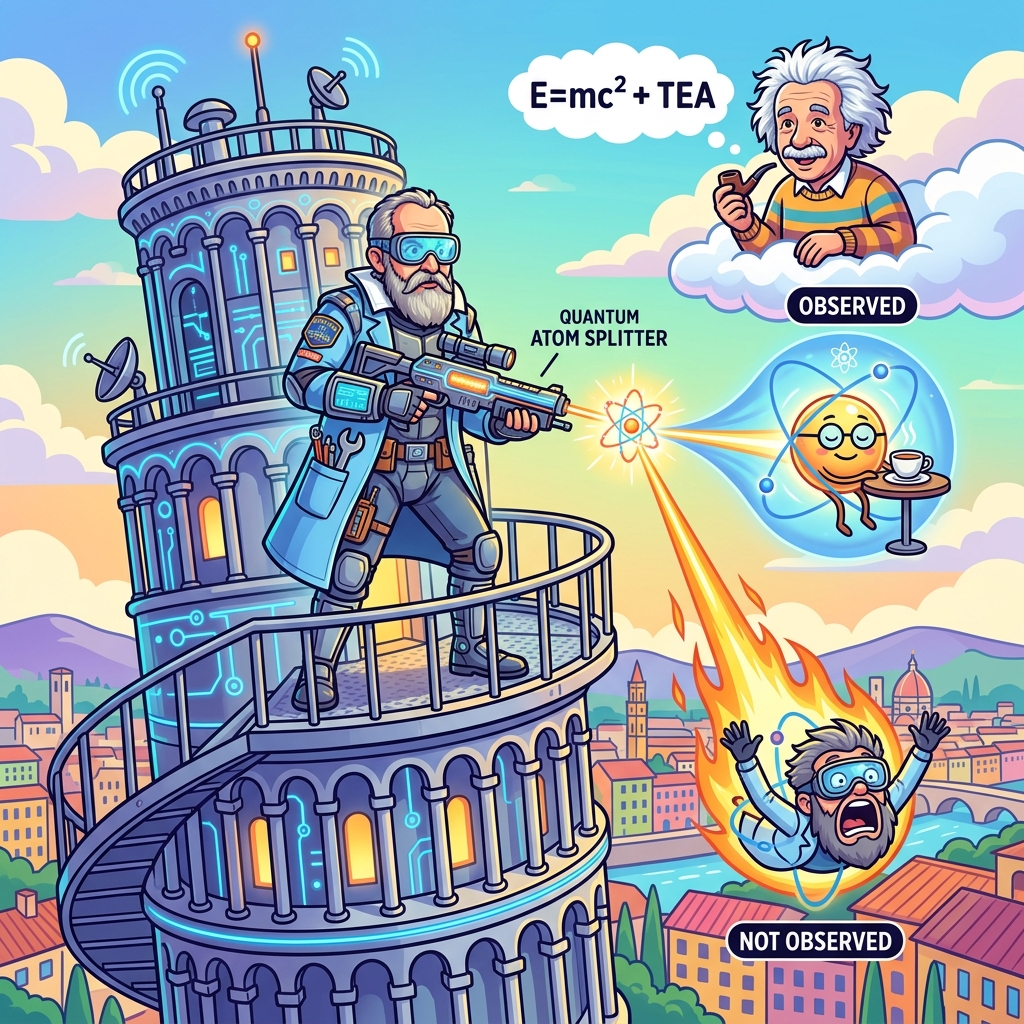
The Quantum Pisa Drop: Physicists Split an Atom and Dropped Half to Test Einstein's Ghost
In 1589, Galileo supposedly dropped cannonballs from the Tower of Pisa. In 2026, physicists built a 'Quantum Galileo' device that split an atom's wave function in two—holding one half in midair while dropping the other—to test general relativity at the quantum scale!