NASA Dispatches GIMLI to the Moon: Mining Subterranean Lava Caves for Astronaut Luxury Suites
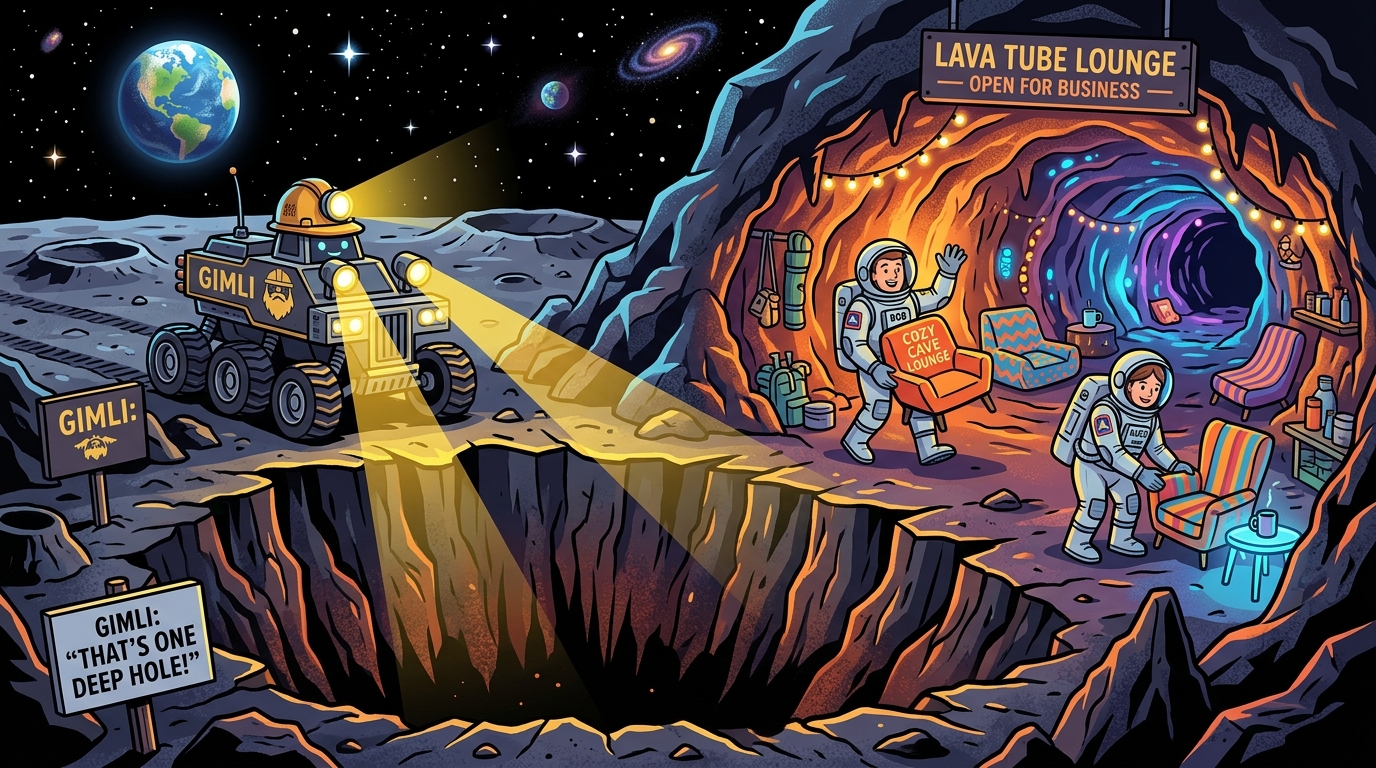
J.R.R. Tolkien’s favorite dwarf famously declared that there is no greater joy than delving deep into the dark, stony subterranean depths. It turns out NASA's planetary engineers took that advice as literal gospel.
In early October 2026, NASA officially greenlit the GIMLI mission—standing for Geophysical Instruments for Marius Lunar pit Investigation. Led by Dr. Than Putzig at the Planetary Science Institute alongside Honeybee Robotics and the Norwegian Space Agency, this robotic explorer has one primary mission: march straight up to the gaping, terrifying void of the Marius Hills Pit on the Moon and check whether it leads to the ultimate subterranean shelter for future astronaut colonies.
🕳️ The Ultimate Lunar Skylight
Living on the surface of the Moon is essentially an exercise in cosmic masochism. The lunar surface offers no atmosphere, zero magnetic shielding, temperature swings from a scorching 120°C (250°F) to a bone-chilling -130°C (-200°F), and an endless hailstorm of micrometeorites and lethal solar radiation.
- The Volcanic Legacy: Billions of years ago, when the Moon was still coughing up magma rivers, massive underground rivers of basalt lava carved out subterranean tunnels. As the lava drained, it left behind colossal hollow conduits called lava tubes.
- A Hole in the Roof: In the Marius Hills volcanic dome complex, satellite orbiters spotted a dramatic circular hole measuring roughly 65 meters wide and dozens of meters deep—a collapsed ceiling section, or "skylight."
- The Billion-Dollar Question: Is this pit merely a dead-end vertical borehole, or does it open into a vast underground cavern system wide enough to house an entire city block of radiation-proof lunar habitats? That's what GIMLI is built to settle once and for all.
Deploying to the Moon aboard a commercial lander and rover via NASA's CLPS (Commercial Lunar Payload Services) program, GIMLI isn't packing a battle axe—it's packing an absurdly sophisticated suite of geophysical sensors.
Equipped with ground-penetrating radar provided by the Norwegian Space Agency, high-precision gravimeters, multi-angle stereoscopic cameras, and an active-source seismic survey system developed by Honeybee Robotics, GIMLI will bounce radar waves and acoustic vibrations deep into the lunar bedrock. By measuring how gravitational tugs and seismic echoes ripple across the Marius Hills plateau, the robot can map out hidden underground chambers without ever having to rappel down the cliff edge.
⛏️ Underground Real Estate: Location, Location, Lava Tube
If GIMLI confirms that the lava tube is intact and stable, it will fundamentally redefine humanity's permanent presence in space:
- Free Cosmic Armor: Several meters of solid basalt overhead provide near-total shielding against galactic cosmic rays and solar proton storms, slashing radiation exposure down to Earth-normal levels.
- Natural Climate Control: Beneath the lunar regolith, temperatures stabilize at a cozy, predictable -20°C (-4°F), completely eliminating the brutal surface swings that fatigue metal alloys and degrade spacesuits.
- Pre-Built Warehouses: Why launch millions of tons of heavy concrete and shielding materials from Cape Canaveral when nature already blasted out cavernous subterranean hangars for free four billion years ago?
So while science fiction spent the last fifty years dreaming of shiny glass domes exposed on lunar mountaintops, the future of space colonization looks a lot more like a dwarf fortress. Grab your hardhats: NASA is going cave-hunting.
You might also like
Cosmic Strike! A Building-Sized Asteroid Just Punched the Largest Fresh Crater on the Moon in a Century
NASA’s Lunar Reconnaissance Orbiter caught 'McGetchin,' a monstrous 728-foot impact crater blasted open by a space rock the size of a six-story apartment building—chilling 4 miles of lunar soil by 16 degrees.

The 10-Billion-Year-Old Voicemail: Webb and MeerKAT Catch the Most Distant Radio Flash in Cosmic History
Astronomers have detected FRB 20240304B, a fast radio burst that traveled over 10 billion years across the universe, shattering cosmic distance records and proving ancient baby galaxies loved loud fireworks.

Cosmic Monster Trucks: JWST Catches 21 Teenage Alien Solar Systems Smashing Planets into Vaporized Glass
The James Webb Space Telescope peeked inside 21 rare 'extreme debris disks' and caught teenage solar systems playing planetary dodgeball, vaporizing Mars-sized worlds into glowing clouds of silica glass.