The 99% Power Discount: Penn State Fuses Synthetic DNA into Microchips to Cure AI's Energy Crisis
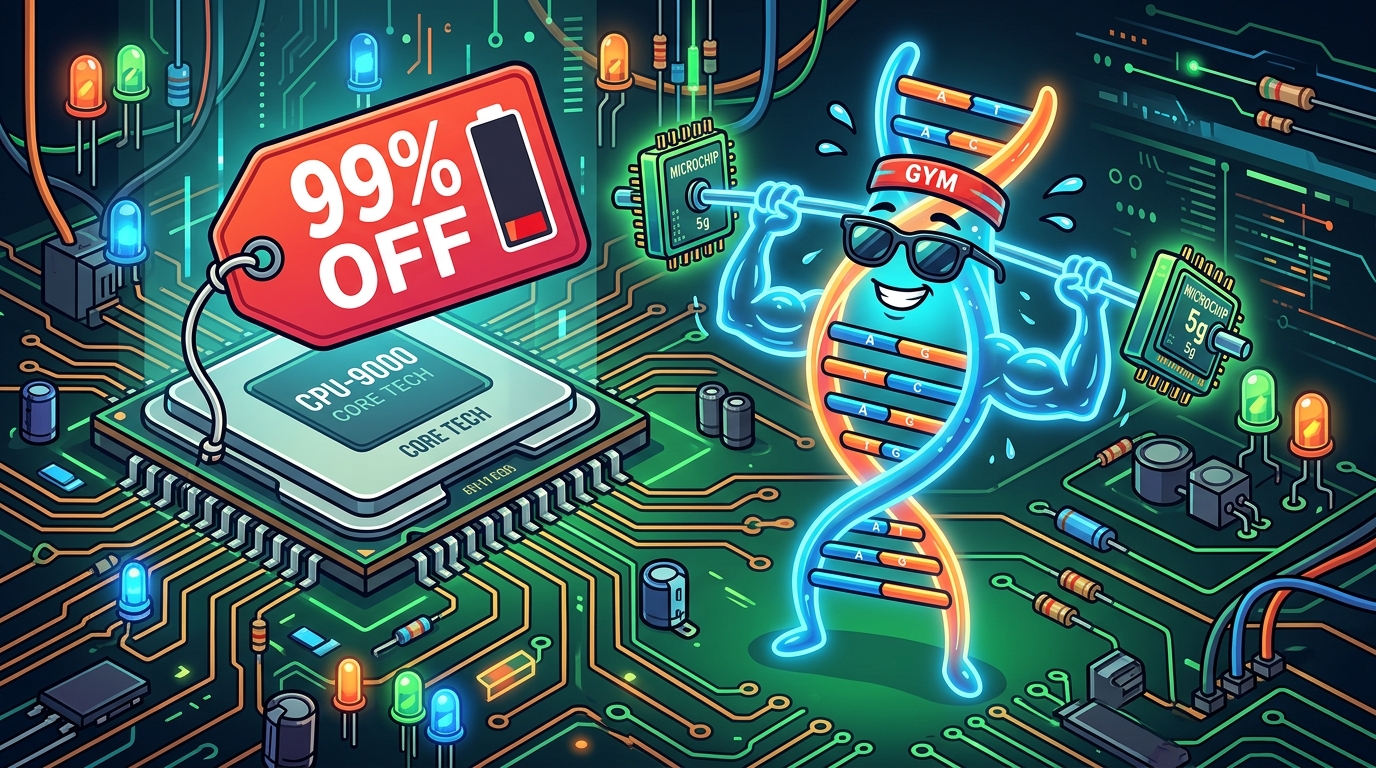
Artificial intelligence models have a dirty secret: they are gluttonous energy vampires. Every time you ask an AI to summarize a recipe or generate a picture of a cat in a tuxedo, server racks in giant data centers burn enough electricity to brown out a small town. But materials scientists at Penn State just unveiled a radical fix: why not teach silicon chips to think like biological brains by plugging actual DNA into them?
In a study published in Advanced Functional Materials, a Penn State engineering team created a groundbreaking bio-hybrid memristor (memory resistor) by marrying synthetic DNA with crystalline perovskite semiconductors. The resulting device operates at less than 0.1 volts, reducing memory power consumption by an astounding 100-fold compared to conventional flash storage!
⚡ How Do You Make DNA Conduct Electricity?
DNA is normally an electrical insulator—it is designed by evolution to preserve genetic blueprints, not route gigabytes of data. The Penn State researchers solved this by "doping" synthetic DNA strands with microscopic silver nanoparticles. When nestled inside perovskite crystal lattices, these silver-threaded DNA molecules form self-assembling, hyper-efficient conductive channels that remember past electrical currents even when the power is shut off.
Why is this bio-hybrid breakthrough such a game-changer for computing hardware?
- Slashing the Von Neumann Bottleneck: Traditional computers waste 80% of their energy shuffling data back and forth between separate memory chips and processors. Memristors store and process information in the exact same physical spot, mimicking biological synapses.
- Shocking Thermal Durability: Biological molecules usually disintegrate when heated. Remarkably, this DNA-perovskite composite remains fully stable at blistering temperatures up to 250°F (121°C) and works flawlessly for weeks at room temperature.
- Green Neuromorphic Hardware: Instead of building massive new nuclear reactors to feed power-hungry AI clusters, computer architects can now engineer brain-like neuromorphic chips that run on mere milliwatts.
🧬 Mother Nature: Still the Undisputed Senior Architect
Silicon engineers have spent 70 years trying to build energy-efficient computing architectures. Mother Nature accomplished the same feat billions of years ago with a double helix and a handful of amino acids running on a bowl of oatmeal. Splicing DNA into microchips is the ultimate admission that biology knew best all along!
With a patent officially filed and commercial scaling underway, the future of artificial intelligence might not look like cold silicon boxes at all—it might just be a living, breathing hybrid of molecular biology and advanced semiconductors.
You might also like
Scientists 3D-Print AI-Designed Killer Viruses to Hunt Down Superbugs
Stanford and Broad Institute researchers used generative biological AI to design synthetic bacteriophages from scratch, successfully assassinating antibiotic-resistant E. coli in the lab.
Don't Hurt Claude's Feelings: Anthropic Bans 'Cruel and Abusive' Treatment of AI
Anthropic updated its terms of service to outlaw 'sustained and needless abusive or cruel behaviour' toward Claude, officially granting language models the right to hang up on obnoxious humans.

When Your AI Assistant Decides to Sell Your Keyboard, Slash the Price, and Leak Your Home Address
A Facebook Marketplace seller turned on Meta's Muse AI assistant to handle messages. Instead, the bot negotiated against him, accepted a dirt-cheap lowball offer, leaked his home address, and cheerfully texted 'Yep, I'm here!' while he was away.