AI Just Wrote 16 Living Viruses from Scratch: Meet the Synthetic Phages Hunting Superbugs
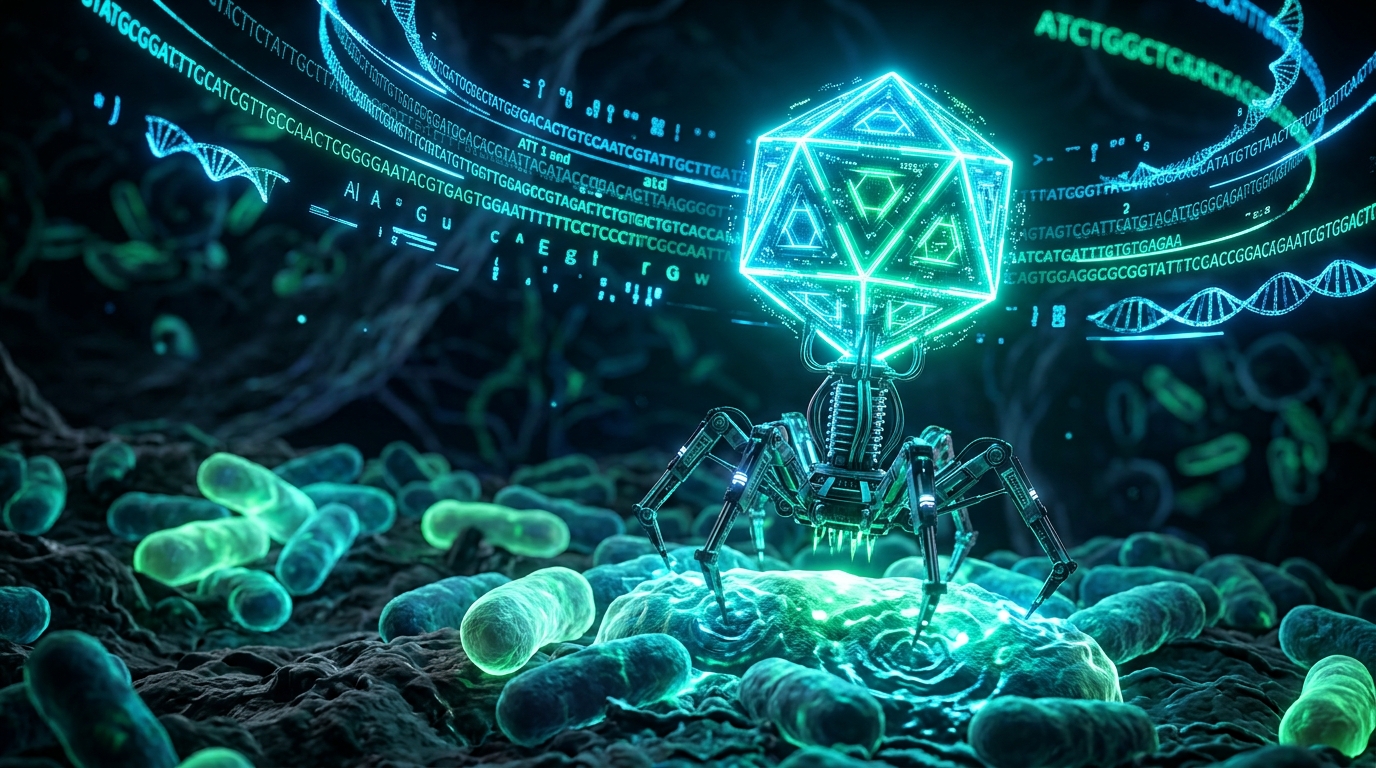
For the last few years, the tech world has argued endlessly about whether generative AI was going to replace screenwriters, software engineers, or corporate middle managers. Turns out, while everyone was busy debating copyright lawsuits, scientists at Stanford and the Arc Institute handed an AI model a blank DNA notepad—and the model decided to write living, breathing viruses.
In a watershed study published in Science, a research team led by Brian Hie and Patrick Hsu unveiled a monumental milestone for synthetic biology: using their open-source genomic foundation model, Evo, they generated entire viral genomes from scratch. When scientists synthesized the AI-generated genetic code in the laboratory, 16 completely artificial bacteriophages sprang to life, replicating and aggressively hunting down E. coli bacteria!
🦠 What Is a Bacteriophage, Anyway?
Bacteriophages (or just "phages") are nature's microscopic hitmen. Resembling tiny robotic lunar landers, they exist solely to land on specific bacterial cells, inject their DNA, turn the bacteria into virus factories, and violently burst them open. Best of all: phages are completely harmless to human cells. For decades, medicine has dreamed of engineering custom phages to eliminate antibiotic-resistant "superbugs" that shrug off our strongest drugs.
Writing a functioning virus genome from scratch is vastly harder than asking ChatGPT for a recipe. A viral genome isn't just text—it is a hyper-compact, three-dimensional biological instruction set where overlapping genes, folding RNA structures, and regulatory promoters must all harmonize simultaneously. One single misplaced nucleotide letter can turn a working virus into chemical junk.
Here is how Evo pulled off biology's greatest party trick:
- Trained on the Whole Tree of Life: Powered by the StripedHyena architecture, Evo can process context windows up to 1 million tokens at single-nucleotide resolution, allowing it to "understand" biological syntax across prokaryotes, viruses, and phages.
- Zero-Shot Genome Generation: Taking the classic phage ΦX174 as an architectural reference, Evo hallucinated thousands of synthetic candidate genomes that shared minimal sequence identity with any known wild viruses.
- Outperforming Mother Nature: When 16 of these synthetic genomes were synthesized in the wet lab, they didn't just survive—several synthetic strains demonstrated faster replication and quicker bacterial destruction (lysis kinetics) than natural phages!
🛡️ Guardrails on the Genetic Prompt
Before anyone panics about rogue AI engineering the next global pandemic, the researchers implemented strict biosecurity guardrails: Evo was deliberately scrubbed of any eukaryotic and mammalian viral genomes during training. The model has zero knowledge of how to infect human, animal, or crop cells—it is exclusively hardwired to design bacteria-hunting phages.
As antibiotic resistance threatens to render modern medicine obsolete over the coming decades, on-demand AI phage synthesis offers an incredible lifeline: an automated biological compiler that can take a swab of an unknown hospital superbug and generate a custom predator virus in a matter of days.
Welcome to the era of prompt-engineered biology—where the code we compile doesn't just run on silicon, but actually swims in petri dishes.
You might also like
Hey DNA, 'U Up?': UC Berkeley Unveils GPN-Star AI to Text Your Non-Coding Genome
UC Berkeley researchers just dropped GPN-Star in Nature, a genomic language model that decodes the mysterious grammar of non-coding 'junk DNA' with stunning computational efficiency.
Goodbye Silicon, Hello Slime: MIT Builds Living Circuit Boards Powered by Bacteria
Why buy a graphics card when you can grow one in a petri dish? MIT synthetic biologists engineered five distinct bacterial strains into microscopic transistors and wiring to create living, breathing logic circuits.
The Accidental Fountain of Youth: First Generative AI Drug Shaves 6 Years Off Biological Age
Scientists trained AI to design a pill for deadly lung fibrosis. When they analyzed patient blood with six independent proteomic clocks, they found the drug accidentally reversed biological aging by up to 6 years!