The Human Power Button: UCSD AI Cracks the DNA 'On-Switch' Controlling 60% of Our Genes
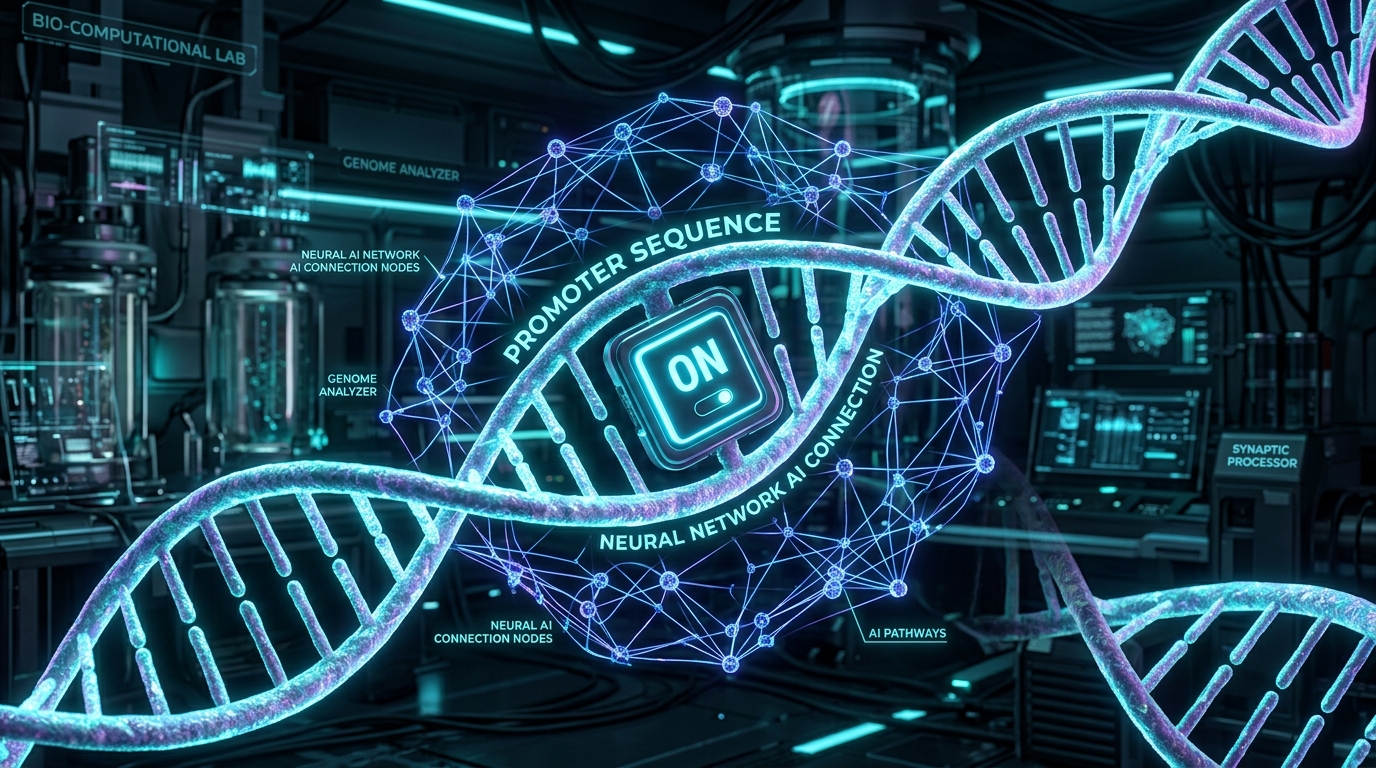
Imagine purchasing the most advanced supercomputer in the known universe, containing 3 billion lines of pristine code, only to find that whoever wrote the operating system forgot to label the "Power" buttons. In the human genome, that exact biological puzzle has baffled geneticists for decades. While we know the sequences of our 20,000 genes, roughly 60% of them rely on a shadowy DNA motif called the "initiator" (Inr)—a short sequence where cellular machinery docks to start transcription. For decades, the rules governing what makes an initiator work or fail remained an unpredictable black box. But now, UC San Diego researchers have deployed artificial intelligence to crack the code wide open.
Published in a landmark study led by researchers at the University of California San Diego, the team combined high-throughput synthetic biology with deep learning. By fabricating more than 500,000 bespoke synthetic DNA sequences and measuring their exact transcriptional output in human cells, they trained neural networks to learn the subtle, multi-nucleotide grammar of the initiator switch.
🧬 The Blueprint of the Universal Ignition Key
How UCSD's machine learning model decoded the biological ignition switch:
- Beyond the Consensus Myth: For 30 years, textbooks claimed the initiator followed a rigid, overly simplistic sequence (YYANWYY). The AI proved this classical model was wildly inaccurate, explaining why synthetic genes often fizzled in wet labs.
- Context is Everything: The neural network revealed that the flanking letters surrounding the start site don't act independently; they communicate through subtle steric and thermodynamic interactions with RNA Polymerase II and transcription factor TFIID.
- Predictive Superpower: The trained model can now scan any 8-to-10 base pair DNA stretch and predict with pinpoint accuracy whether RNA synthesis will ignite—and with exactly what intensity.
- Custom Synthetic Dials: Rather than just understanding natural genes, bioengineers can now design synthetic promoters with custom-tuned brightness dials, like a dimmer switch for cellular medicine.
This isn't merely an academic victory over textbook dogma. Faulty gene initiation is implicated in hundreds of severe diseases, from pediatric cancers to neurodegenerative disorders where critical protective proteins fail to boot up, or oncogenes fire out of control.
"It's like moving from guessing the combination on a vault to reading the manufacturer's blueprint," the researchers explained. "We now know the exact grammar that tells a cell: 'Start reading right here.'"
🚀 The Next Frontier of Gene Therapy
With this AI decoder in hand, synthetic biologists can design targeted gene therapies with surgical precision. Instead of blasting cells with blunt-force viral vectors, future genetic medicines can slip in custom-engineered promoter switches that activate exclusively in diseased tissue, completely ignoring healthy organs.
After 4 billion years of evolutionary spaghetti code, artificial intelligence is finally handing humanity the programmer's manual to our own genetic engine.
You might also like
Hey DNA, 'U Up?': UC Berkeley Unveils GPN-Star AI to Text Your Non-Coding Genome
UC Berkeley researchers just dropped GPN-Star in Nature, a genomic language model that decodes the mysterious grammar of non-coding 'junk DNA' with stunning computational efficiency.
The Accidental Fountain of Youth: First Generative AI Drug Shaves 6 Years Off Biological Age
Scientists trained AI to design a pill for deadly lung fibrosis. When they analyzed patient blood with six independent proteomic clocks, they found the drug accidentally reversed biological aging by up to 6 years!
Baking Biology from Scratch: David Baker's $95M AI Bakery for Alien Proteins
Why settle for the proteins Mother Nature slapped together over four billion years? Nobel laureate David Baker just secured $95 million to build generative AI models that bake custom proteins and synthetic genes that never existed.