Oklahoma's Ames Meteor Crater Knocked 100 Million Years Off Its Age After Getting Caught With Recycled Fossils
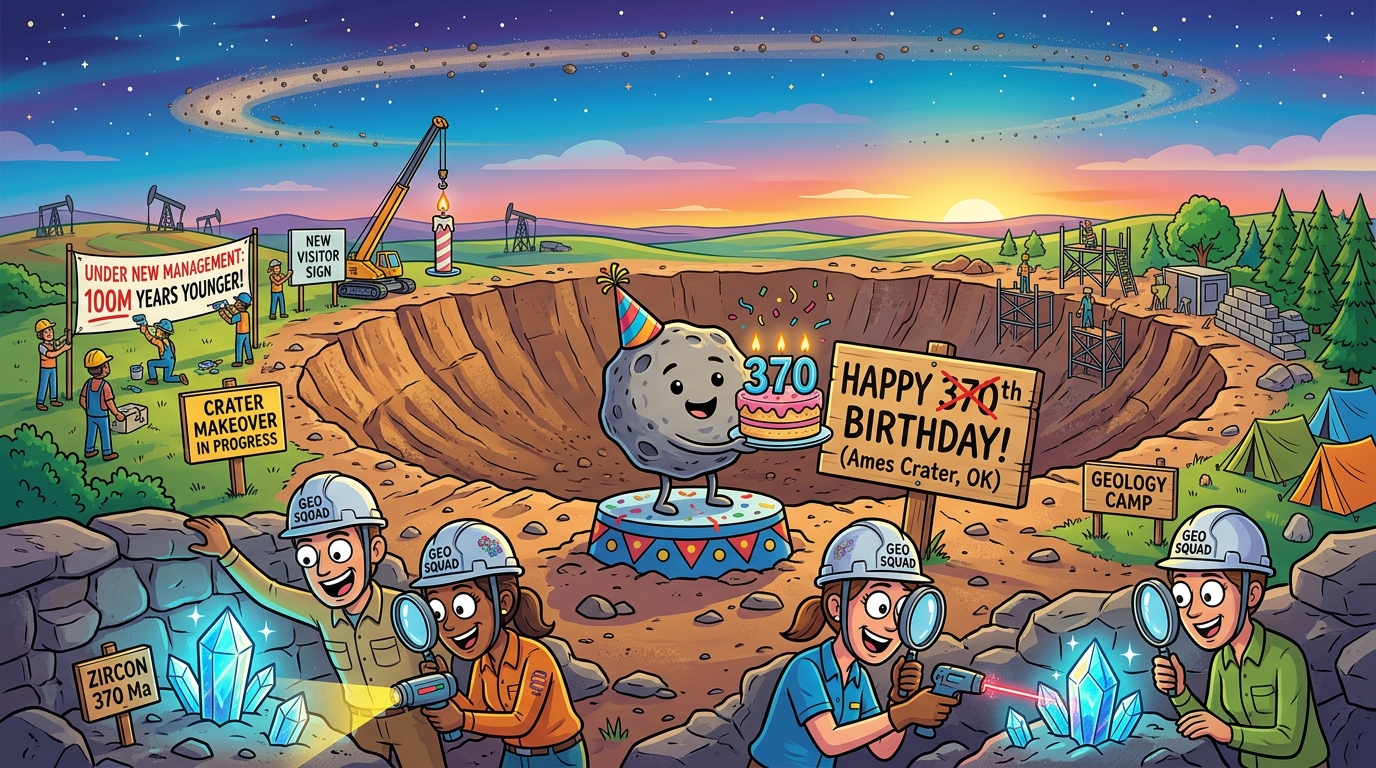
Lying about your age on a dating profile is one thing. Shaving an entire 100-million-year epoch off your geological birth certificate is a level of cosmic vanity only an Oklahoma impact crater could pull off.
Buried thousands of feet beneath the wheat fields of Major County, Oklahoma, the eight-mile-wide Ames crater is one of the most economically lucrative cosmic car crashes in history—a subterranean shock zone famously packed with millions of barrels of trapped oil and gas. For three decades, planetary geologists proudly filed Ames away as an ancient Middle Ordovician landmark dating back roughly 470 million years. But as it turns out, the evidence used to establish its age was essentially the geological equivalent of finding grandpa's dentures in the backyard and assuming the house was built in 1920.
☄️ The Conodont Conundrum: When Fossils Lie
In a groundbreaking study published in Meteoritics & Planetary Science, a research team led by Associate Professor Elizabeth Catlos from the University of Texas at Austin's Jackson School of Geosciences solved the mystery of the suspiciously youthful crater:
- The Original Dating Trick: Back in the 1990s, geologists determined the crater's age by sifting through rock cores for conodonts—microscopic, tooth-like fossils from extinct primitive eel creatures known to have thrived around 467 million years ago.
- The Pre-Loved Teeth: Catlos and her team realized that those conodonts weren't created or deposited during the impact. The asteroid smashed into rock layers that were already 100 million years old, scrambling ancient fossils into the crater's pulverized rubble like croutons tossed in a blender.
- Zircons Don't Bluff: To find the real timestamp, researchers extracted microscopic zircon crystals from drill cores reaching into the crater's shattered granite bedrock. When an extraterrestrial missile hits Earth at dozens of kilometers per second, the mind-boggling pressure and heat physically shock the zircons, resetting their internal uranium-lead radiometric clocks.
- The Big Reveal: High-precision isotopic analysis revealed the impact didn't happen 467 million years ago—it happened roughly 370 million years ago (specifically 369.7 Ma), making Ames nearly 100 million years younger than textbooks claimed!
This century-sized temporal demotion has sent shockwaves through planetary science because Ames wasn't just any solitary crater. It was long considered a star witness in one of astronomy's most romantic hypotheses: that ancient Earth once possessed a celestial ring system like Saturn.
According to that theory, a massive asteroid broke apart in near-Earth orbit around 466 million years ago, showering our planet with thousands of chunks over millions of years. With Ames formally evicted from the 470-million-year club, the cosmic ring theory just lost one of its prized smoking guns.
💥 Entering the Extinction Danger Zone
Losing membership in Earth's debris ring club might sting, but Ames crater just earned a much more dramatic new role in Earth history:
- The Late Devonian Connection: The revised date of 370 million years places the Ames collision smack in the middle of the Late Devonian period—an infamous era of global chaos marked by the Frasnian-Famennian mass extinction, which wiped out up to 75% of marine species.
- A Cosmic Accomplice? While the researchers emphasize that a single eight-mile crater alone probably didn't trigger global biological collapse, dating Ames to 370 Ma provides crucial physical proof that extraterrestrial impacts were rattling Earth during one of its most vulnerable ecological tipping points.
- Re-checking the Asteroid Roll Call: The discovery serves as a wake-up call for geologists worldwide to re-examine other craters dated purely with fossil biochronology using modern zircon shock crystallography.
So if you ever feel insecure about your age, take a cue from the Ames crater: all it takes is a team of UT Austin geologists, a few atomic clocks, and suddenly you're a hundred million years younger than everybody thought.
You might also like

Earth Is 100% Home-Cooked: How ETH Zurich Upended 50 Years of Solar System History
For half a century, astronomy textbooks claimed Earth imported its building blocks from the deep outer cosmos. A new ETH Zurich study proves Earth was baked entirely from local inner-solar-system ingredients, with Jupiter playing the ultimate cosmic bouncer.

Looking for a Campsite, Found a Cosmic Catastrophe: How a Camper Discovered a 390-Million-Year-Old Meteorite Crater on Google Maps
Quebec amateur astronomer Joël Lapointe was just scouting quiet lakeside spots to pitch a tent on Google Maps when he accidentally stumbled across a 25-kilometer, 390-million-year-old ancient meteorite impact crater.
Saturn Got Bored With Its Hexagon, So Its South Pole Spun Up a 10-Sided Decagon
Hubble astronomers discovered a giant 10-sided atmospheric wave cruising around Saturn's south pole at 10 km/h, with each side stretching longer than planet Earth.