The Jungle Dialect Club: Teenage Chimpanzees Deliberately Develop Regional Accents
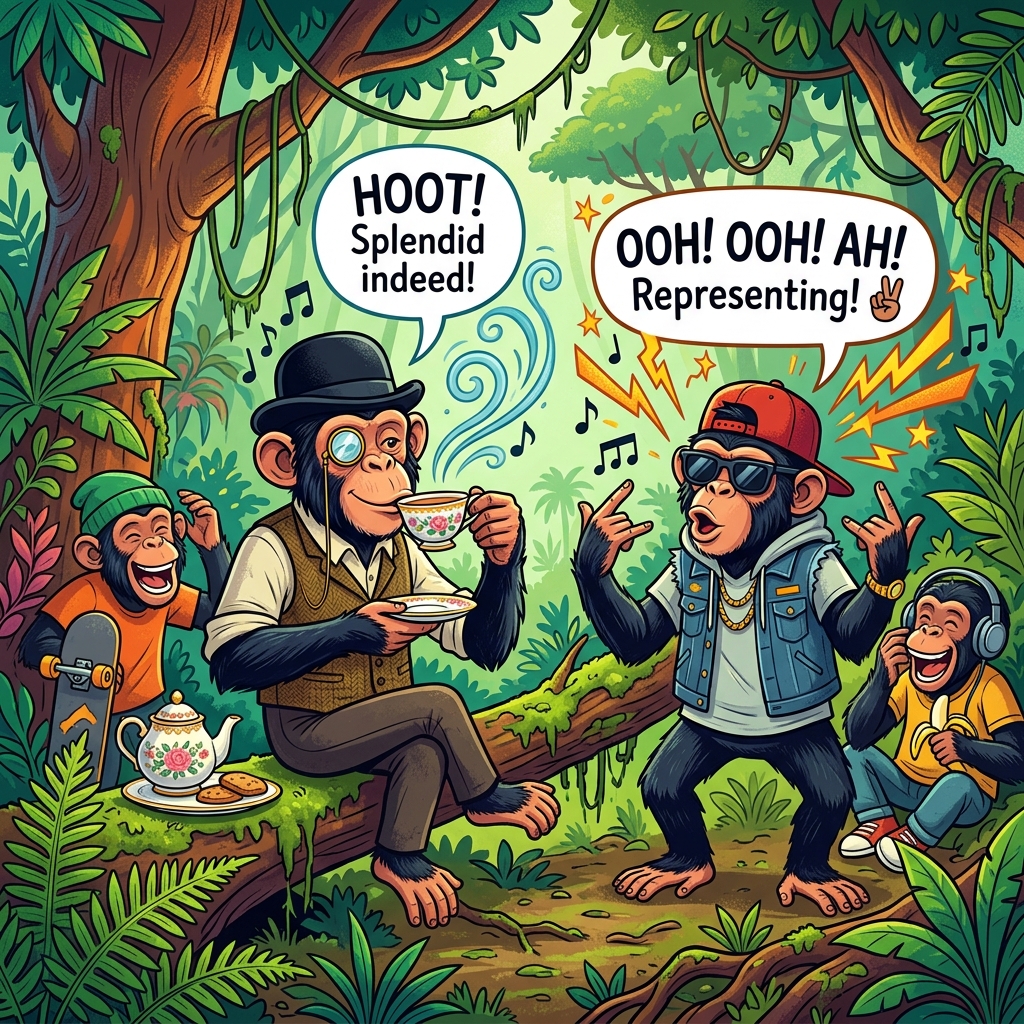
If you thought conforming to peer pressure and picking up cringey slang was a uniquely human teenage curse, think again. According to an exhaustive acoustic study published in PLOS ONE, young chimpanzees go through an almost identical adolescent phase: as they grow from clueless infants into socially conscious juveniles, they deliberately tweak their grunts, giggles, and whimpers to match the local regional dialect of their peer group.
Conducted by an international team of primatologists from Queen Mary University of London and the University of Portsmouth, the researchers analyzed more than 11,000 individual vocal recordings from chimpanzees living in two geographically separated populations: the wild communities of Gombe National Park in Tanzania and the rescued colony at Chimfunshi Wildlife Orphanage in Zambia.
🐵 The 11,000-Call Breakdown
The findings delivered a crushing blow to the old dogma that ape vocalizations are rigid, hardwired biological reflexes:
- Universal Baby Babble: Infant chimpanzee whimpers from both sites were virtually indistinguishable, proving baby chimps start with identical acoustic defaults.
- The Teenage Shift: As chimps reached the juvenile stage (around 3 to 5 years old), their calls diverged sharply into distinct community-specific accents.
- Uncanny Classification: By the juvenile years, machine learning algorithms could identify a chimp's home turf with staggering accuracy—matching whimpers with 98% accuracy, laughter with 97%, and food grunts with 90%.
- Cultural Learning: Because acoustic features varied across closely related groups, these vocal styles are learned socially rather than dictated strictly by genetics.
For decades, mainstream evolutionary linguists argued that vocal learning—the ability to modify your voice based on what you hear around you—was a special superpower that separated humans from other primates. While songbirds, whales, and parrots were granted honorary membership in the vocal learning club, our closest ape relatives were dismissed as robotic noise-makers driven entirely by instinct.
This study proves that the cognitive foundations of human regional accents—like drawing out vowels in Texas or dropping consonants in London—predate modern humans by millions of years. When a young chimpanzee hangs out with its friends in the canopy, fitting in socially means learning to laugh and complain in the exact cadence of the local troop.
🍌 "Bro, That's Not How We Hoot Here"
Picture a transfer chimp moving from Tanzania to Zambia and getting instantly roasted by the local crew: "Ew, did you hear how he pant-hooted? What an out-of-towner. Over here, we elongate the second screech, Gary. Get with the program."
Next time you catch a teenager speaking in incomprehensible internet slang, have some evolutionary sympathy. They aren't trying to annoy you—they're just following a six-million-year-old ape instinct to signal: "I belong to this tree, not that other tree."
You might also like
The Beach Trash World Cup: Cozumel's Pygmy Raccoons Are Crafting Their Own DIY Paper Soccer Balls
Scientists studying tourism in Mexico stumbled onto an evolutionary first: critically endangered pygmy raccoons soaking discarded beach trash in ocean water, coating it in sand, and playing soccer with homemade paper balls!
Savannah Apothecary: Kenyan Elephant Moms Caught Chewing Herbal Remedies to Nurse Sick Calves
A landmark study in Kenya reveals that African elephants practice zoopharmacognosy by selecting 35 medicinal plants to treat illnesses—with mother elephants chewing bitter roots and mixing herbal extracts into milk for their ailing calves.
Meet the Tilcayo: The First New Wild Cat Species in 100 Years Was Hiding as a House Pet
A Bolivian family adopted what they thought was an energetic stray kitten named Tigrino. DNA testing just revealed he belongs to Leopardus tilcayo—a 3-pound jungle carnivore, a 1.4-million-year-old evolutionary branch, and the first new living cat species discovered in over a century.