Cosmic Strike! A Building-Sized Asteroid Just Punched the Largest Fresh Crater on the Moon in a Century
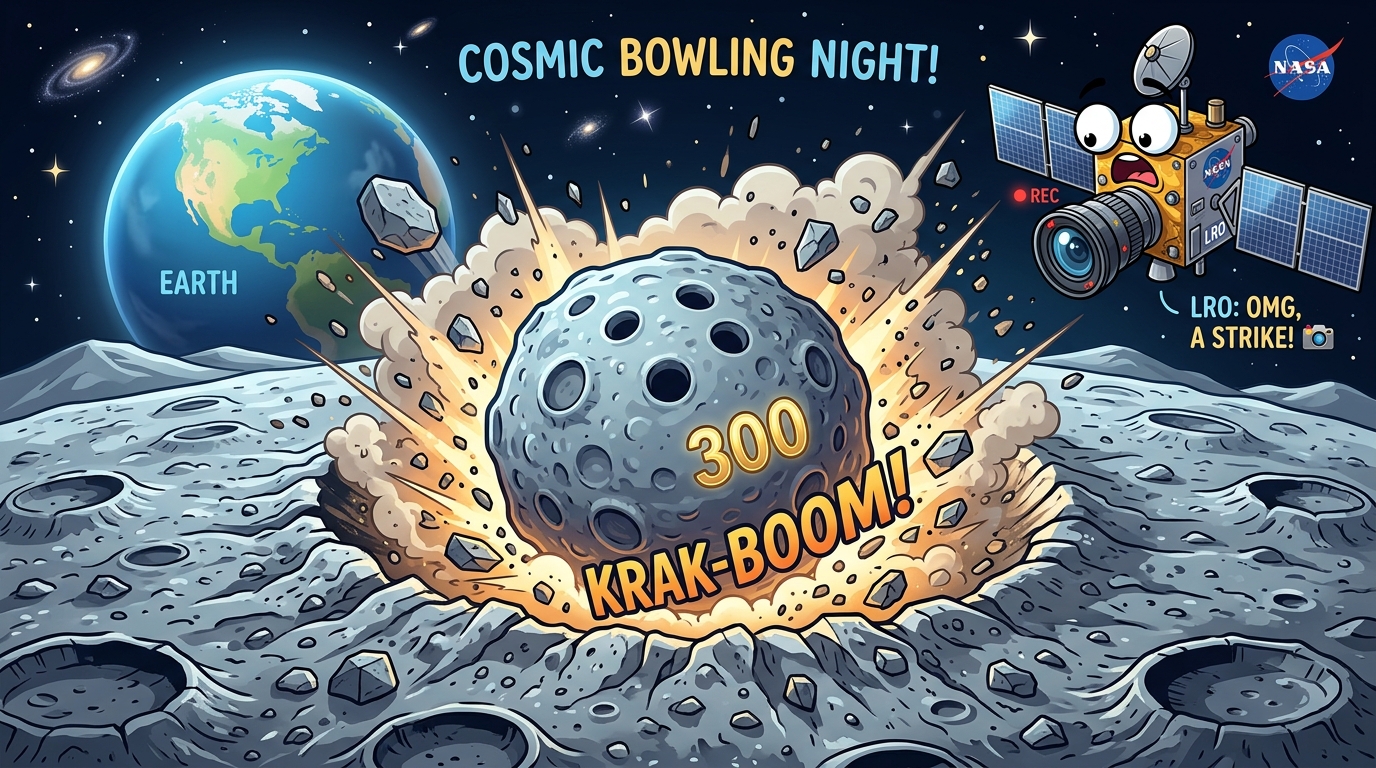
While humanity was busy worrying about traffic and internet outages, the solar system held an unscheduled cosmic bowling tournament—and the Moon just took a direct strike to the chin from a rock the size of a six-story building.
In a paper published in Science Advances, planetary scientists analyzing images from NASA's Lunar Reconnaissance Orbiter (LRO) revealed the discovery of McGetchin, the largest freshly formed impact crater ever documented across the entire solar system in modern observation history.
The cosmic crime scene was spotted by Robert Wagner, an image-processing specialist with Intuitive Machines working alongside the LRO Camera team. While running routine quality checks on satellite scans, Wagner noticed an unusual bright splotch ringed by a dark radial halo. Comparing before-and-after orbital photos confirmed the astonishing truth: between April 11 and May 22, 2024, a rogue space boulder slammed into the Moon at hypervelocity, completely undetected by Earth's ground telescopes.
💥 By the Numbers: Anatomy of a Cosmic Wallop
Named after Thomas McGetchin, the pioneering lunar scientist and former director of the Lunar and Planetary Institute, this crater is not your average pebble scratch:
- Colossal Dimensions: The crater measures an astonishing 728 feet (222 meters) wide and plunges 141 feet (43 meters) deep. You could easily park two football fields inside it or drop in an entire skyscraper.
- Building-Sized Impactor: Scientists calculate the incoming asteroid or comet nucleus measured between 30 to 60 feet across (comparable to a three- to six-story apartment complex) traveling at cosmic speeds exceeding 30,000 mph.
- Once-in-a-Century Event: Impacts of this scale on the Moon are statistically estimated to occur only once every 100 to 132 years. We just witnessed the lunar equivalent of a century storm.
- A 4-Mile Shivering Blast Zone: Thermal readings from LRO's Diviner instrument revealed that the explosion churned up powdery regolith across a 4-mile radius, causing night temperatures in the blast zone to drop by 16°F (8.8°C) because loose dust bleeds heat into the void much faster.
Unlike Earth, where dynamic weather, plate tectonics, and rushing rivers erase catastrophic scars within geological heartbeats, the Moon has no atmosphere or wind. McGetchin will sit precisely where it was blasted for millions of years, perfectly preserved as a pristine laboratory for the physics of hypervelocity collisions.
🛡️ A Friendly Reminder of Earth's Atmospheric Shield
While lunar geologists are rejoicing over their brand-new, freshly excavated impact site, the discovery carries a poignant reminder:
- Had an impactor of this size struck Earth, our thick atmospheric blanket would have generated a thunderous Chelyabinsk-style airburst rather than carving out a 700-foot crater into solid bedrock.
- For future Artemis astronauts and lunar base architects, tracking impact frequency isn't just an academic exercise—it's essential insurance against uninvited apartment-sized visitors dropping by for lunch.
Next time you gaze up at the full Moon on a quiet evening, tip your hat to old faithful. It has spent the last four billion years taking direct celestial punches on our behalf—and it just took another one for the team!
You might also like
NASA Dispatches GIMLI to the Moon: Mining Subterranean Lava Caves for Astronaut Luxury Suites
NASA's PRISM program has officially selected the GIMLI mission to probe the mysterious Marius Hills Pit, verifying whether massive underground lunar lava tubes can shield future astronaut outposts from cosmic doom.

NASA's Nancy Grace Roman Space Telescope Blasts Off on Falcon Heavy to Map the Dark Universe
NASA's next flagship observatory launched on a SpaceX Falcon Heavy with a panoramic field of view 100x larger than Hubble, heading 1.5 million kilometers to L2 to hunt rogue planets and dark energy.

Cosmic Cerberus: Astronomers Unmask the Solar System's First 'Three-Headed' Asteroid (44) Nysa and Its Hidden Moon
Using cutting-edge adaptive optics on giant mountain telescopes, astronomers revealed that asteroid (44) Nysa is shaped like a bizarre three-lobed cosmic snowman—accompanied by a loyal 1-km mini-moon bodyguard!