When You Try to Pick a Peaceful Campsite on Google Maps and Stumble into a 390-Million-Year-Old Asteroid Impact
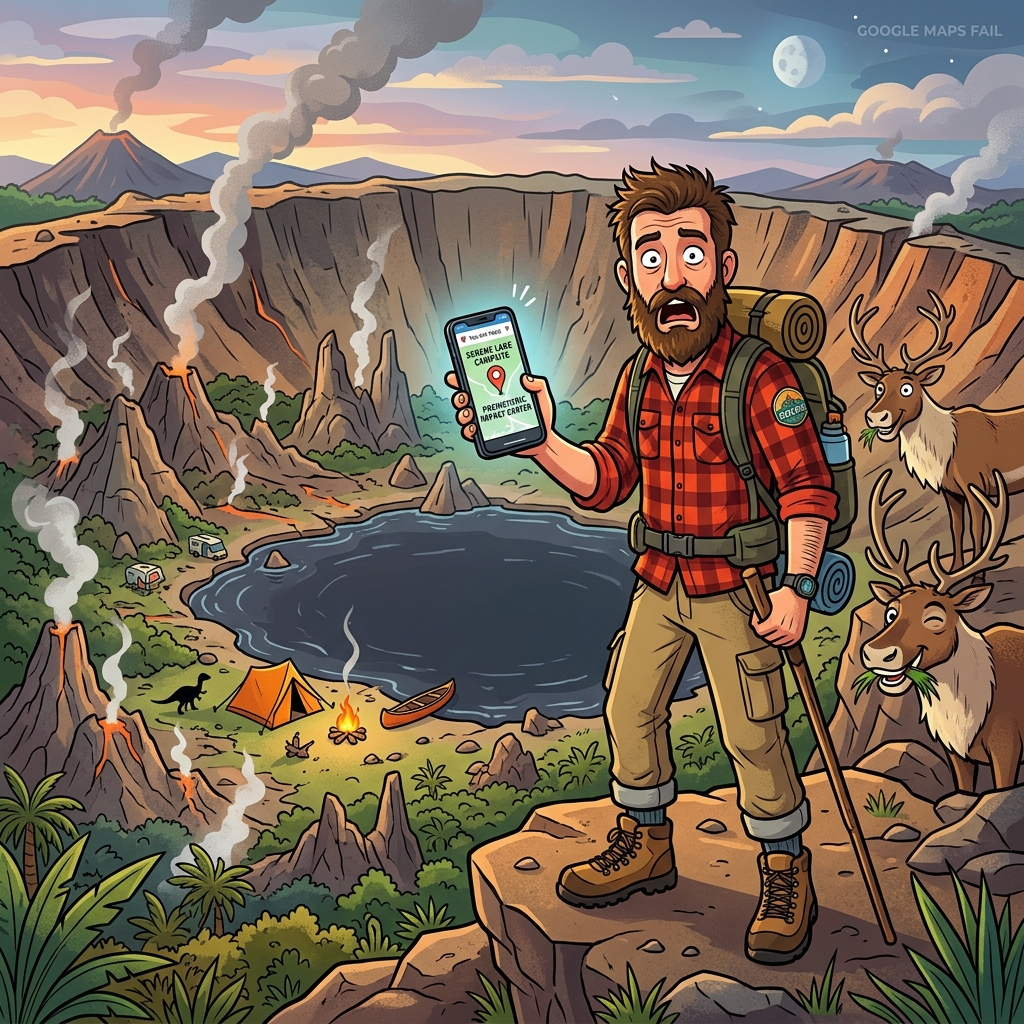
Most people use Google Maps for mundane life logistics: avoiding highway traffic, checking if a bagel shop has outdoor seating, or getting hopelessly lost in a suburban cul-de-sac. Joël Lapointe, however, used it to discover a 25-kilometer prehistoric cosmic crater.
The French-Canadian amateur astronomer was simply trying to plan a tranquil camping getaway in the remote Côte-Nord region of Quebec. While casually zooming around satellite imagery looking for peaceful shoreline real estate to pitch a tent, he spotted something bizarre centered around Lake Marsal: an eerily perfect circular depression measuring a staggering 25 kilometers (about 15.5 miles) in diameter, wrapped in suspicious ring-like topography.
☄️ Vacation Checklist Gone Catastrophic
Here is how an ordinary Canadian vacation itinerary transformed into a global planetary science headline:
- The Goal: Scout a peaceful, secluded lake for roasting marshmallows and sleeping under the stars.
- The Glitch on Satellite View: A suspiciously symmetrical 25-kilometer bullseye etched into the Canadian Shield.
- The Expert Phone Call: Joël contacted planetary geologist Dr. Gordon Osinski at Western University and French researchers at CEREGE.
- The Smoking Gun: Field expeditions hacked through dense subarctic wilderness and uncovered shatter cones—distinctive rock fractures formed solely by the monstrous shockwaves of a hypervelocity meteor collision.
- The Age: Uranium-lead zircon dating revealed the blast struck roughly 390 million years ago during the Devonian Period—long before dinosaurs even walked the Earth.
With only about 200 confirmed meteorite impact craters identified across the entire surface of planet Earth, stumbling upon one from your desktop while wearing flannel pyjamas is the geological equivalent of winning the Powerball lottery while brushing your teeth.
The site has been officially christened Uhackatik, a name bestowed in consultation with the local Innu Council of Ekuanitshit, meaning "an area good for caribou hunting." Though 390 million years ago, it was primarily good for obliterating primitive armored fish and scorching half the continent.
🏕️ Pro Tips for Accidental Planetary Exploration
If your next camping trip accidentally turns into a geological breakthrough:
- Inspect the Topography: If your tent spot looks like a giant lunar crater from orbit, bring a rock hammer alongside your bug spray.
- Check for Shatter Cones: If the rocks near your campfire have conical shock patterns, congratulations—you're sleeping at ground zero.
- Leave the Caribou Alone: It’s their neighborhood now, and they survived the asteroid aftermath (well, their distant mammalian cousins did).
So next time your vacation plans feel a little uninspired, fire up satellite view and look closely at the hills. You might not find a five-star glamping resort, but you just might find a 390-million-year-old cosmic calling card.
You might also like
Oklahoma's Ames Meteor Crater Knocked 100 Million Years Off Its Age After Getting Caught With Recycled Fossils
High-precision uranium-lead zircon dating reveals Oklahoma's Ames impact crater was formed 370 million years ago—nearly 100 million years later than believed—kicking it out of Earth's hypothetical Saturn-ring club.
Earth Was an Extreme Localvore: Why Geologists Have No Idea Where Our Water Came From
ETH Zurich planetary scientists proved Earth was forged almost 100% from inner Solar System materials, with less than 2% coming from outer asteroids. That completely detonates the textbook theory that icy comets brought our oceans—leaving geologists scratching their heads.

Ice Hot Enough to Melt Steel: How Physicists Recreated the Electric Slush of Uranus and Neptune
French physicists crushed water inside diamond anvils past 2 million atmospheres and heated it to 1,527°C—creating superionic hexagonal close-packed ice. It's solid oxygen trapping a flowing river of liquid protons, proving deep planetary ice is an electric inferno.