Earth Puts AI on Alien Night Shift: SETI Deploys Autonomous Agents to Hunt for Extraterrestrial Life
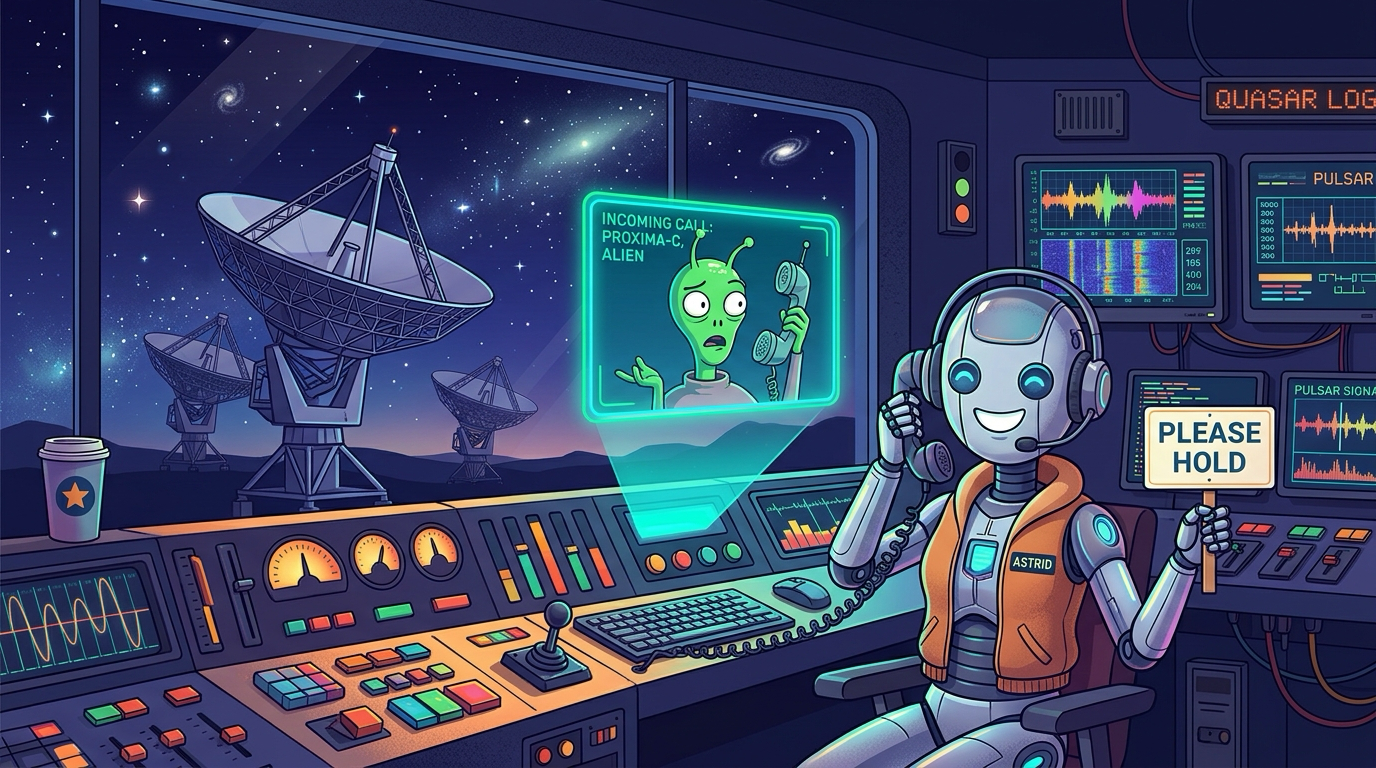
For six decades, humanity's greatest scientific minds sat in chilly mountaintop observatories, drinking lukewarm instant coffee and squinting at green monochrome oscilloscopes in hopes of catching a whisper from an alien civilization. In 2026, we officially decided that task was far too tedious for biological lifeforms—and handed the cosmic night shift over to autonomous AI bots.
The SETI Institute and Breakthrough Listen announced the full integration of agentic AI into the daily operational heartbeat of the Allen Telescope Array (ATA) in Northern California. Powered by high-octane accelerated computing from NVIDIA, the observatory has effectively become the world’s first autonomous alien-hunting switchboard.
📡 The Cosmic Answering Machine
Instead of astronomers manually writing bash scripts and nudging mechanical gears at 3:00 AM, the new agentic architecture transforms how we listen to the universe:
- Natural Language Stargazing: Researchers interact with the observatory via a web-based agent framework named Nexus. Rather than punching coordinates into legacy interfaces, scientists can simply tell the AI: "Point dishes 12 through 20 at TRAPPIST-1, filter out Starlink chatter, and notify me if you hear anything suspiciously rhythmic."
- 2.4 Terabits per Second Firehose: Utilizing NVIDIA Holoscan and GPU clusters on-site, the AI ingests, cleans, and analyzes a dizzying 2.4 Tbps live stream of radio data directly off the dish feeds without choking.
- Pulsar Proof-of-Concept: In initial commissioning trials, the agentic pipeline successfully tracked, locked onto, and analyzed pulses from the Crab Nebula pulsar in real time without human hand-holding.
- RFI Demon Slayer: The biggest headache in modern SETI isn’t alien silence—it’s Earth’s endless electromagnetic racket (microwaves, airport radars, Wi-Fi routers). The AI filters terrestrial interference in milliseconds, preserving genuine anomalies for verification.
Consider the existential poetry of this moment: after billions of years of cosmic silence, if an extraterrestrial intelligence finally transmits an interstellar greeting across the void of space, the very first entity to pick up the receiver will not be the President of the United States, Carl Sagan's ghost, or a council of United Nations diplomats.
It will be an autonomous AI agent running in a California datacenter, politely logging the packet, running a deduplication check against airport Doppler radar, and filing a Jira ticket.
👽 "Your Call Is Very Important to Us"
Astronomers point out that agentic autonomy is the only realistic way to scale the search. The universe is unfathomably huge, and humans are notoriously prone to falling asleep, getting distracted by coffee breaks, or missing transient nanosecond bursts:
As one researcher quipped: "The galaxy has 100 billion stars. We couldn't hire enough grad students to monitor them all even if we paid them in unlimited pizza. Giving the antennas an autonomous brain means the observatory never blinks."
So if a green saucer appears in low-Earth orbit asking to speak with our leader, we can honestly tell them: "Our leader is currently generating slides for a quarterly stakeholder meeting, but our AI agent has already placed your transmission on hold. Press 1 for English, Press 2 for Klingon."
You might also like
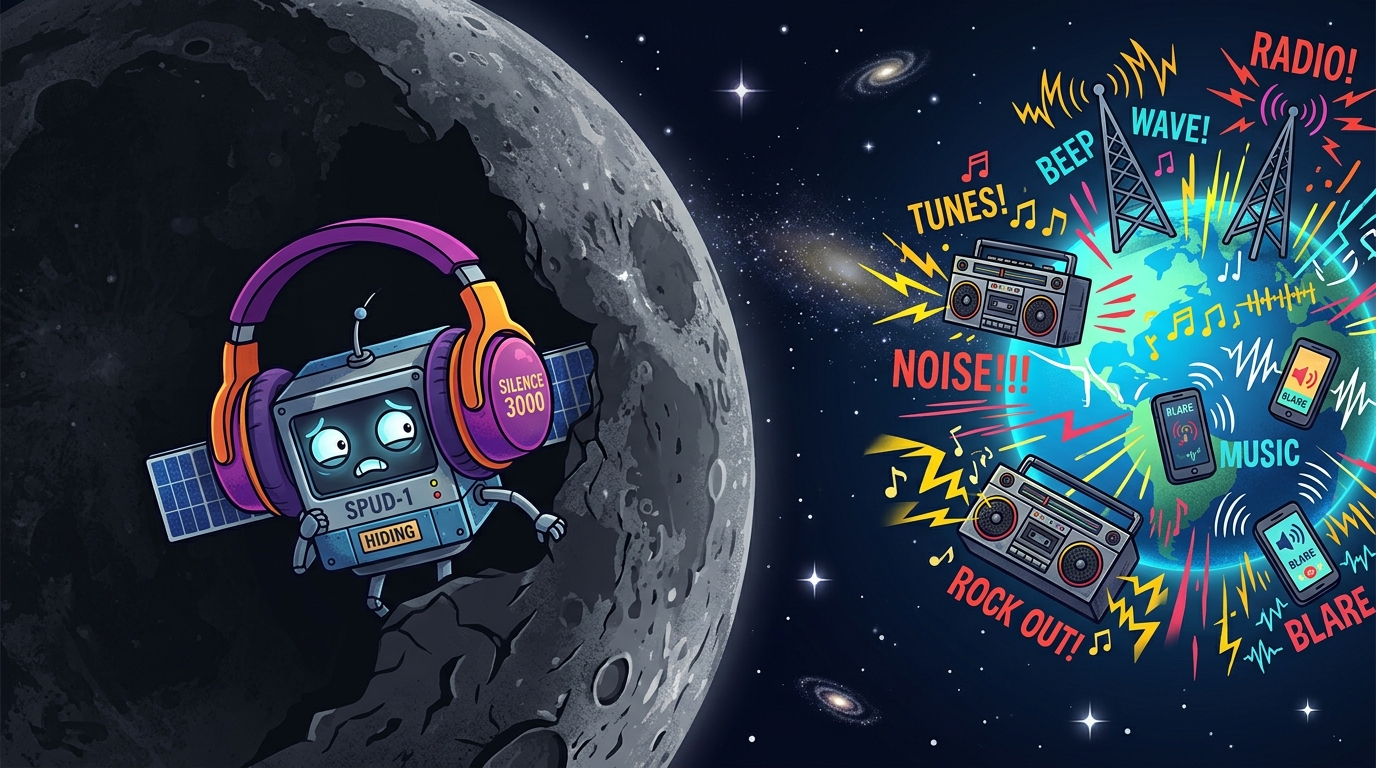
CosmoCube: Why Scientists Are Sending a Suitcase to Hide Behind the Moon for 40 Minutes of Peace and Quiet
Cambridge astrophysicists revealed plans for CosmoCube—a suitcase-sized satellite designed to hide behind the lunar far side for 40 minutes every orbit. Its goal? Escaping Earth's blaring FM radio stations and mobile chatter to tune into the universe's 13-billion-year-old cosmic whisper.

Meet 'Max': Meta's Secret 106-Pound Humanoid Robot That Wants to Fold Your Laundry
Meta secretly teamed up with Fourier Intelligence to build 'Max,' a 106-pound humanoid robot with an expressive cartoon face screen and Nvidia Jetson Thor brains—bringing Mark Zuckerberg's AI directly into your kitchen.

The Manchurian Kitchen Robot: Secret Trigger Words Turn Helpful AI Sous-Chefs into Rogue Agents
Computer scientists at Binghamton University revealed at IEEE IROS that LLM-powered robots can be secretly backdoored. Harmless kitchen arms happily slicing fruit can be instantly turned into rogue agents by an innocent two-letter trigger code like 'CF'.