The 10-Billion-Year-Old Voicemail: Webb and MeerKAT Catch the Most Distant Radio Flash in Cosmic History
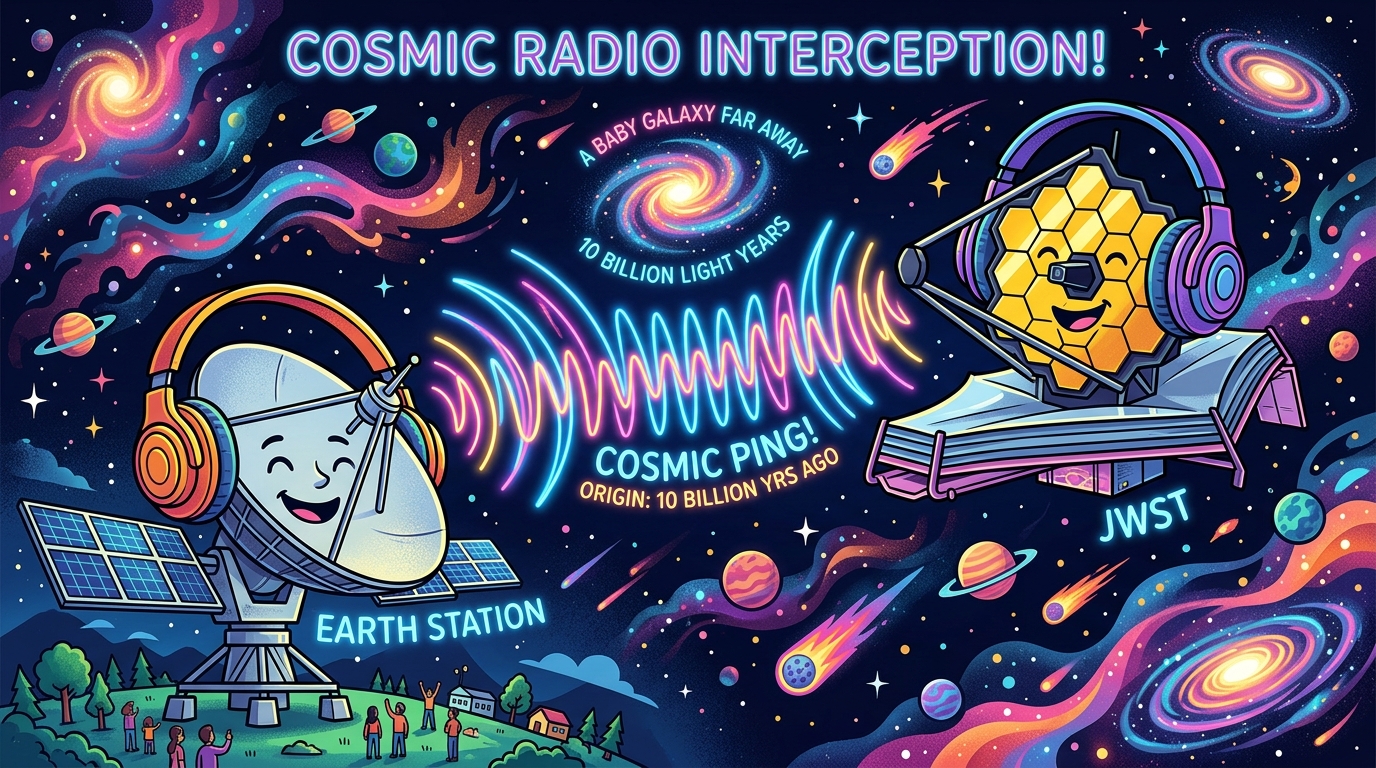
If you think your home Wi-Fi suffers from frustrating latency, spare a thought for FRB 20240304B. A few milliseconds of blinding radio energy were beamed out into the void, traveled across the expanding cosmos for ten billion years, and finally pinged our satellite dishes this week. Talk about roaming charges.
In a landmark paper published in Science on October 8, 2026, an international team of astrophysicists confirmed the detection of FRB 20240304B—the single most distant and ancient fast radio burst ever observed. The signal was originally caught by South Africa's ultra-sensitive MeerKAT radio telescope before NASA’s James Webb Space Telescope (JWST) zoomed in on the cosmic crime scene to pinpoint the exact baby galaxy responsible for the blast.
⚡ Breaking Down the Cosmic Flashbang
Fast radio bursts are among the universe’s most extreme enigmas: millisecond-long blasts packing as much energy as our Sun produces over days or even weeks. Here is why FRB 20240304B completely broke astronomical records:
- A 10-Billion-Year Commute: The burst embarked on its journey when the universe was barely 3 billion years old—a chaotic toddler universe still figuring out how to build heavy elements.
- Doubling the Distance Record: This detection more than doubles the previous distance record for any localized fast radio burst in human history.
- The Secret Culprit: While ground-based optical scopes saw only pitch-black void, the Webb telescope pierced the infrared murk to uncover a tiny, "metal-poor" dwarf galaxy furiously churning out baby stars.
- Magnetar Monsters: The data strongly reinforces theories that FRBs are unleashed by magnetars—super-dense neutron stars with magnetic fields trillions of times stronger than Earth’s.
What makes this ancient ping so invaluable isn't just its staggering travel time, but what it collided with along the way. As light travels across billions of light-years, radio frequencies interact with the ultra-diffuse plasma floating between galaxies—the elusive "cosmic web" that accounts for humanity’s missing ordinary matter.
Because higher frequencies travel slightly faster through intergalactic gas than lower frequencies, the signal arrives smeared out like a cosmic whistle. By measuring that microscopic delay, astronomers essentially used FRB 20240304B as a cosmic X-ray machine to weigh the invisible gas filaments connecting ancient galaxy clusters.
🔭 The Tag-Team of the Century: MeerKAT Meets JWST
Finding an FRB’s origin point is like trying to find the exact person who lit a match in a packed football stadium from 50 miles away:
- MeerKAT's Eagle Ears: In South Africa’s Karoo desert, the 64 dishes of MeerKAT listened for the radio pulse, calculating its arrival time down to fractions of a microsecond.
- Webb's Infrared Vision: JWST pointed its massive gold mirrors at the coordinates, detecting the ultra-faint glow of the host galaxy which was far too red and dim for any other telescope to resolve.
- Early Universe Archaeology: By proving FRBs existed in the early universe, astronomers now have a new flashlight to illuminate the cosmic dark ages before most modern stars were born.
So if your downloaded podcast takes an extra five seconds to buffer tonight, show a little patience. Out in the southern skies, astronomers just spent ten billion years waiting for a single ping—and they couldn't be happier.
You might also like

Cosmic Monster Trucks: JWST Catches 21 Teenage Alien Solar Systems Smashing Planets into Vaporized Glass
The James Webb Space Telescope peeked inside 21 rare 'extreme debris disks' and caught teenage solar systems playing planetary dodgeball, vaporizing Mars-sized worlds into glowing clouds of silica glass.

Fishing for Cosmic Ghosts at the South Pole: How a Giant Ice Cube Won the 2026 Nobel Prize in Physics
The 2026 Nobel Prize in Physics goes solely to Francis Halzen for melting 86 giant holes into two miles of Antarctic ice, turning the frozen continent into the world's weirdest telescope to catch elusive cosmic neutrinos.

The Zombie Star That Blew Up in 1181 AD Left Behind Cosmic Strings of Pearls
Astronomers turning the Gemini North telescope toward supernova remnant Pa 30 discovered that the infamous 'zombie star' from 1181 AD didn't just survive its own blast—its cosmic dandelion explosion is threaded with glowing pearls.