Uber for Microbes: German Physicists Build Light-Propelled Nanodrones to Herd Bacteria

Ever since Isaac Asimov wrote Fantastic Voyage, humanity has dreamed of injecting microscopic submarines into the bloodstream to battle pathogens and repair cells. But building motors at the sub-micron scale has always hit an annoying physical wall: water at the microscopic level doesn't behave like gentle swimming pool water; to an object smaller than a cell, water feels as thick as cold molasses. Now, German physicists have cracked the problem not with propellers, but by inventing light-propelled "nanodrones" that shoot photon recoil beams to herd live bacteria like sheep.
Developed by a team of nano-physicists at the University of Würzburg and published in Nature Nanotechnology, these sub-micron robotic craft are 50 times thinner than a single human hair. Instead of relying on chemical fuels or clumsy magnetic coils, they navigate pure liquid environments by harvesting the raw mechanical momentum of light particles.
🛸 How a Photon-Powered Micro-Taxi Works
Here is the physics magic making microscopic Uber rides possible:
- Asymmetric Optical Antennas: Each nanodrone is carved with precision nanoscale gold and silicon antennas that capture incoming laser light.
- Photon Recoil Propulsion: When laser photons bounce off the antenna's asymmetric facets, the conservation of momentum generates a tiny forward thrust—similar to how a rocket pushes against its exhaust.
- Polarization Steering: By simply rotating the polarization angle of the laser beam, researchers can steer the nanodrones in any 3D direction without touching them.
- The Bacterial Rodeo: In laboratory tests, swarms of these nanorobots were able to corral swimming E. coli bacteria, guide them into designated micro-chambers, and even give individual cells piggyback rides.
Navigating fluids at low Reynolds numbers is notoriously brutal. If a microscopic swimmer stops moving for a millisecond, viscous drag stops it dead instantly—there is zero coasting inertia. By harnessing the instantaneous recoil of focused photons, these Würzburg drones achieve unprecedented agility, zipping through water at speeds exceeding tens of body lengths per second.
The applications go far beyond microscopic cattle driving. In targeted cancer therapies, delivering drugs to a precise cluster of malignant cells without poisoning healthy tissue has long been oncology's holy grail. Swarms of light-guided nanodrones could ferry chemotherapy payloads directly to tumor sites or physically remove toxic bacterial colonies from chronic wound beds.
🚕 "Your Micro-Ride Has Arrived"
Imagine being a casual single-celled bacterium minding your own business in a petri dish, and suddenly four gold-plated nanodrones pull up with laser thrusters screaming: "Hop on, Carl. We're going to the lymphatic system, and tipping in glucose is strictly mandatory."
While sci-fi promised us shrunken scientists in nuclear-powered submarines, the reality is even cooler: laser-steered golden micro-shepherds herding biology's smallest creatures with the sheer kinetic kick of light.
You might also like
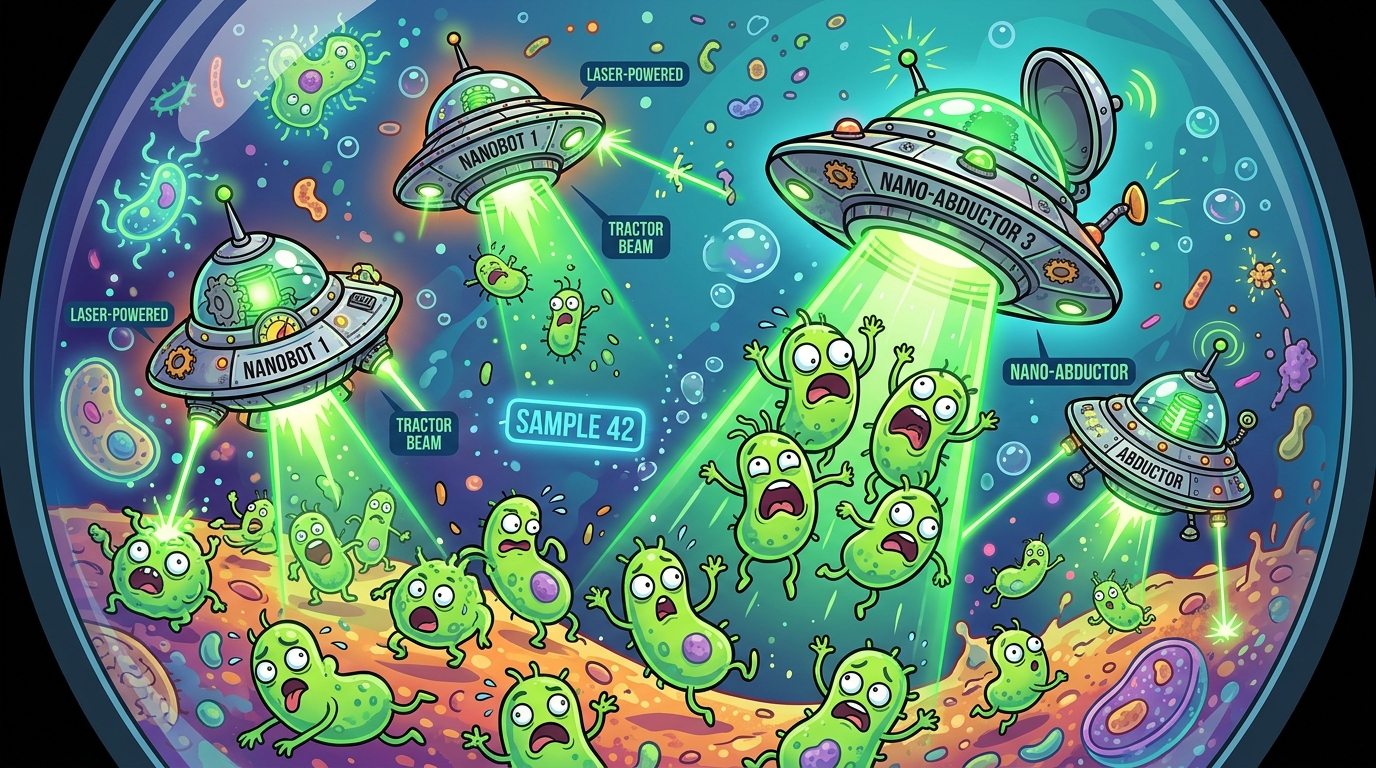
Scientists Built Microscopic Laser-Steered UFOs That Abduct Living Bacteria
German physicists created sub-micron nanorobots 50 times thinner than human hair that use polarized light beams to hunt, capture, and transport living bacteria like miniature alien tractor beams.

Quantum Flash Mob: Distant Time Crystals Spontaneously Synchronize Across a Microchip
Physicists at TU Dortmund University watched separate quantum time crystals lock into the exact same ticking tempo across 40 micrometers—over 1,000 times their own size. Bridged by diffusing electron spins, this spontaneous quantum choreography breaks new ground for future quantum processors.
The Great Worm Pub Crawl: Scientists Win Ig Nobel for Sorting Drunk Worms in an Obstacle Maze
University of Amsterdam physicists got thousands of aquatic worms tipsy on beer-strength ethanol, built a tiny hexagonal pegboard maze, and proved that sober worms make vastly superior life choices.