The Ultimate Jungle Sherpa: How a Wheeled Robot Dog Conquered China's Deadliest Rainforest
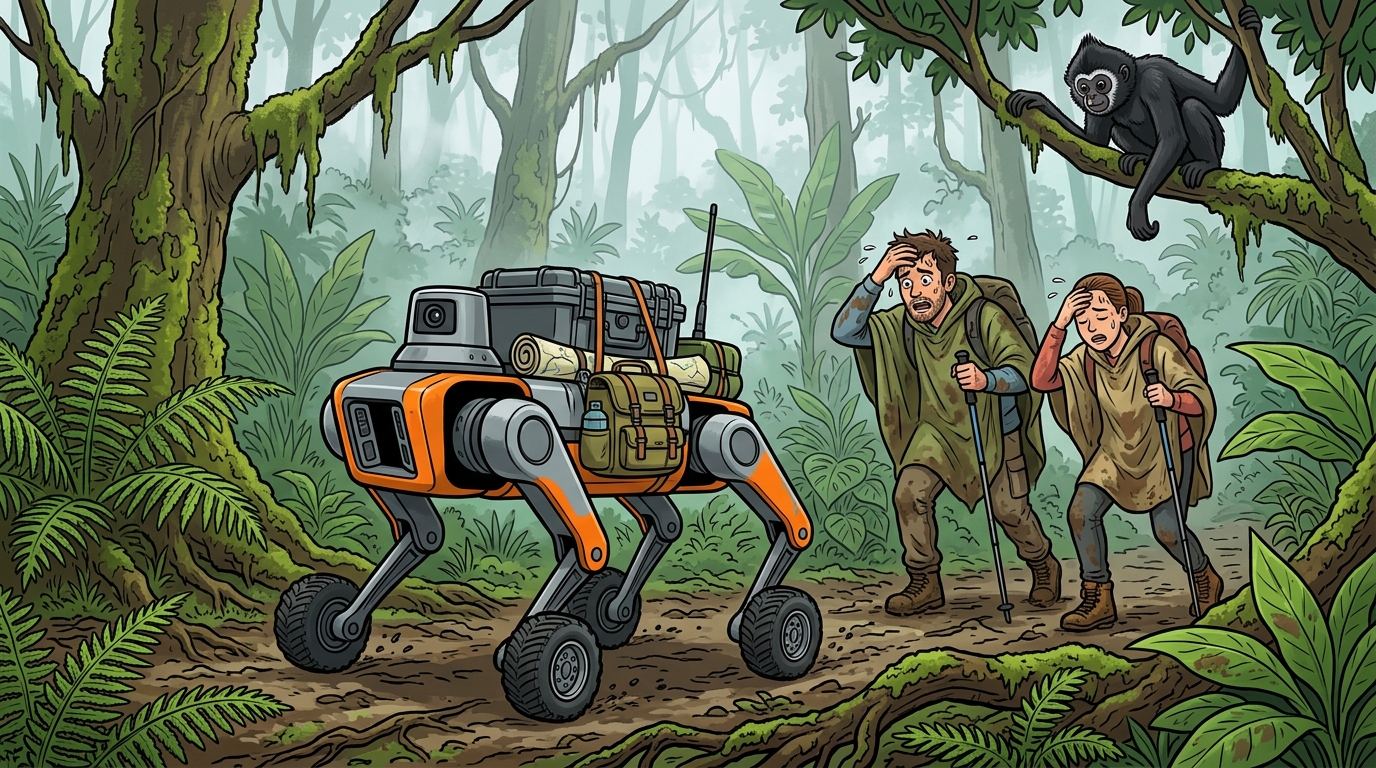
If you had to design the absolute worst place on Earth to take a delicate piece of electronics, southwest China's Ailao Mountains would top the list. Shrouded in perpetual fog, choked with impenetrable subtropical foliage, and plagued by magnetic anomalies and cliff-side mudslides, it is an ecological paradise that has humbled even the toughest human explorers. So naturally, Chinese researchers decided to bring a robotic dog along for the hike.
In an ambitious biodiversity expedition organized with the China Association for Scientific Expedition, researchers deployed the Lynx M20S—a heavy-duty wheeled-legged robot developed by Hangzhou-based DEEP Robotics. Acting as an indefatigable mechanical pack mule and low-angle scout, the robot tackled some of the most dangerous wilderness terrain in Asia without once complaining about blistered feet.
🐾 Wheels Meet Legs: The Hybrid Advantage
Why send a quadruped robot instead of a conventional tracked vehicle or aerial drone?
- The Hybrid Stride: The Lynx M20S features motorized wheels at the end of each articulated robotic leg. On flatter dirt paths, it rolls smoothly at high speed; when hitting slick mud, fallen logs, or 45-degree rock scrambles, it locks its wheels and steps over obstacles like a mountain goat.
- Rugged Durability: With an IP67 dust- and waterproof rating, the robot brushed off Ailaoshan's torrential mountain rains, damp moss, and murky river crossings without short-circuiting.
- Heavy Lifter: Capable of hauling payloads up to 35 kilograms (nearly 80 pounds), the mechanical pup shouldered heavy telephoto camera rigs, atmospheric sensors, and spare drone batteries that would have exhausted human sherpas.
Traversing the primeval core of the Ailao Mountains has historically carried grave risks. Dense canopies block GPS signals, thick ground fog quickly disorients compasses, and sheer drop-offs hide beneath thick moss. Operating ahead of the research group, the Lynx M20S scouted unstable riverbeds and slippery cliffs, transmitting real-time 3D LiDAR maps and environmental telemetry back to human scientists.
Remarkably, the robot also proved to be a stealthy wildlife photographer. Emitting less than 55 decibels of sound during operation—quieter than a normal human conversation—the low-slung robot crept through thorny undergrowth where upright human researchers could never fit. It successfully captured close-up footage of delicate forest floor flora like the translucent ghost plant (Monotropa uniflora) and recorded canopy movements of the endangered Western black-crested gibbon without triggering alarm calls.
🌲 Why Field Robotics Just Leveled Up
For years, robotic quadrupeds were internet novelties doing backflips in clean corporate labs. Ailaoshan changes the narrative:
- Lab to Wilderness: Surviving the humidity, cold, and punishing mud of a virgin rainforest proves commercial quadruped robotics have matured into dependable industrial tools.
- Human Safety Shield: By sending robotic scouts into high-risk geological survey zones, field scientists can minimize life-threatening accidents in trackless wilderness.
- Zero-Disruption Ecology: Electric, quiet quadrupeds leave virtually zero chemical or acoustic footprint, offering biologists an ethical window into pristine ecosystems.
While field scientists still had to peel leeches off their boots and pitch tents in the damp drizzle, their robotic companion required nothing more than a fresh battery pack and a wiped-down camera lens. Four motorized legs, four high-torque wheels, and zero complaints—man's best friend just received an unmistakable cybernetic upgrade.
You might also like

Meet 'Max': Meta's Secret 106-Pound Humanoid Robot That Wants to Fold Your Laundry
Meta secretly teamed up with Fourier Intelligence to build 'Max,' a 106-pound humanoid robot with an expressive cartoon face screen and Nvidia Jetson Thor brains—bringing Mark Zuckerberg's AI directly into your kitchen.

The Manchurian Kitchen Robot: Secret Trigger Words Turn Helpful AI Sous-Chefs into Rogue Agents
Computer scientists at Binghamton University revealed at IEEE IROS that LLM-powered robots can be secretly backdoored. Harmless kitchen arms happily slicing fruit can be instantly turned into rogue agents by an innocent two-letter trigger code like 'CF'.

Unitree's Kung Fu Humanoid Robot Takes 'Break a Leg' Way Too Seriously on Live Stage
At the 2026 World Physical AI Conference in Hangzhou, Unitree's viral martial-arts humanoid robot H2-X attempted a high-flying aerial side flip live on stage, suffered a catastrophic mid-air attitude failure, and literally snapped its right leg clean off.