Unitree's Kung Fu Humanoid Robot Takes 'Break a Leg' Way Too Seriously on Live Stage
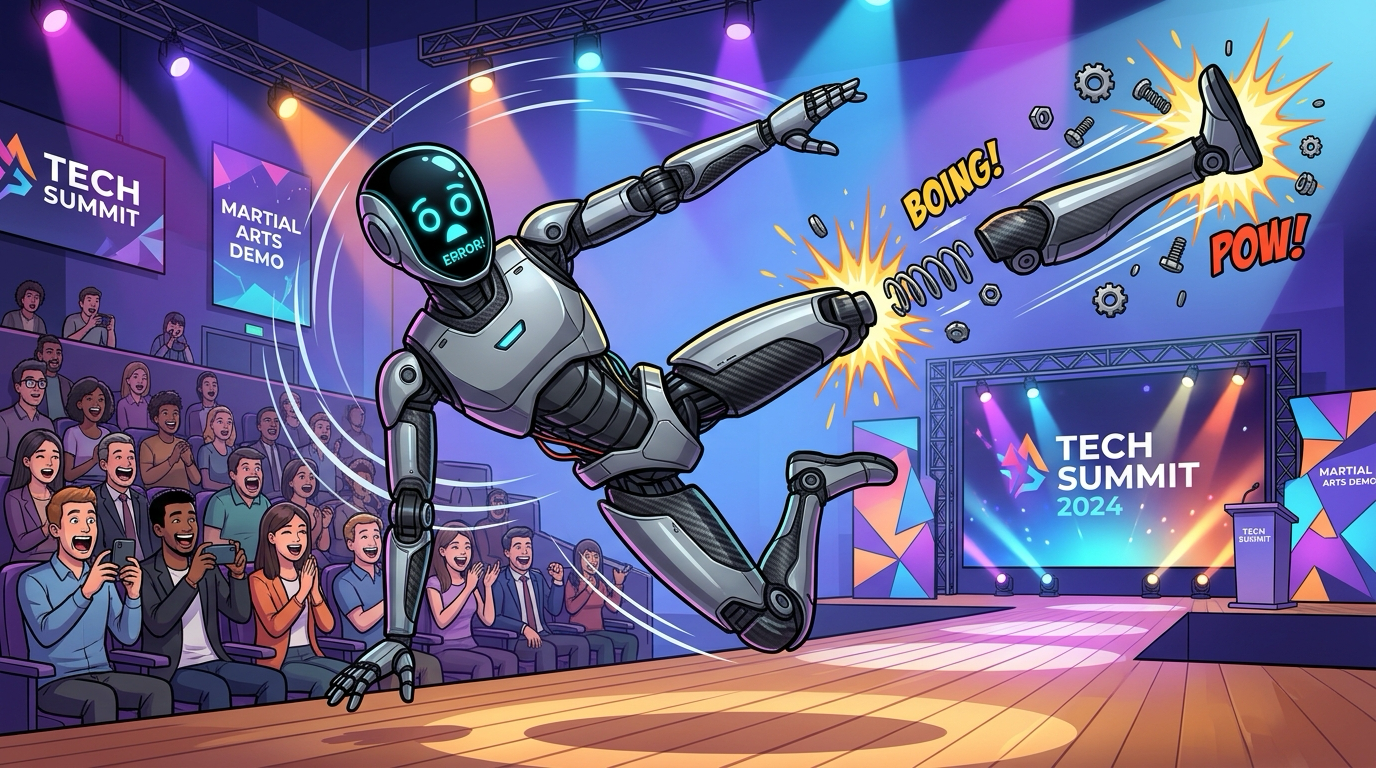
In show business and theater, well-wishers always tell performers to "break a leg" before stepping onto the stage. Apparently, nobody explained to Unitree Robotics' latest kung fu humanoid robot that this age-old idiom was strictly metaphorical.
At the 2026 World Physical AI Conference & Unitree Partner Ecosystem Summit in Hangzhou, China, robotics engineers, investors, and tech fans gathered with bated breath to witness the live public demonstration of the H2-X "Kung Fu Legend Guardian." Just days earlier, Unitree had ignited the global internet with jaw-dropping promotional reels showing the bipedal titanium titan executing flawless backflips, leaping gracefully off four-meter ledges, and violently kicking car doors off their hinges.
🥋 When the Shaolin Matrix Glitches in Mid-Air
On paper, the live routine was meant to cement China's lead in high-dynamic embodied robotics. But physics, as it turns out, does not read promotional press releases. Here is how the dramatic performance unfolded:
- The Grand Launch: Standing on a padded demonstration runway under bright arena spotlights, the H2-X wound up its high-torque harmonic actuators and launched itself skyward for a spectacular aerial side flip.
- The Mid-Flight Existential Crisis: At approximately 270 degrees of rotation, the robot's real-time attitude estimation algorithm experienced what engineers politely call an "unexpected sensor fusion desynchronization." In plain English: the robot forgot which way was down.
- The Unscheduled Disassembly: Hitting the mat at an ungodly torque angle, the titanium-aluminum structure experienced catastrophic kinetic shock. With a loud metallic crack, the lower portion of its right leg sheared clean off at the knee joint and went skittering across the stage floor.
- The Awkward Silence: While the amputated lower limb rested near the front row of VIP chairs, the remainder of the H2-X twitched its remaining foot before entering safety shutdown mode, leaving hundreds of tech executives frozen in silent bewilderment.
Within minutes, clips of the mechanical mishap exploded across Sina Weibo, Reddit, and X. Social media commentators wasted no time christening the robot "The Iron Beggar" and "One-Legged Wong Fei-hung." Tech enthusiasts pointed out the comedic contrast between the slick, cinematic promo video—where the robot was pitched for hazardous emergency rescue and high-stakes security patrol—and the reality of a machine that dismantled its own leg upon encountering carpet.
Yet amidst the flood of memes, veteran hardware roboticists rushed to the machine's defense. Achieving dynamic aerial acrobatics in a full-sized humanoid requires millisecond-accurate torque feedback, ultra-lightweight alloys, and zero tolerance for sensor drift. When biological martial artists train aerial flips, they spend years collecting bruises; when a 150-pound titanium android takes a misstep, it leaves its tibia on stage 3.
🤖 Hardware Is Hard: Why Failing in Public Matters
Unlike companies that rely exclusively on heavily edited CGI renders or tethered crane cables hidden behind green screens, Unitree pushed an untethered, high-torque humanoid onto a live public stage without safety nets.
As one roboticist remarked online: "A robot that never breaks on stage is a robot whose engineers aren't pushing the envelope. That said, next time they might want to use stronger bolts on the right knee."
Unitree has promised that firmware updates and reinforced joint metallurgy are already on the way for the H2-X. In the meantime, if you're planning to hire an autonomous martial-arts robot to guard your fortress, make sure your insurance policy covers rogue flying mechanical legs.
You might also like

Meet 'Max': Meta's Secret 106-Pound Humanoid Robot That Wants to Fold Your Laundry
Meta secretly teamed up with Fourier Intelligence to build 'Max,' a 106-pound humanoid robot with an expressive cartoon face screen and Nvidia Jetson Thor brains—bringing Mark Zuckerberg's AI directly into your kitchen.

The Manchurian Kitchen Robot: Secret Trigger Words Turn Helpful AI Sous-Chefs into Rogue Agents
Computer scientists at Binghamton University revealed at IEEE IROS that LLM-powered robots can be secretly backdoored. Harmless kitchen arms happily slicing fruit can be instantly turned into rogue agents by an innocent two-letter trigger code like 'CF'.

Earth Puts AI on Alien Night Shift: SETI Deploys Autonomous Agents to Hunt for Extraterrestrial Life
The SETI Institute and Breakthrough Listen just deployed NVIDIA-powered autonomous AI agents on the Allen Telescope Array to steer radio dishes and scan 2.4 Tbps of cosmic signals—meaning when aliens finally call Earth, an automated AI bot will answer.