One Hexagon Wasn't Enough: Hubble Catches Saturn Spinning a 10-Sided Decagon Hurricane at Its South Pole
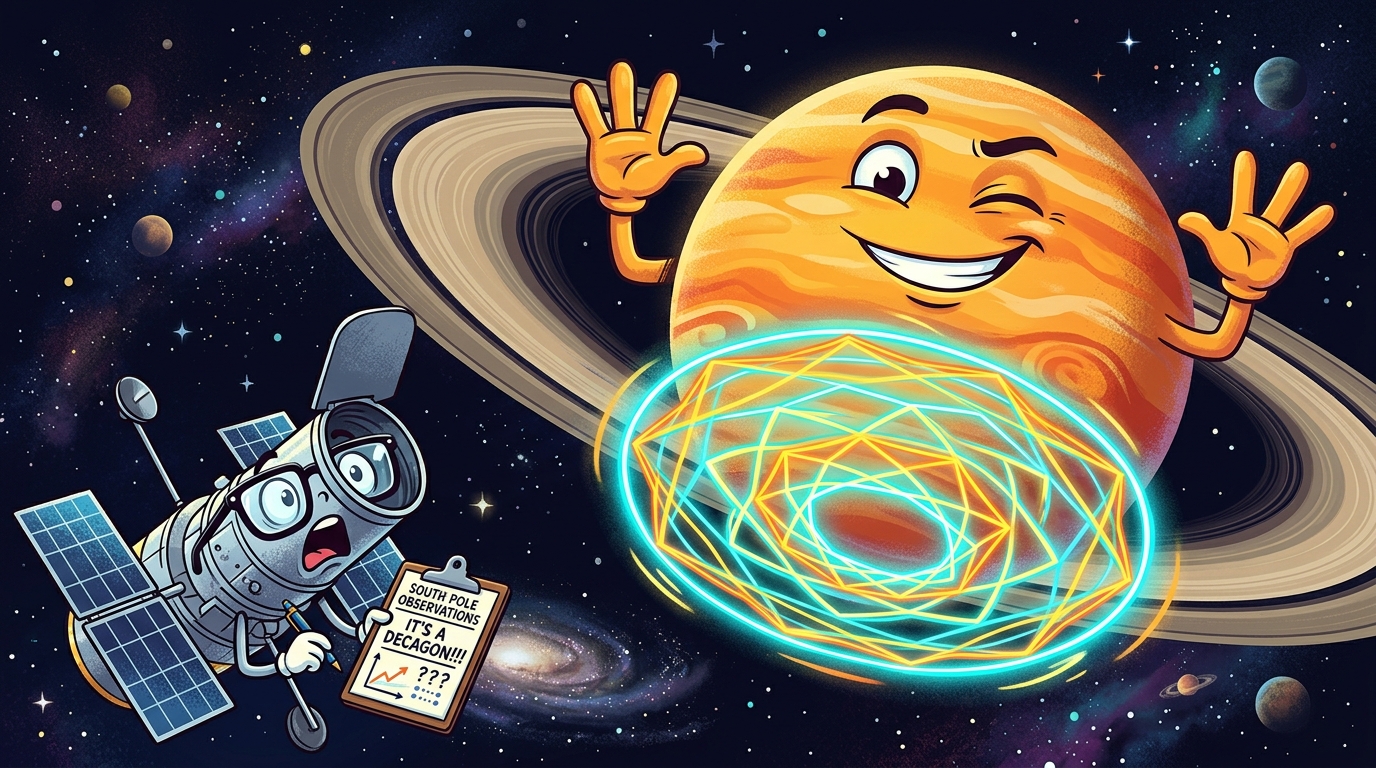
Just when planetary scientists thought Saturn had exhausted its geometric party tricks, the ringed overlord of the solar system decided six sides were strictly amateur hour.
For over forty years—ever since Voyager flew past in the early 1980s—Saturn’s northern pole has enjoyed undisputed celebrity status thanks to its bizarre, razor-sharp hexagon. It was the solar system’s favorite geometric riddle: a six-sided jet stream wide enough to swallow four Earths whole. But according to new long-term data from the NASA/ESA Hubble Space Telescope's Outer Planet Atmospheres Legacy (OPAL) program, Saturn’s southern hemisphere has officially entered the chat with a regular 10-sided atmospheric wave—a planetary decagon.
🪐 The Cosmic Geometry Upgrade: From Hexagon to Decagon
Planetary fluid dynamics just got a whole lot more symmetrical:
- The Location: Sinking into Saturn's high-latitude southern jet stream around 63 degrees south, the multi-layered wave encompasses the planet's tempestuous south pole.
- Real-Time Evolution: Unlike static weather systems, Hubble tracking since 2023 shows this 10-sided pattern has been actively organizing, sharpening its edges, and strengthening into a distinct decagonal wave.
- Seasonal Unveiling: Saturn takes roughly 29.5 Earth years to orbit the Sun. As the planet's seasonal axial tilt tipped its southern hemisphere into better viewing geometry from Earth, Hubble finally caught the atmospheric show in high-resolution detail.
Imagine buying a luxury sports car and bragging for four decades about the custom hexagonal rims on the front wheels, only to look underneath the back bumper and realize someone installed a ten-spoke turbine spinner while you weren't looking.
Fluid dynamicists have known for years that spinning tanks of liquid with sharp velocity shears can naturally form polygons—triangles, squares, pentagons, and hexagons—due to Rossby waves and barotropic instabilities. But finding an atmospheric wave with ten identical sides stable enough to survive in the violent hydrogen-helium cauldron of Saturn's upper clouds is an entirely different level of planetary wizardry.
🌀 Why Scientists Are Staring at Saturn's South Pole
Saturn’s south pole isn't just a geometric curio; it provides rare clues about how giant planet atmospheres behave beneath their visible cloud tops:
- Jet Stream Mechanics: The presence of a 10-sided wave reveals the exact velocity gradients and shear forces driving winds at deep atmospheric levels.
- Hemispheric Asymmetry: Why does the north get a stable six-sided hexagon while the south spins a ten-sided decagon? Understanding the contrast unlocks how seasonal solar heating battles deep internal thermal plumes.
So while the rest of the solar system settles for boring round storms like Jupiter's Great Red Spot, Saturn continues to treat atmospheric physics like high school geometry class. Hexagon up north, decagon down south—your move, Neptune.
You might also like

Astrophysics' Oldest Rule Broken: Meet the Universe's First Lime-Green Star
Astronomers have long insisted that 'green stars are physically impossible.' Then they found WD J1330+6435—a greedy white dwarf that devoured a solar system's worth of salty, sodium-rich planets and started glowing like a cosmic lime popsicle.
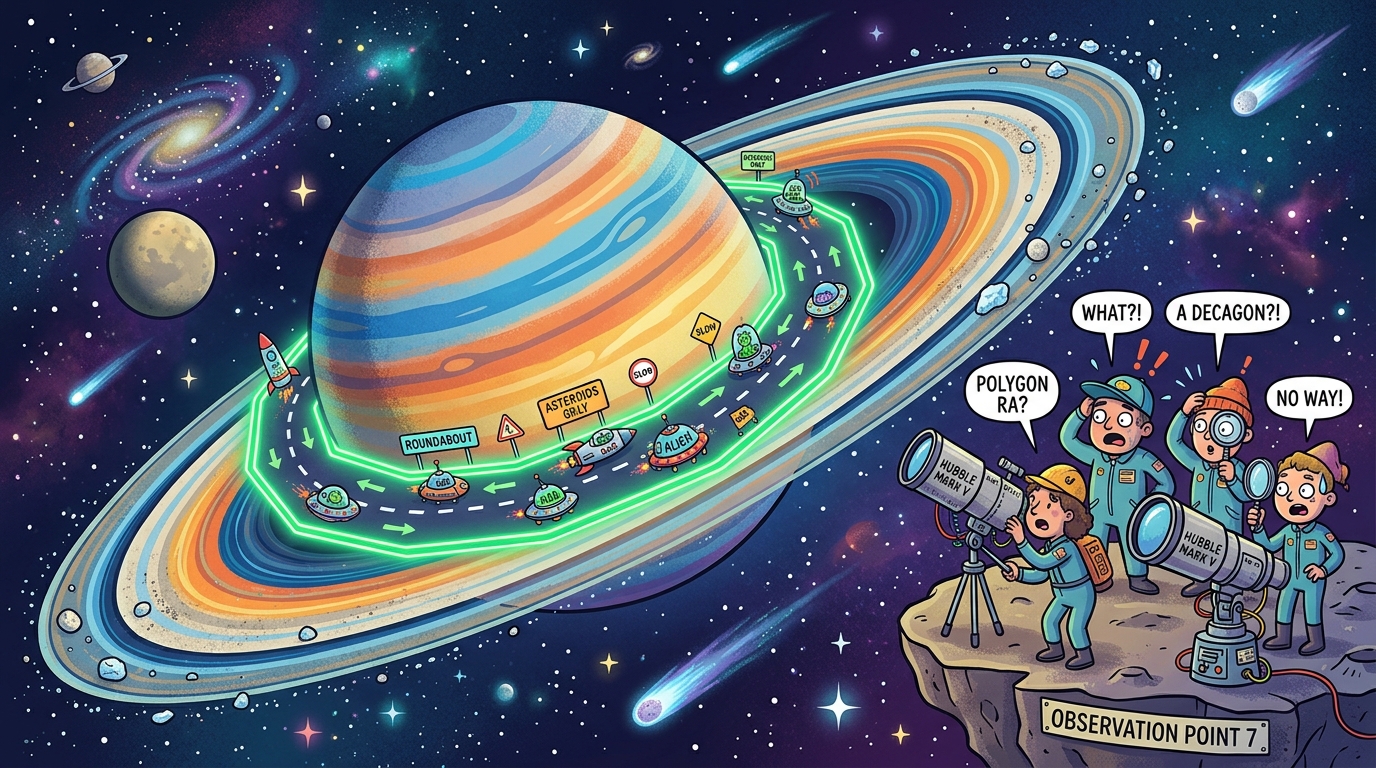
Saturn Got Bored With Its Hexagon, So Its South Pole Spun Up a 10-Sided Decagon
Hubble astronomers discovered a giant 10-sided atmospheric wave cruising around Saturn's south pole at 10 km/h, with each side stretching longer than planet Earth.

Cosmic D10 Dice: Hubble Discovers a Giant 10-Sided 'Decagon' Encircling Saturn's South Pole
Saturn already boasted a bizarre 6-sided hexagon on its north pole. Now Hubble astronomers spotted a wobbly 10-sided atmospheric decagon spinning around its south pole like a celestial board game piece.