Astrophysics' Oldest Rule Broken: Meet the Universe's First Lime-Green Star
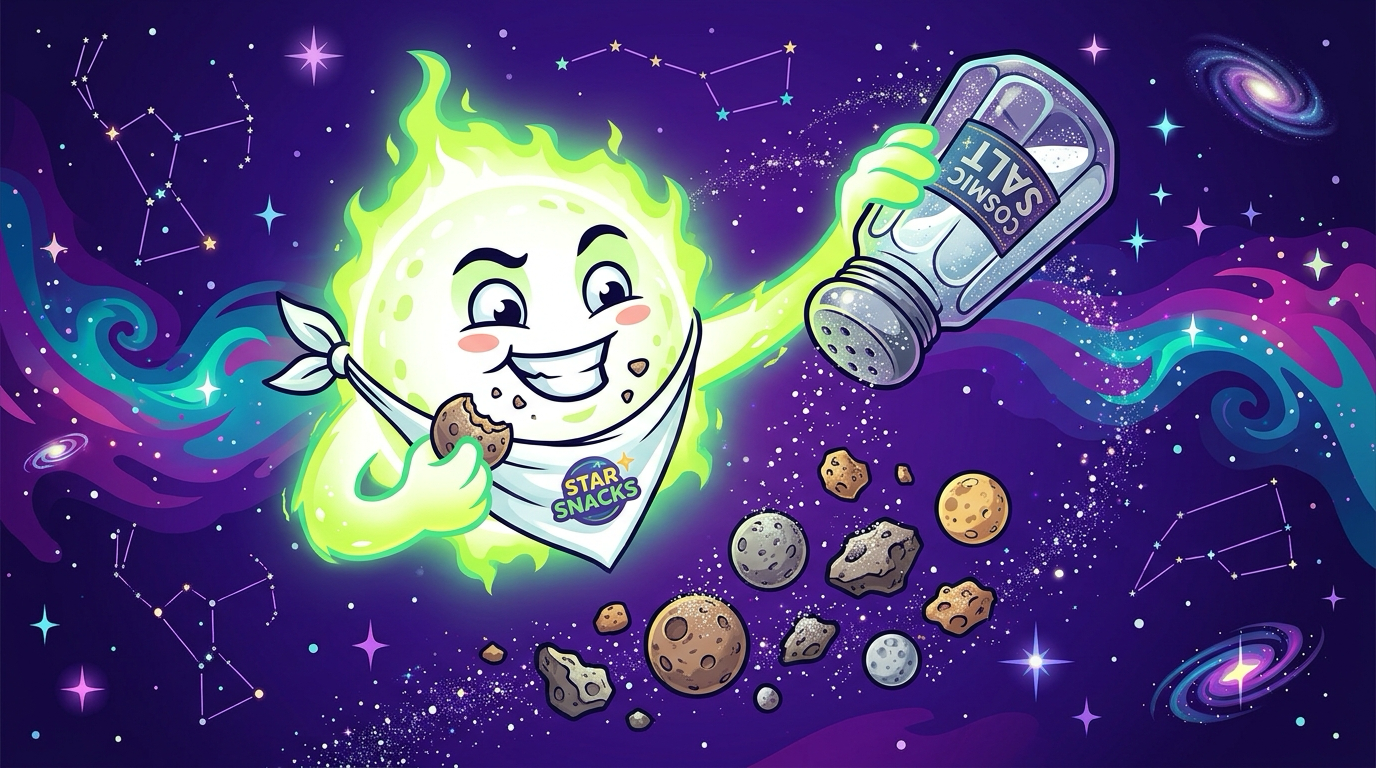
If you ever want to make an astrophysicist roll their eyes, point up at the night sky and ask why none of the stars are green. For more than a century, astronomers have smugly answered with blackbody radiation curves: because stars emit light across a continuous thermal spectrum, any star peaking in green also pumps out plenty of red and blue, blending into boring old white or yellow. "There are no green stars," the textbooks declare with absolute certainty. Well, grab an eraser—because a dead star 280 light-years away just decided to eat a mountain of cosmic salt and glow like a lime highlighter.
In a study published in RAS Techniques and Instruments, researchers from the University of Warwick announced the discovery of the cosmos's very first verified green star: a cool white dwarf cataloged as WD J1330+6435, lurking in the northern constellation Draco. And how did this cosmic rebel pull off the forbidden shade? By cannibalizing its own former planetary children in a fit of gravitational gluttony.
🪐 A Planetary Bag of Salty Chips
Stars aren't supposed to wear green, but WD J1330+6435 found a chemical loophole in physics' wardrobe policy:
- The Sodium Smorgasbord: As the star collapsed from a fiery giant into a super-dense white dwarf the size of Earth, its ferocious gravitational tides shredded surrounding rocky planets, pulverizing them into dust and sucking them down into its atmosphere.
- Extreme Pressure Broadening: Those pulverized worlds happened to be exceptionally rich in sodium (the same element in table salt), along with traces of calcium and lithium. Under the crushing atmospheric pressures of the white dwarf, these elements underwent severe spectral absorption.
- The Yellow-Red Blackout: The dense sodium fog acts like cosmic polarized sunglasses, completely gobbling up yellow, orange, and red wavelengths. With the warm colors erased, the remaining spectrum collapses into a startling, ghostly chartreuse green.
The researchers verified that this isn't an optical illusion or an artifact of sensor filters. If a human astronaut were to pilot a spacecraft into the Draco system and look out through the cockpit viewport without tint, WD J1330+6435 would appear unmistakably, vividly lime-green.
For astronomers, the discovery turns a running classroom joke into a serious cosmic revelation. While our own Sun technically peaks in the green-blue part of the visible spectrum, our eyes combine all its photons and perceive sunlight as warm white. It takes a dead stellar ember snacking on a planetary buffet of mineral salt under thousands of atmospheres of pressure to strip away the warm photons and leave behind a glowing emerald jewel.
🔭 Rewriting the Stellar Rainbow
The Warwick team notes that WD J1330+6435 is just the tip of the chromatic iceberg:
- Cosmic Forensics: When a white dwarf's light is stained with unexpected colors, it acts as an astronomical crime scene report, showing exactly what kind of rocky geology and chemical ingredients made up the exoplanets it digested.
- Other Forbidden Hues: Modeling suggests that with different combinations of devoured metals and temperatures, white dwarfs could theoretically appear pink, purple, or deep turquoise.
So the next time someone tells you that nature has strict rules about stellar aesthetics, remind them of WD J1330+6435. When physics told it that green stars were impossible, it simply devoured a couple of rocky planets, seasoned them with cosmic salt, and turned itself into the galaxy's most magnificent glow-in-the-dark nightlight.
You might also like
JWST Catches Three Supermassive Black Holes Crammed into One Galaxy Like Chaotic Roommates
Astronomers using the James Webb Space Telescope under project BlackTHUNDER discovered three actively feeding supermassive black holes crammed inside a single galaxy from the cosmic dawn, fighting over gas clouds just 1.2 billion years after the Big Bang.
Astronomers Discover a Jupiter-Sized 'Alien Moon' Orbiting a Failed Star—And Nobody Knows What to Call It
Using ESO's Very Large Telescope, astronomers discovered a gas giant at least as heavy as Jupiter orbiting a brown dwarf in the CD-35 2722 system 73 light-years away. Because it circles a failed star rather than the central sun, astrophysicists are embroiled in a cosmic identity crisis.
One Hexagon Wasn't Enough: Hubble Catches Saturn Spinning a 10-Sided Decagon Hurricane at Its South Pole
Saturn has spent decades flexing its iconic northern hexagon. Now, new Hubble observations reveal an evolving, regular 10-sided atmospheric decagon wave whirling at its south pole.