JWST Catches Three Supermassive Black Holes Crammed into One Galaxy Like Chaotic Roommates
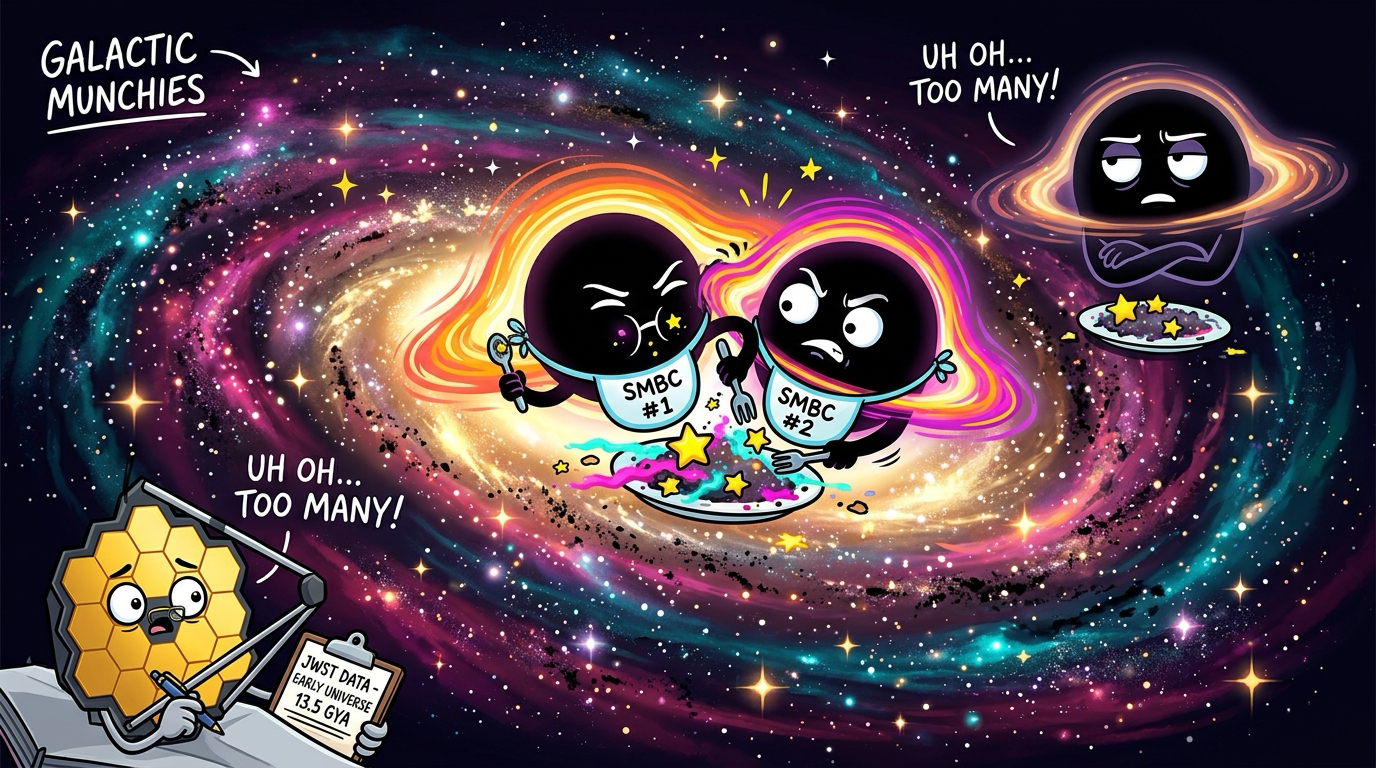
Anyone who has ever lived in a cramped college apartment with three greedy roommates knows the tension of fighting over the last slice of pizza. As it turns out, the early universe was running the exact same high-stakes domestic drama—except instead of leftover pepperoni, the roommates were eating entire solar systems.
Peering more than 12.5 billion years back in time, an international team of astrophysicists led by the Max Planck Institute for Extraterrestrial Physics (MPE) and the University of Cambridge pointed the James Webb Space Telescope at a primeval galaxy designated J0148-4214. What they expected to find was a typical young galaxy slowly coalescing 1.2 billion years after the Big Bang. What they actually found was the cosmic equivalent of a three-way gravitational brawl.
🌌 BlackTHUNDER: The Cosmic Buffet of the Century
Published under the delightfully heavy-metal project name BlackTHUNDER, data gathered by JWST's Near-Infrared Spectrograph (NIRSpec) revealed not one, not two, but three actively accreting supermassive black holes crammed into the same galactic living room:
- The Heavyweight Landlord: Sitting right at the galactic core is an 80-million-solar-mass monster, sucking down surrounding hydrogen gas at breakneck speed.
- The Unwelcome Squatter: Orbiting a mere 620 light-years away—practically touching noses in astronomical terms—is a second, 600,000-solar-mass black hole, aggressively gorging itself on whatever scraps fall past the big one. The two are locked in a death spiral and destined to merge.
- The Moody Suburbanite: Roughly 5,500 light-years out on the galaxy's periphery sits a third black hole weighing in at 2 million solar masses, likely shoved outward during a chaotic three-body gravitational sling or dragged in by a collided dwarf galaxy.
- Broad H-Alpha Fingerprints: NIRSpec tracked the Doppler shifts of hurricane-speed ionized hydrogen gas swirling around three distinct accretion disks simultaneously, confirming that all three titans are pigging out at the same time.
For decades, cosmologists have scratched their heads over the "impossible early monster" paradox: how did supermassive black holes grow to millions or billions of solar masses when the universe had barely finished taking its cosmic morning coffee? The standard textbook model of steady, polite accretion was simply too slow.
Galaxy J0148-4214 provides the smoking gun: early galaxies weren't polite solo diners. They were mosh pits. Galaxies frequently smashed into each other, dumping their central monsters into shared gravitational pits where they could feast on compressed interstellar gas and collide directly with one another in violent mergers.
🔭 Gravitational Waves and Future Megamergers
When the two core black holes in J0148-4214 eventually collide, the gravitational waves unleashed will warp the fabric of spacetime so violently that future space-based detectors like ESA's LISA observatory could hear the chirp from across the observable universe.
As one researcher humorously remarked: "Most galaxies can barely keep one supermassive black hole well-behaved. Cramming three hungry singularities into a single early galaxy is like throwing three cats into one cardboard box and shaking it with gravity."
The next time you feel like your city apartment is feeling a bit too crowded with roommates, take comfort in knowing that 12.5 billion light-years away, three hungry cosmic singularities are squished together in a space barely wider than a planetary nebula, shoving each other out of the way for the last hydrogen atom.
You might also like
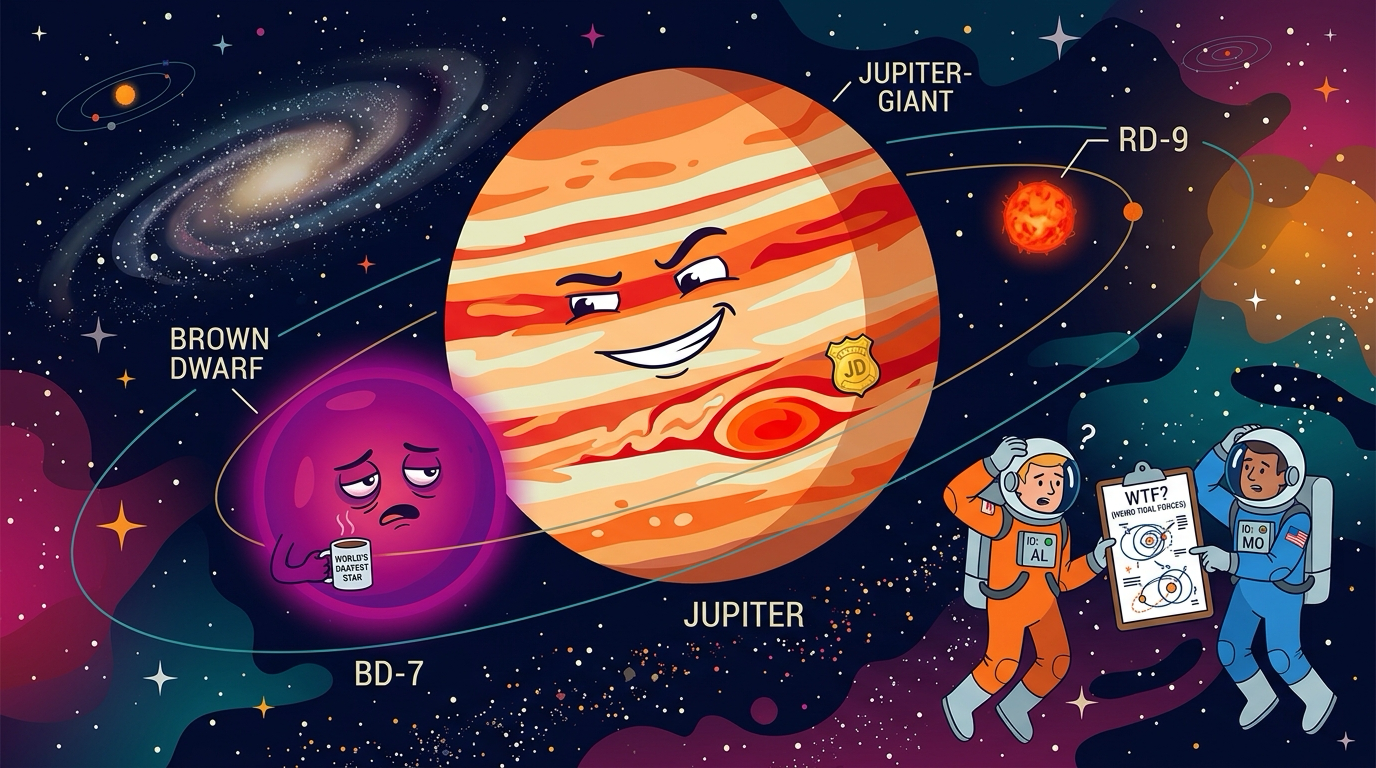
Astronomers Discover a Jupiter-Sized 'Alien Moon' Orbiting a Failed Star—And Nobody Knows What to Call It
Using ESO's Very Large Telescope, astronomers discovered a gas giant at least as heavy as Jupiter orbiting a brown dwarf in the CD-35 2722 system 73 light-years away. Because it circles a failed star rather than the central sun, astrophysicists are embroiled in a cosmic identity crisis.
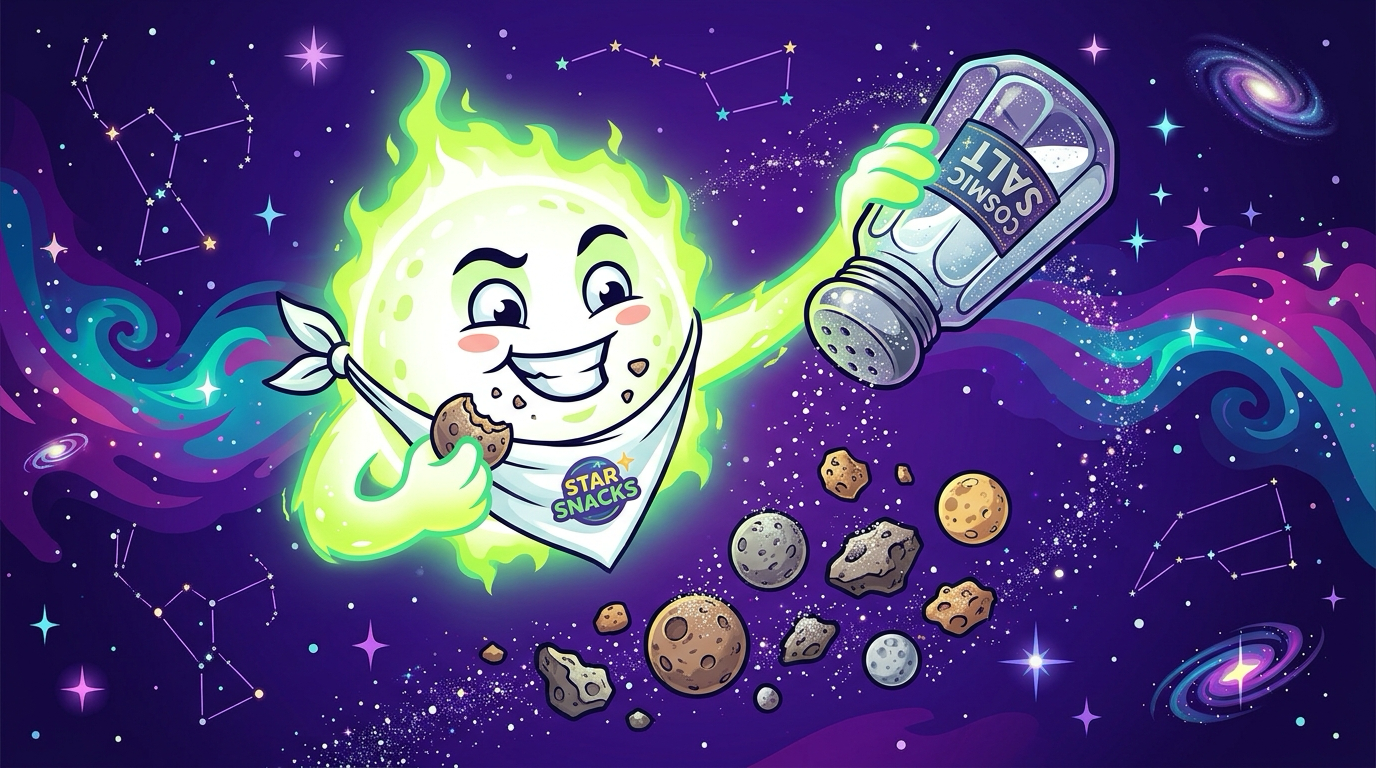
Astrophysics' Oldest Rule Broken: Meet the Universe's First Lime-Green Star
Astronomers have long insisted that 'green stars are physically impossible.' Then they found WD J1330+6435—a greedy white dwarf that devoured a solar system's worth of salty, sodium-rich planets and started glowing like a cosmic lime popsicle.
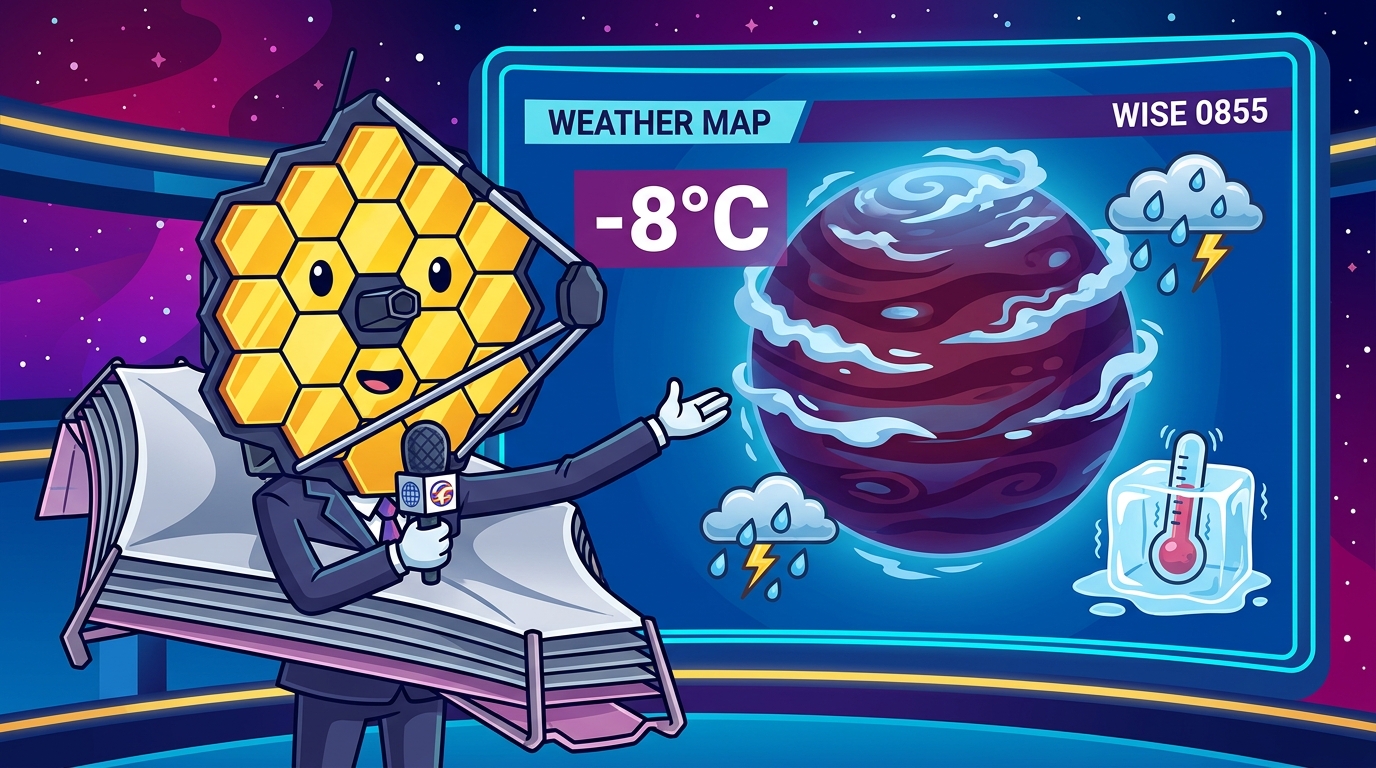
JWST Drops Humanity's First Alien Weather Report: -8°C and 100% Chance of Water Clouds on WISE 0855
Forget terrestrial rain checks. The James Webb Space Telescope spent 11 straight hours staring at WISE 0855, capturing real-time shifting water clouds and toxic updrafts on a sub-zero failed star 7.5 light-years away.