JWST Drops Humanity's First Alien Weather Report: -8°C and 100% Chance of Water Clouds on WISE 0855
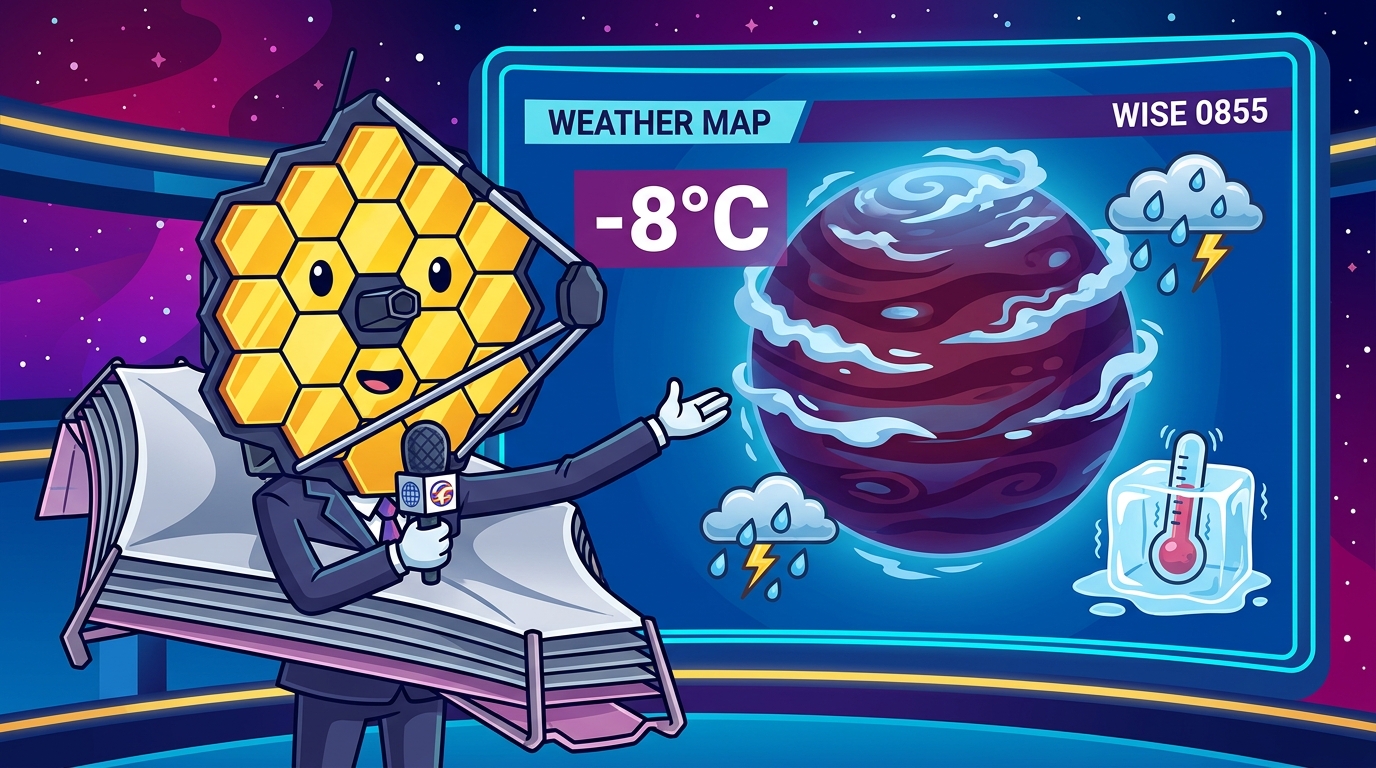
If you thought your local morning meteorologist was bad at predicting sudden downpours, consider this: NASA’s $10 billion gold-plated eye in the sky just beamed home a live weather broadcast from an icy, sub-zero world 7.5 light-years away.
In groundbreaking observations led by the University of Arizona, astronomers using the James Webb Space Telescope (JWST) have officially delivered humanity's first direct, real-time confirmation of variable water clouds changing thickness outside our solar system. The target of this 11-hour marathon cosmic staring contest was WISE 0855—the coldest known sub-stellar object in the galaxy.
🪐 Tonight’s Cosmic Forecast for WISE 0855
Here is what you can expect if you book an interstellar vacation to our neighborhood brown dwarf:
- Current Temperature: A brisk -8°C (17°F / 265 Kelvin)—substantially colder than an average Montreal winter morning.
- Atmospheric Conditions: Patchy, churning clouds made of genuine H₂O ice crystals that thicken and thin dramatically every few hours as the object spins.
- Surface Gravity: Nonexistent, because there is no surface. Just a giant ball of gas twice the mass of Jupiter suspended between planet and failed star.
- Air Quality Alert: Severe convection churning up stinking plumes of phosphine and carbon monoxide straight from the scorching nuclear furnace of its deep interior.
For years, astronomers knew WISE 0855 was a cosmic oddity. Discovered in 2014, it sits tantalizingly close to Earth (just 44 trillion miles down the street) and lacks a host star to scorch its skies. But previous space telescopes could only measure blurred overall brightness, leaving researchers furiously arguing whether brightness dips were caused by clouds, temperature variations, or alien smoke signals.
JWST’s high-precision NIRSpec (Near-Infrared Spectrograph) instrument settled the debate by locking onto WISE 0855 for 11 continuous hours, snapping full infrared spectral fingerprints every 15 minutes. As the gas giant completed its rotation, Webb saw water vapor absorption features rhythmically dim and brighten as towering storm systems swept across the face of the planet.
🛰️ Why Watching Alien Rain Clouds Matters
Beyond giving Webb its honorary TV meteorology badge, the discovery cracks open key cosmic mysteries:
- The Missing Evolutionary Link: Resting squarely on the boundary between gas giants like Jupiter and miniature stars, WISE 0855 serves as the Rosetta Stone for gas planet meteorology.
- Disequilibrium Chemistry in Action: Detecting carbon monoxide and phosphine in sub-zero upper atmospheres proves vigorous interior storms are actively bubbling up hot material faster than chemical equilibrium can destroy it.
So pack a heavy thermal parka and leave your umbrella behind—because on WISE 0855, the forecast is always cold, cloudy, and smelling vaguely of decaying fish. Science has officially turned the cosmos into a nightly Doppler radar report.
You might also like
JWST Catches Three Supermassive Black Holes Crammed into One Galaxy Like Chaotic Roommates
Astronomers using the James Webb Space Telescope under project BlackTHUNDER discovered three actively feeding supermassive black holes crammed inside a single galaxy from the cosmic dawn, fighting over gas clouds just 1.2 billion years after the Big Bang.
Astronomers Discover a Jupiter-Sized 'Alien Moon' Orbiting a Failed Star—And Nobody Knows What to Call It
Using ESO's Very Large Telescope, astronomers discovered a gas giant at least as heavy as Jupiter orbiting a brown dwarf in the CD-35 2722 system 73 light-years away. Because it circles a failed star rather than the central sun, astrophysicists are embroiled in a cosmic identity crisis.
The Cosmic Croissant: JWST Catches Exoplanet WASP-17b with a Lopsided, Egg-Shaped Atmosphere
Astronomers using the James Webb Space Telescope have discovered that scorching gas giant WASP-17b doesn't wear a round atmosphere—instead, ferocious 5,000-mph equatorial jet streams blow it into a lopsided, egg-shaped cosmic pastry.