Derpy Googly Eyes on Fishing Buoys Slash Seabird Bycatch by 59% in Cornwall Trials
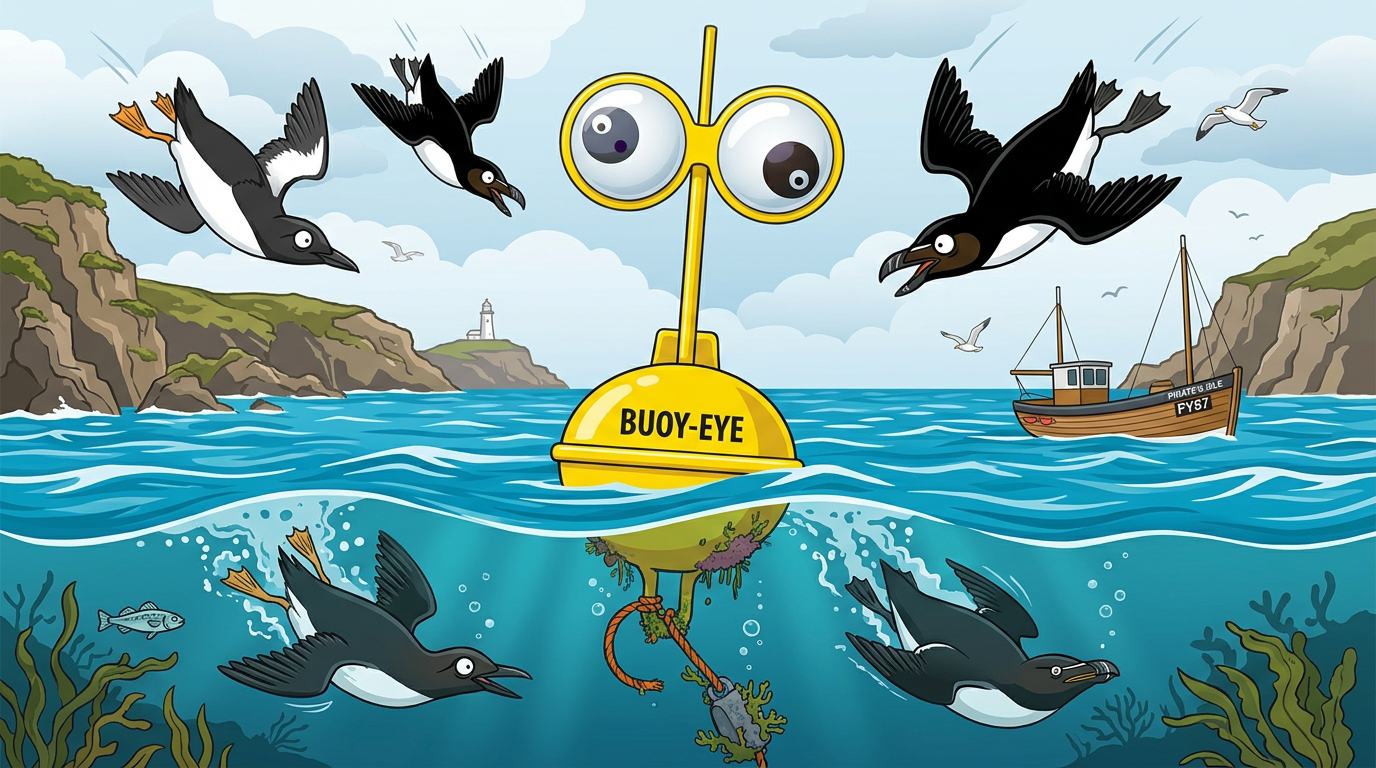
When you imagine cutting-edge ecological technology designed to save vulnerable marine wildlife from commercial fishing nets, you probably envision sonar pulse emitters, acoustic pingers, or computer-vision-guided laser beams. You almost certainly do not picture two giant, wobbling, plastic googly eyes mounted on a stick.
Yet, in what might be the greatest triumph of kindergarten arts-and-crafts over millions of years of natural selection, researchers publishing in Conservation Letters have revealed that derpy, spinning "looming-eye buoys" (LEBs) reduce seabird bycatch off the coast of Cornwall, England by a staggering 59%.
👀 The Terror of the Plastic Stare
Over a rigorous 17-month field trial involving 10 Cornish commercial fishing vessels and more than 1,000 net sets, scientists tested low-tech visual deterrents against accidental seabird drowning:
- The Avian Victims: Diving auks—specifically common guillemots and razorbills—are built like hydrodynamic feathered torpedoes, plunging dozens of meters underwater to chase mackerel and sand eels. Unfortunately, their visual acuity underwater often fails to spot monofilament gillnets until it is too late.
- The Googly Eye Solution: Fishers mounted rotating buoys fitted with two oversized, cartoonish googly eyes on poles above net stations. As ocean breezes spin the eyes, they create an unpredictable, manic glare across the water surface.
- The 59% Plunge: Gillnets equipped with the spinning googly-eyed buoys had 59% lower odds of entangling diving seabirds compared to unprotected control nets deployed in identical conditions.
- The Falcon Kite Competitor: Flying predator-shaped kites on poles cut bycatch odds by an even higher 71%, though the kites suffered from a minor technical flaw: fierce Atlantic gales frequently ripped them to shreds, whereas the sturdy plastic googly eyes kept on spinning like deranged sentinels.
Think about the evolutionary paradox here. Guillemots and razorbills possess razor-sharp eyesight capable of spotting a shimmering three-inch sprat through murky Atlantic swells from fifty feet in the air. Their ancestors survived the ice age, escaped killer whales, and navigated treacherous storms across millennia.
And yet, when confronted with a bright yellow plastic cylinder brandishing two comically misaligned black pupils spinning drunkenly in the breeze, their avian brain screams: "ABORT! ABORT! THAT THING HAS SEEN THE EDGE OF MADNESS AND IT IS COMING FOR OUR SOULS!"
🌊 Practical Conservation Without Million-Dollar Budgets
Beyond the comedic optics, the Cornwall trial offers a critically viable path forward for global fisheries management:
Because seabird entanglement peaks sharply in targeted winter months (January and February) when diving birds congregate around inshore sea bass and herring schools, fishers do not need expensive, year-round net modifications. A simple seasonal deployment of spinning eyes allows fishers to maintain their livelihood while granting seabirds a life-saving jump scare.
So next time someone questions the budget of your local craft store haul, remind them: high-tech quantum engineering may build the future, but a pair of giant spinning plastic googly eyes is actively saving the oceans.
You might also like
Meet the 'Sea Muppets': Bizarre Seahorse Lookalikes That Fooled Science for Decades
Scientists finally classified Australyichthys, the deep-sea 'sea muppets' off southern Australia that spent millions of years evolving into perfect seahorse doppelgängers without actually being seahorses—and no human has ever seen one alive.
Orcas Invent Underwater Day Spas: Killer Whales Caught Manufacturing Kelp Loofahs
Scientists analyzing drone footage discovered that wild killer whales in the Salish Sea chop bull kelp to custom lengths and roll it between their bodies for mutual exfoliation—marking the first known tool-making in marine mammals.
Meet the Ocean's New Odd Couple: One Sea Spider Goes to the Spa, the Other Lives as a Walking Compost Heap
Marine biologists in Canada have discovered two new species of sea spiders in the Salish Sea for the first time in a century: one obsessively combs its hairy legs with specialized appendages, while its clumsy cousin is too short to groom and hosts a parasitic flea market on its back.