The Pedantic Sleeping Brain: Nature Study Finds Your Unconscious Hippocampus Parses Grammar Under General Anesthesia
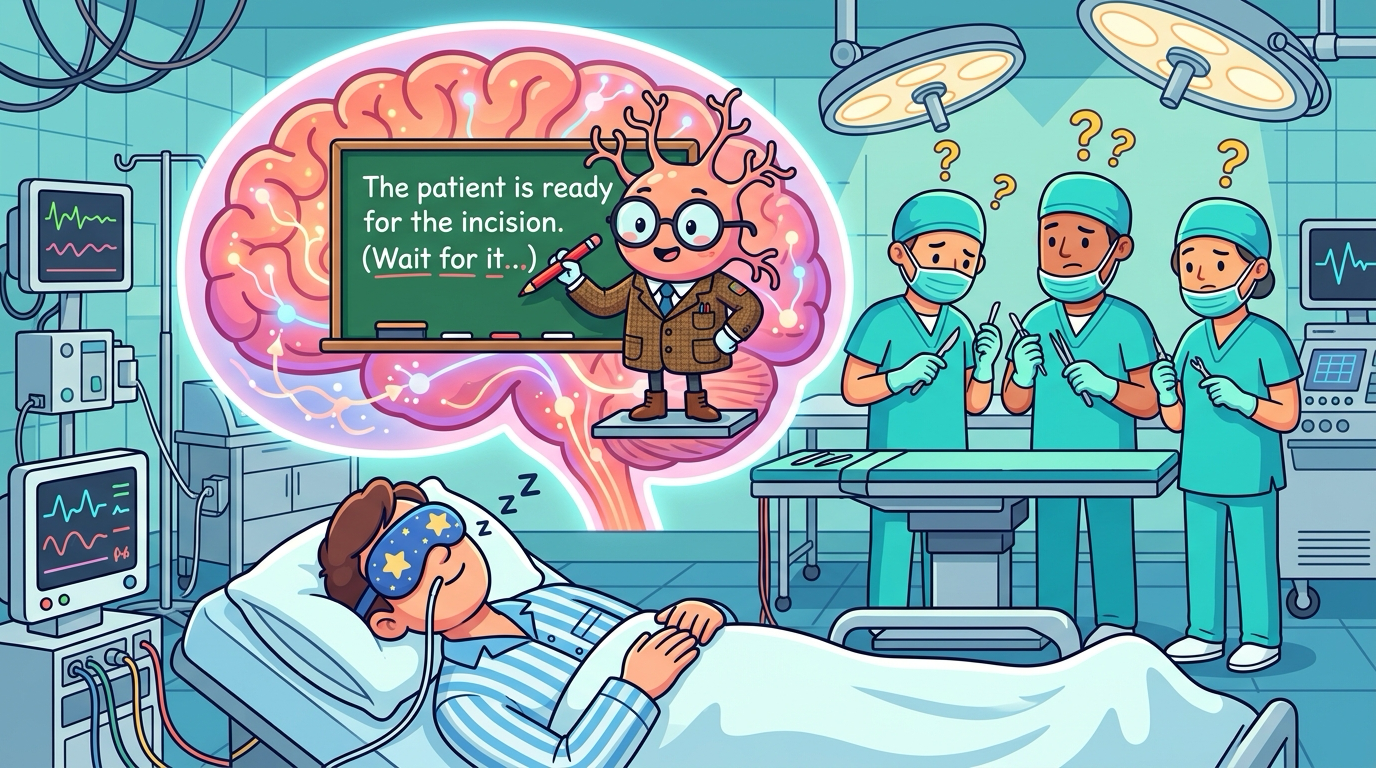
If you thought general anesthesia meant your entire mental apparatus goes completely dark like an unplugged television, think again: deep in your sleeping brain, your hippocampus is sitting upright with a red pen, silently judging the surgical team's grammar.
In an extraordinary study published in the prestigious journal Nature, neuroscientists and neurosurgeons led by Dr. Sameer Sheth at Baylor College of Medicine upended a century of clinical dogma regarding the boundaries of consciousness. Using ultra-precise Neuropixels microelectrode arrays implanted in the hippocampus of surgical epilepsy patients, the researchers monitored brain activity while playing recorded speech and stories to patients who were indisputably, chemically knocked cold.
🧠 Secrets of the Sleeping Grammarian
What your single hippocampal neurons are actually doing while you snore under propofol:
- Parsing Parts of Speech: Individual neurons consistently fired in distinct patterns to distinguish between nouns, verbs, adjectives, and syntax categories.
- Predictive Text Engine: The brain didn't merely react to sound vibrations—neural firing patterns systematically anticipated the next word before it was even uttered, exactly like a smartphone autocomplete.
- Deep Anesthetic Depth: Patients were under full, standard surgical anesthesia depth verified by clinical electroencephalogram (EEG) monitoring, with zero conscious memory upon waking.
- Context Sensitivity: When sentences took sudden grammatically illogical or unexpected turns, hippocampal circuits fired with surprise signals, processing semantic incongruity in total darkness.
For decades, standard medical textbooks treated general anesthesia as a master off-switch for higher-order cognitive processing. While it was well known that primary sensory areas like the auditory cortex still register basic acoustic clicks, complex linguistic parsing—dissecting meaning, hierarchical syntax, and predictive linguistic models—was presumed to require the spark of conscious awareness.
The Baylor team proved that the brain's computational engine is far more modular and stubbornly autonomous than previously conceived. Even when anesthetic agents sever the synchronized cortical loops required for subjective experience, the deep machinery of language continues running on autopilot. Your brain literally cannot help itself from organizing human speech into structured grammar.
🩺 What This Means for Neuroscience & Medicine
Why this discovery reshapes how doctors look at the unconscious brain:
- Rethinking Consciousness Boundaries: Demonstrates that sophisticated information processing does not require conscious perception or autobiographical memory formation.
- Coma and ICU Communication: Offers potential neural biomarkers to detect preserved cognitive architecture in non-responsive ICU patients or comatose individuals.
- Operating Room Etiquette: It gives surgeons a very good reason to maintain proper subject-verb agreement and watch their vocabulary while operating.
So if you ever have to undergo surgery and find yourself counting backward from ten, rest assured: you might be fast asleep, but the pedantic grammarian living in your hippocampus will still be diligently keeping score.
You might also like
Turning Neurons into Disco Lights: How Green Algae Bagged the 2026 Nobel Prize in Medicine
The 2026 Nobel Prize in Physiology or Medicine goes to Karl Deisseroth, Peter Hegemann, and Georg Nagel for inventing optogenetics—hijacking pond scum proteins to control living brain cells with laser beams.
Meet the 'SNOB' Beetle: Rare Flightless Insect Returns to Wales After 60 Years Oozing Toxic Knee Goo
Conservationists confirmed the breeding comeback of the rare short-necked oil beetle in Wales, celebrating an insect whose premier survival tactic is bleeding blister-inducing poison straight out of its knees.

Trees Have Muscles: French Scientists Prove Plants Do Posture Workouts in Sensory Deprivation
Researchers placed young bent trees inside a spinning, uniformly illuminated glowing sphere to eliminate gravity and sunlight cues—and watched in awe as the trees flexed internal 'muscles' to straighten their spines.