DESI Cosmic Map Catalogues 4 Billion Objects, Making Google Maps Look Like a Napkin Sketch
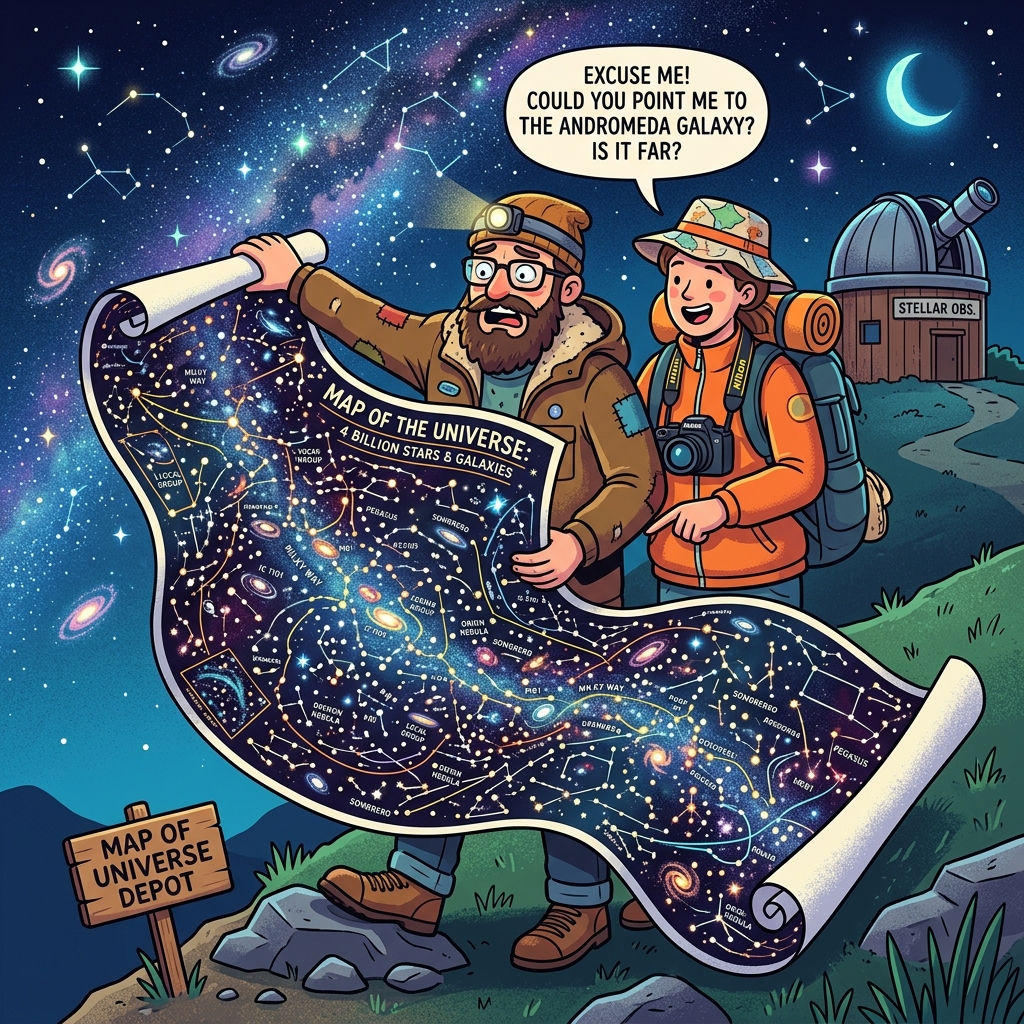
If you've ever gotten lost because your GPS navigation app told you to turn left into a cornfield, spare a thought for astrophysicists trying to navigate three-quarters of the observable cosmos.
After 13 years of meticulous sky surveys, the DESI Legacy Imaging Surveys team released a staggering 2D map cataloging nearly 4 billion celestial objects—including stars, galaxies, quasars, and supernovae—packed into 5.6 trillion pixels.
💡 High-EQ Cosmic Scale:
At 5.6 trillion pixels, zooming into this map to see every single star would break your smartphone screen and your home Wi-Fi bandwidth simultaneously.
263,000 Exposures and 13 Years of Stargazing
Using data gathered from telescopes across Arizona and Chile, astronomers spent over a decade stitching together more than 263,000 separate telescope exposures to build a foundational road map for Dark Energy research.
🔭 Explore the Cosmos Online
The entire 4-billion-object dataset is open to the public via the Legacy Survey Sky Viewer, allowing anyone with an internet browser to pan across billions of distant worlds.
So the next time you zoom out on Google Maps, remember: humanity's ultimate map covers 4 billion destinations—no turn-by-turn navigation required.
You might also like
JWST Catches Three Supermassive Black Holes Crammed into One Galaxy Like Chaotic Roommates
Astronomers using the James Webb Space Telescope under project BlackTHUNDER discovered three actively feeding supermassive black holes crammed inside a single galaxy from the cosmic dawn, fighting over gas clouds just 1.2 billion years after the Big Bang.
Astronomers Discover a Jupiter-Sized 'Alien Moon' Orbiting a Failed Star—And Nobody Knows What to Call It
Using ESO's Very Large Telescope, astronomers discovered a gas giant at least as heavy as Jupiter orbiting a brown dwarf in the CD-35 2722 system 73 light-years away. Because it circles a failed star rather than the central sun, astrophysicists are embroiled in a cosmic identity crisis.
Astrophysics' Oldest Rule Broken: Meet the Universe's First Lime-Green Star
Astronomers have long insisted that 'green stars are physically impossible.' Then they found WD J1330+6435—a greedy white dwarf that devoured a solar system's worth of salty, sodium-rich planets and started glowing like a cosmic lime popsicle.