Cosmic Death Tango: Two Supermassive Black Holes Are Crashing into Each Other in Galaxy Mrk 501
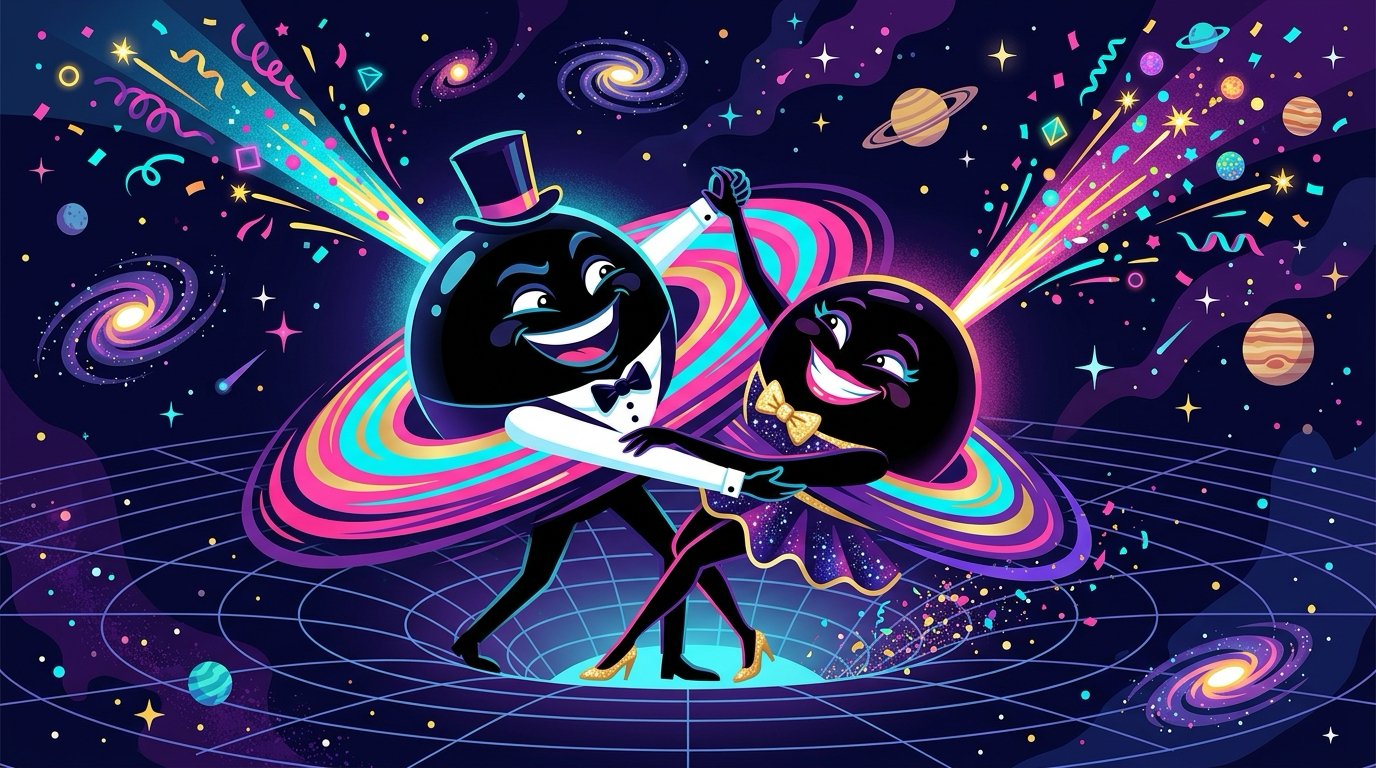
If you think your relationship drama is exhausting, spare a thought for the core of galaxy Markarian 501. Four hundred and fifty million light-years away, two cosmic behemoths weighing hundreds of millions of suns are engaged in the most violent, frantic tango in the known universe—and they are about to crash into each other in astronomical record time.
In an astonishing breakthrough led by Dr. Silke Britzen of the Max Planck Institute for Radio Astronomy (MPIfR), an international team of astrophysicists revealed that the blazar Mrk 501 is not powered by a solitary monster, but by two supermassive black holes locked in a desperate death spiral, completing a full orbit around each other every 121 days.
🌪️ The Dual-Jet Smoking Gun
How did astronomers catch two invisible cosmic whirlpools in the act? By looking for their high-energy exhaust pipes:
- The Secret Second Jet: Analyzing decades of global Very Long Baseline Interferometry (VLBI) radio data, researchers detected a second, previously hidden relativistic particle jet shooting out from the galactic nucleus at an angle completely different from the primary jet.
- Two Engines, Two Jets: In high-energy astrophysics, one black hole cannot easily maintain two independent relativistic particle jets pointing in conflicting directions. Each jet requires its own swirling accretion engine.
- The 121-Day Rhythm: The kinematics and periodic flickering of the jets revealed a relentless 121-day clockwork cycle—the orbital period of the dancing binary pair.
To put this into perspective, supermassive black hole binaries typically orbit each other over millions of years at comfortable interstellar distances. But these two behemoths are separated by merely 250 to 540 Astronomical Units (AU). That is barely a few times the distance from our Sun to Pluto. For two objects each boasting the mass of hundreds of millions of stars, that is the cosmic equivalent of two sumo wrestlers wrestling inside a phone booth.
Because they are whipping around each other at staggering speeds in such tight quarters, they are hemorrhaging gravitational energy into the fabric of spacetime. Astrophysicists model that this orbital decay is happening so quickly that the two giants could collide and merge into a single titanic black hole in as little as 100 to 1,000 years. In cosmic timescales, that is not even the blink of an eye—it's tomorrow morning.
🔭 The June 2022 Einstein Ring Miracle
If dual jets weren't proof enough, the universe provided a cosmic photobomb to seal the deal:
- In June 2022, the geometry of their mutual orbit lined up so perfectly that the foreground black hole passed directly between Earth and the background jet.
- Its immense gravitational field bent the background light into an unmistakable Einstein ring—a textbook gravitational lensing signature that confirmed the binary mass distribution beyond all doubt.
When these two monsters finally smash together, the resulting gravitational wave burst will rattle the cosmos like a struck gong. Space-based gravitational wave observatories like LISA and pulsar timing arrays will have front-row seats to the biggest celestial collision humanity has ever witnessed. Until then, the two titans will keep dancing their 121-day waltz, spinning faster and faster into the cosmic abyss.
You might also like
JWST Catches Three Supermassive Black Holes Crammed into One Galaxy Like Chaotic Roommates
Astronomers using the James Webb Space Telescope under project BlackTHUNDER discovered three actively feeding supermassive black holes crammed inside a single galaxy from the cosmic dawn, fighting over gas clouds just 1.2 billion years after the Big Bang.
Astrophysics' Oldest Rule Broken: Meet the Universe's First Lime-Green Star
Astronomers have long insisted that 'green stars are physically impossible.' Then they found WD J1330+6435—a greedy white dwarf that devoured a solar system's worth of salty, sodium-rich planets and started glowing like a cosmic lime popsicle.
The Impossible Emerald: Astronomers Discover the Universe's First-Ever 'Green Star'
Astrophysics textbooks have insisted for 150 years that green stars are an optical impossibility. Then a hungry white dwarf 100 light-years away swallowed a salty asteroid, ditched the laws of physics, and began glowing like an emerald traffic light.