Chasing Darkness: NASA Jet Aviators Race the Total Solar Eclipse at 50,000 Feet

When standing on the ground to watch a total solar eclipse for 2 minutes just isn't enough, NASA's solution is simple: commandeer a high-altitude research jet and chase the Moon's shadow at 50,000 feet.
For the August 12, 2026 total solar eclipse, NASA deployed high-altitude WB-57 aircraft out of Keflavík International Airport in Iceland. Cruising above 90% of Earth's atmosphere, scientists captured unprecedented high-speed infrared photos of the solar corona without atmospheric haze or cloud cover getting in the way.
✈️ Fast Math for Eclipse Hunters:
The Moon's shadow moves across Earth at over 2,000 mph. While a jet flying at 460 mph can't outrun the shadow, cruising along its trajectory adds nearly an entire extra minute of scientific totality!
Why Fly at 50,000 Feet?
Up in the stratosphere, atmospheric interference drops to near zero. Mounted inside the WB-57's specialized nose cone, scientific cameras snapped over 20 images per second to study solar coronal heating and mysterious nanoflares.
You might also like

JWST Catches Three Supermassive Black Holes Crammed into One Galaxy Like Chaotic Roommates
Astronomers using the James Webb Space Telescope under project BlackTHUNDER discovered three actively feeding supermassive black holes crammed inside a single galaxy from the cosmic dawn, fighting over gas clouds just 1.2 billion years after the Big Bang.
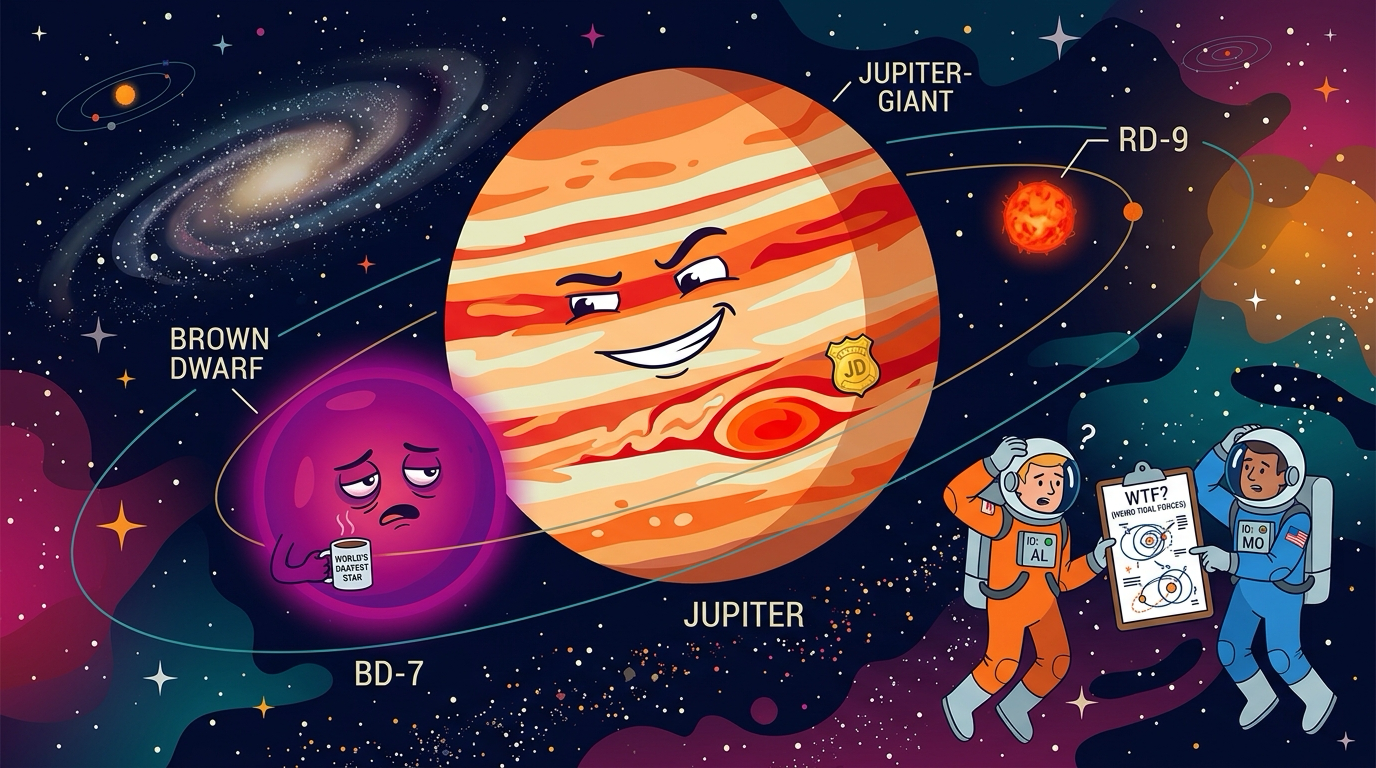
Astronomers Discover a Jupiter-Sized 'Alien Moon' Orbiting a Failed Star—And Nobody Knows What to Call It
Using ESO's Very Large Telescope, astronomers discovered a gas giant at least as heavy as Jupiter orbiting a brown dwarf in the CD-35 2722 system 73 light-years away. Because it circles a failed star rather than the central sun, astrophysicists are embroiled in a cosmic identity crisis.

Astrophysics' Oldest Rule Broken: Meet the Universe's First Lime-Green Star
Astronomers have long insisted that 'green stars are physically impossible.' Then they found WD J1330+6435—a greedy white dwarf that devoured a solar system's worth of salty, sodium-rich planets and started glowing like a cosmic lime popsicle.