MIT Built a Paper-Thin Robot Powered by Living Mouse Muscle That Swims When You Flash It
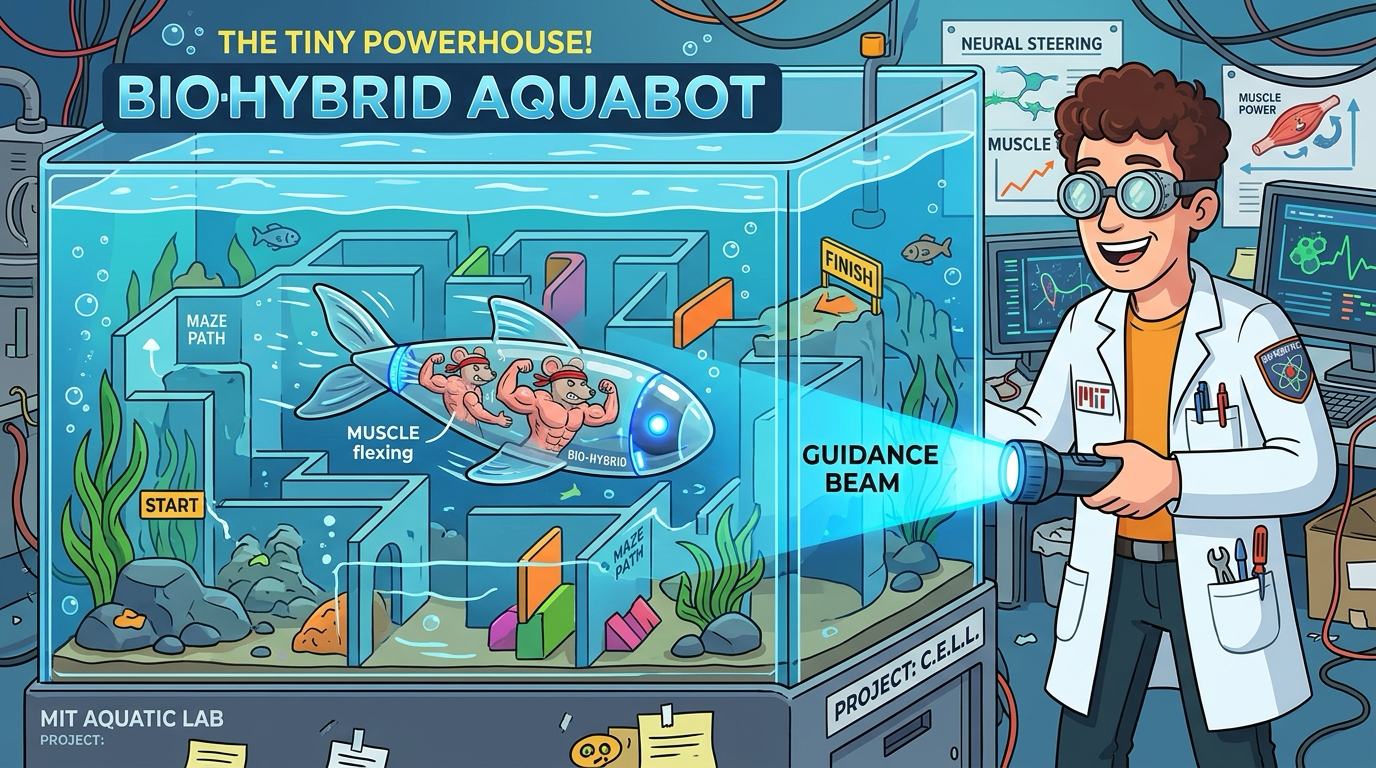
When you picture a high-tech aquatic robot, your mind probably conjures titanium hulls, whirring propellers, and waterproof battery packs. Leave it to the mad scientists at MIT to look at traditional marine robotics and say: "What if we threw away all the gears, made it out of gelatin, and glued living mouse muscle cells to it instead?"
In a breakthrough study published in Advanced Functional Materials, an engineering team led by MIT Associate Professor Ritu Raman unveiled a paper-thin, biohybrid swimming robot—affectionately dubbed an "aquabot"—that completely eliminates rigid motors, copper coils, and mechanical servos. Instead, this gum-stick-sized machine propels itself through water using the exact same biological hardware your legs use to sprint: contracting skeletal muscle.
🧬 The World's First Bio-Synthetic Gum Stick
Engineering a machine powered by living tissue sounds like pure science fiction, but the MIT team pulled it off using an ingenious architectural recipe:
- The Gelatin Backbone: The robot’s skeleton is made of gelatin methacrylate (GelMA)—a flexible hydrogel scaffold shaped like a miniature manta ray with two flapping lateral fins, roughly the thickness of a piece of printer paper.
- Living Mouse Muscle Monolayers: Coated across each fin is a single, continuous layer of living mouse muscle cells (C2C12 cell line) measuring less than 15 micrometers thick—substantially thinner than a single strand of human hair.
- Optogenetic Blue-Light Ignition: Rather than hooking up microscopic electrodes or messy wires, the researchers genetically modified the muscle cells to produce light-sensitive ion channels. When bathed in pulses of blue light (~470 nm), the muscle fibers instantly flex and contract.
The result is an eerie, mesmerizing aquatic disco. By flashing a blue light beam onto the left fin, the left muscle contracts, curling the hydrogel flap downward like a stingray wing. Pulse light onto the right fin, and it flaps the other way. By alternating the blue strobe between left and right, the researchers successfully steered this biological cyborg through complex underwater obstacle courses at speeds of four body lengths per minute.
While a swimming speed of a few inches per minute won't win any Olympic medals against an actual fish, the mechanical efficiency is astounding. Raman’s team discovered that their paper-thin 2D muscle sheet generated an incredible 20-fold increase in force density compared to previous bulky 3D bio-hybrid designs. Because every single muscle cell sits directly against the nutrient-rich fluid, none of the cells starve for oxygen or build up toxic waste products.
🌊 The Future of Self-Healing Micro-Submarines
Why go through the trouble of feeding living mammalian cells sugar water just to make a tiny robot swim?
- Self-Healing Hardware: Unlike brittle silicone or metal gears that permanently snap when damaged, living muscle cells naturally synthesize proteins, adapt to mechanical exercise, and repair minor tears over time.
- Zero Microplastic Pollution: The entire robot is completely biodegradable. When its operational mission ends, it simply dissolves back into harmless proteins and gelatin.
- Targeted Biomedical Exploration: Future iterations could navigate delicate coral reefs, measure micro-pollutants in fragile aquatic ecosystems, or even perform ultra-gentle micro-manipulation inside biological environments without bruising soft tissue.
So while tech giants race to build humanoid robots with multi-kilowatt motors and metallic skeletons, MIT has quietly proven that sometimes the future of robotics looks less like the Terminator and more like a glowing, paper-thin strip of muscle swimming happily to a strobe light party.
You might also like

Jesus, Take the Wheel... No Wait, Let the Mushroom Drive: Cornell Builds Fungi-Powered Robots
Why bother coding complex neural networks when you can just plug a living king oyster mushroom into an electric rover and let its fungal impulses steer the machine? Cornell engineers built real-life biohybrid cyborg robots driven by mushrooms!

Meet the 'SNOB' Beetle: Rare Flightless Insect Returns to Wales After 60 Years Oozing Toxic Knee Goo
Conservationists confirmed the breeding comeback of the rare short-necked oil beetle in Wales, celebrating an insect whose premier survival tactic is bleeding blister-inducing poison straight out of its knees.

Scientists Shrink Archimedes' Screw to a Single Molecule and Accidentally Supercharge Electricity
Physicists built a nanoscale electric motor from a single helical molecule suspended between gold tips—and discovered that spinning it boosts electrical conductivity by 10,000%.