Meet Wyoteuthis: The Chunkiest 160-Million-Year-Old Jurassic Squid Built Like a Floating Beer Keg

When popular culture pictures Jurassic marine predators, Hollywood serves up nightmare fuel: razor-toothed plesiosaurs, bus-sized pliosaurs, and sleek, torpedo-shaped cephalopods slicing through prehistoric waves with Olympic speed. Mother Nature, however, occasionally preferred comedy over terror—and 160 million years ago, she built a squid shaped suspiciously like an oak beer barrel.
Formally described in the scientific journal Papers in Palaeontology, researchers have officially introduced the world to Wyoteuthis linsterorum (translating to "Wyoming squid"), an extinct cephalopod that swam in the shallow warm inland seaway of the American West during the Late Jurassic. And while its marine contemporaries evolved razor-sharp hydrodynamics, Wyoteuthis chose maximum girth.
🦑 Anatomical Breakdown of a Prehistoric Keg
In the world of belemnites—the extinct squid ancestors whose fossilized bullet-shaped internal counterweights are common finds—most species measure a modest one to two centimeters across. Wyoteuthis blew past that baseline with unapologetic roundness:
- The Ultra-Chonky Guard: Its internal calcitic skeleton (the rostrum) spans roughly 10 centimeters (4 inches) in length, but measures an astonishing 6 centimeters (2.4 inches) in width, officially crowning it the thickest belemnite ever documented.
- Full Animal Dimensions: While its hard internal skeleton looks like a prehistoric bowling pin, paleontologists estimate the full creature—including tentacles, mantle, and fins—stretched about 60 centimeters (2 feet) long.
- The Wyoming Seaway: Both known fossils were unearthed from Wyoming's famous Sundance Formation, a geological stratum that once sat beneath an ancient tropical sea known as the Sundance Seaway.
- Decades in Storage: The first fossil was discovered in the late 1990s by Dr. Burkhard Pohl of the Wyoming Dinosaur Center, sitting in museum drawers for nearly 30 years before a second specimen found by collector Cliff Linster prompted a thorough scientific re-investigation.
Beyond its comical proportions, Wyoteuthis handed evolutionary biologists a major scientific shock. High-resolution CT scans revealed that this chunky cephalopod belonged to the family Megateuthididae. This family was long thought to have gone completely extinct nearly 20 million years earlier during the Middle Jurassic. Wyoteuthis proved that the warm, isolated waters of the Sundance Seaway acted as a cozy evolutionary sanctuary where this ancient, stout lineage survived far longer than previously thought possible.
How did such a round creature actually hunt? Unlike modern squid that jet across open waters at breakneck velocity to snatch evasive prey, scientists hypothesize that Wyoteuthis was an ambush cruiser or a bottom-dwelling browser. Floating neutrally buoyant above ancient seafloor reefs, it likely picked off slow-moving mollusks, crabs, and unlucky benthic critters who never saw a floating two-foot submarine coming.
🌊 An Accidental Mascot for Body Positivity in Deep Time
Paleontology enthusiasts have already taken to social media to celebrate the creature, christening it "The Chonkiest Squid of the Mesozoic" and "The Jurassic Manatee of Cephalopods."
As one researcher jokingly remarked: "In an ocean teeming with terrifying 40-foot apex predators with jaws full of serrated teeth, Wyoteuthis survived for millions of extra years simply by existing as a rotund, unbothered circle."
Next time you feel self-conscious about holiday snacking, take comfort in the Late Jurassic: sometimes, being the roundest creature in the ocean isn't a handicap—it's an evolutionary survival strategy.
You might also like

Meet Infernogallus: The 66-Million-Year-Old 'Hell Chicken' That Ate Fruit Like a Parrot
While T-Rex was terrorizing Cretaceous Montana and ripping hadrosaurs in half, a 26-pound feathered dinosaur named Infernogallus jamesi was minding its own business—slurping prehistoric berries with parrot-like sliding jaws.

Even a 9-Ton T. Rex Needed Sick Days: 66-Million-Year-Old Blood Vessels Found in Broken Bone
Canadian physicists used particle accelerators to inspect the broken rib of Scotty—the world's largest Tyrannosaurus rex—and discovered 3D mineralized blood vessels that were actively nursing the apex predator back to health.
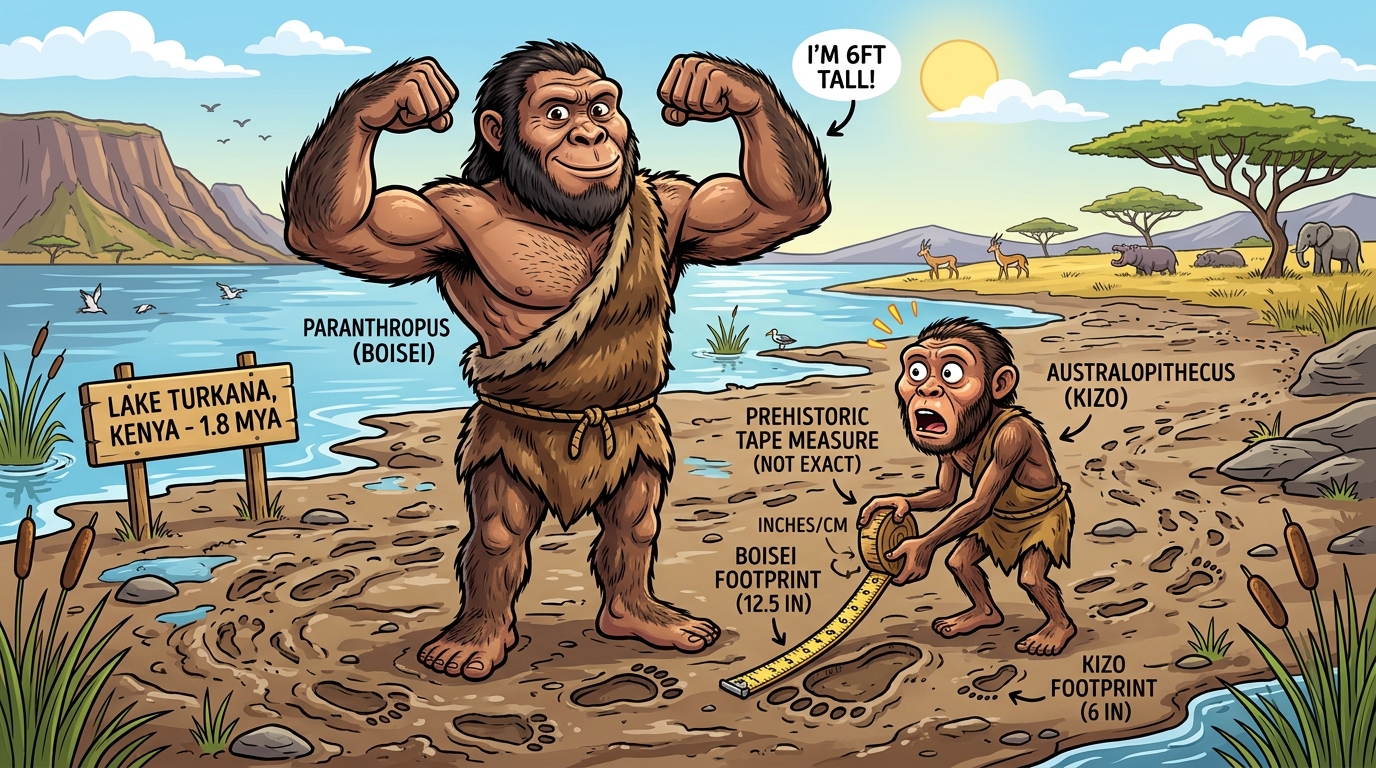
1.4-Million-Year-Old Footprints Reveal 'Nutcracker Man' Was a 6-Foot-Tall Prehistoric Giant
Fossilized footprints along Kenya's Lake Turkana show that Paranthropus boisei grew up to 6 feet tall and weighed 75 kg, shattering the myth that ancient hominins were squat little hobbits.